
As an Amazon Associate I earn from qualifying purchases. CookwareCompass is a participant in the Amazon Services LLC Associates Program, an affiliate advertising program designed to provide a means for sites to earn advertising fees by advertising and linking to Amazon.com.
A saucepan looks like the simplest pot in the kitchen, so it is usually the piece people think about least. Then it scorches the oatmeal, boils milk over the rim, lets rice steam escape around a loose lid, or tips backward on the burner because the handle outweighs the pot. Choose a stainless clad saucepan in this order: pick the capacity for the batch you actually cook, check the shape of the walls and the floor, confirm the cladding goes up the sides, then judge the handle, the lid, and the rim before you look at the brand.

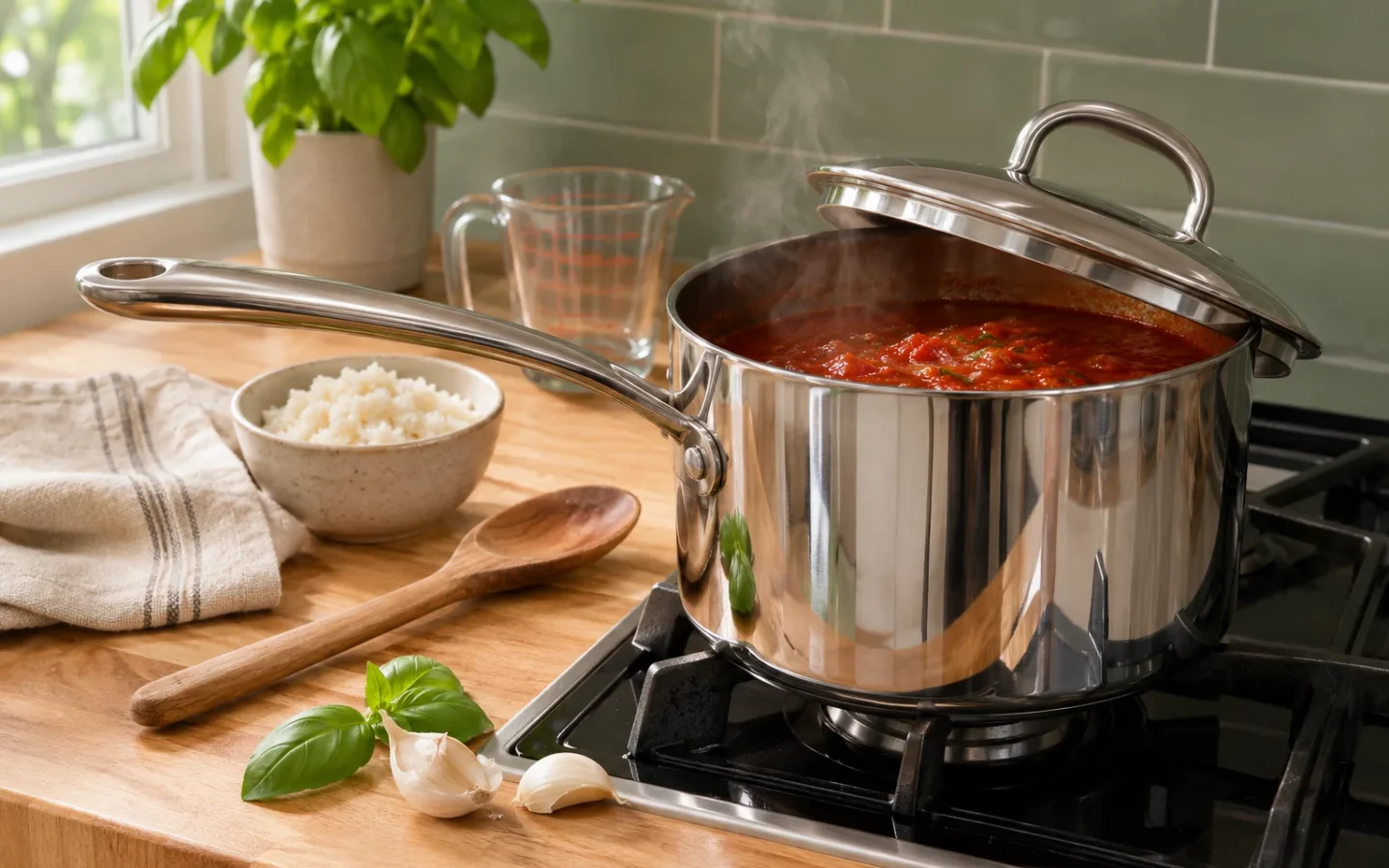
Tramontina Signature Tri-Ply Clad Stainless Steel 3-Quart Sauce Pan with Lid
Certain content that appears on this site comes from Amazon. This content is provided “as is” and is subject to change or removal at any time.
Why we picked it
- Listed as tri-ply clad, with an aluminum core between 18/10 stainless steel layers through the body and a magnetic stainless exterior for induction
- Tall sides and a compact floor suit rice, grains, sauces, and gentle simmering under the included stainless steel lid
- Listed as oven-safe to 500°F, NSF-certified, with a riveted cast stainless handle and a lifetime warranty
Reported drawbacks
- Uncoated stainless needs preheating and enough liquid or fat; starchy and thick foods can stick if the heat is too high
- Some owners report discolored spots on the interior over time, which need occasional cleaning
- Listed as dishwasher-safe, but hand washing is recommended to keep the mirror-polished finish
Size the Saucepan for Your Real Batch, Not the Biggest One
Capacity on a saucepan is measured to the brim, the same way it is on a stockpot. A pan sold as 3 quarts holds three quarts of water only when it is filled to the very top edge, which nobody does with something that bubbles. For anything that simmers, foams, or gets stirred, plan to use about two-thirds of the listed capacity. That puts the realistic working load of a 3-quart saucepan at roughly two quarts, which is eight cups.
Eight cups covers most of what a saucepan is for in a household of two to four people: a pot of rice for dinner, a batch of tomato sauce for a pound of pasta, oatmeal for several people, blanched vegetables, a few cups of soup reheated, or a custard base. It is also the reason 3 quarts is such a common “first saucepan” size. It is big enough that most single recipes fit, and small enough that a cup of liquid still covers the floor instead of spreading into a thin film that scorches.
The sizes on either side serve different jobs, so think about which job you do most:
- 1 to 1.5 quarts: melting butter, warming a cup of milk, a single serving of grains, or a small batch of sauce. Too small for pasta sauce for a family.
- 2 quarts: a good partner to a larger pan; handles grains and sauces for two people with room to stir.
- 3 quarts: the general-purpose size; rice, sauces, oatmeal, and soups for a small household.
- 4 quarts and up: starts to overlap with a small stockpot or Dutch oven; useful for larger families, but heavier and slower to heat a small amount of liquid.
If you only buy one, buy the size that fits the batch you make most often, not the biggest batch you make twice a year. A pot that is too large for the food makes small amounts of liquid evaporate fast and burn at the edges. If you already own a stockpot, our guide to choosing stockpot size explains how to divide work between the tall pot and the smaller one.
Read the Shape: Floor Diameter Controls Evaporation
Two saucepans with the same capacity can behave very differently because of their proportions. A tall, narrow pan has a small floor and a small surface of liquid exposed to air. It loses moisture slowly, holds heat in the liquid, and keeps a small burner’s heat concentrated. A wider, shorter pan of the same volume exposes more surface, so sauces reduce faster, but small amounts spread thin and are easier to scorch.
The listing for the Tramontina saucepan in the box above describes exactly that trade: tall sides and a small surface area that retain heat, which suits simmering and reheating. That shape is a strength for rice, grains, stocks, and anything that should cook gently under a lid. It is less suited to fast reduction, where a wider sauté pan or saucier does the job better.
The usable floor is also smaller than the number in the name suggests. Saucepans are measured by capacity rather than diameter, but the same rule applies as it does to skillets: the curved transition between the floor and the wall takes up part of the bottom. The article on pan diameter versus cooking surface explains how to measure the flat area that actually touches the burner. For a saucepan, the practical test is whether the floor sits fully on your burner or induction ring. A floor much smaller than the burner lets gas flames lick up the sides and heat the handle; a floor much larger than the burner leaves a cold outer ring where food sits at a different temperature.
Confirm the Cladding Goes Up the Walls
“Clad” means the pan is made of bonded layers of metal rather than a single sheet. In a tri-ply pan, a layer of aluminum, which spreads heat quickly, is sandwiched between an inner layer of stainless steel that touches the food and an outer layer of stainless steel that touches the burner. The outer layer is usually a magnetic grade so the pan works on induction.
The important question for a saucepan is where those layers stop. In a fully clad pan, the aluminum core runs from the center of the floor all the way up the walls to the rim. In a disc-bottom pan, a thick aluminum disc is attached only to the base, and the walls above it are thin single-layer stainless. Both designs can work well, and our comparison of disc bottom versus fully clad cookware covers the trade-offs in detail. For a saucepan, the difference shows up in thick foods.
Oatmeal, polenta, risotto, thick tomato sauce, refried beans, and custards all sit against the walls, not just the floor. With thin single-ply walls, the edge where the disc ends can run hotter or cooler than the rest, and thick food clinging to the side wall can scorch in a band. With cladding up the sides, heat moves more evenly into the walls and the food that touches them.
The listing for the Tramontina 3-quart pan describes tri-ply clad construction with an aluminum core between layers of 18/10 stainless steel, a magnetic stainless exterior, and an all-clad vessel, which means the layers run through the body rather than only the base. That is the construction you want to see stated plainly. If a listing only says “tri-ply base” or “encapsulated bottom,” it is a disc-bottom pan, which is not wrong, but it is a different product.
What “18/10” and “Tri-Ply” Do and Do Not Tell You
Numbers on a stainless pan are easy to over-read. The figure 18/10 describes the composition of the stainless steel: roughly 18 percent chromium and 10 percent nickel. Chromium gives stainless its corrosion resistance; nickel adds shine and further resistance to pitting. It is a common grade for the cooking surface. It tells you very little about how evenly the pan heats, because heat spreading is the job of the aluminum core, not the stainless.
“Tri-ply” tells you how many layers there are, but not how thick each one is. Two tri-ply pans can have very different amounts of aluminum, and the thickness of that core is what drives evenness. Most listings do not publish layer thicknesses, so weight is the best proxy a shopper has. The Tramontina 3-quart listing gives an item weight of 3.3 pounds. Compare listed weights between pans of the same capacity and style, and treat a dramatically lighter pan with suspicion. Our guide on how to read stainless cookware specs goes through the rest of the label, including what ply counts beyond three actually change.
Other phrases on saucepan listings are worth checking against the construction rather than accepting at face value:
- “Made without PTFE or PFAS”: true of any uncoated stainless pan, because there is no coating. It is not an extra feature; it is what bare stainless is.
- “Easy-release surface”: stainless is not nonstick. Food releases well when the pan is preheated and there is enough liquid or fat, and sticks when it is not.
- “NSF-certified”: an independent food-equipment standard covering materials and cleanability. It is a reasonable sign of material quality, not a performance score.
- “Lifetime warranty”: read what it covers. Most cookware warranties cover manufacturing defects, not discoloration, scratches, or damage from overheating.
Judge the Handle Before You Buy
A saucepan has one long handle and, in larger sizes, sometimes a small helper handle opposite. That handle carries the whole weight of the pot plus its contents at the end of a lever, which is why handle design matters more on a saucepan than on almost anything else in the kitchen. Two quarts of water weigh a little over four pounds before you add the pan.
Look at three things. First, how the handle is attached. Riveted handles are the most common on clad stainless and are mechanically strong; the trade-off is that rivet heads on the inside are small spots where food can collect. Welded and screwed attachments have their own failure modes, which our article on riveted, welded, and screwed cookware handles explains. The Tramontina pan uses a cast stainless handle with rivets.
Second, the angle and shape. A handle that rises at an angle keeps your hand away from the burner and gives you leverage for pouring. A handle that is too flat brings your knuckles close to the flame; one that is too steep makes the pot top-heavy when it is empty. A rounded or flat-sided profile matters too: round handles can rotate in a wet hand when the pot is full, while a slightly flattened or channeled handle resists twisting.
Third, balance. An empty saucepan should sit flat on the burner without tipping backward under the handle’s weight. This is mostly a problem with small, light pans fitted with long, heavy handles. If you can check a pan in a store, set it down empty and let go.
Stainless handles conduct some heat. Cast stainless is a poor conductor compared with aluminum or copper, and handles stay touchable during normal stovetop cooking, but they get hot in the oven and can warm up when a gas flame is too large for the pan’s floor. Keep a towel or mitt nearby, and size the flame to the floor.
Check the Lid, the Rim, and the Pour
A saucepan does a lot of covered cooking. Rice, grains, steamed vegetables, and gentle braises all depend on the lid holding steam in. A lid that fits loosely lets moisture escape, so rice cooks unevenly and you end up adding water. A lid that seals tightly can trap so much pressure that it rattles, or create a vacuum that makes it hard to lift when it cools. Our piece on why pan lids rattle, spit, and stick explains how to read those signals.
Stainless lids, like the one included with the Tramontina pan, are durable and oven-safe at the same temperature as the pan, but you cannot see through them. Glass lids let you watch for boil-overs, but usually carry a lower oven limit and can crack under thermal shock. For rice and grains, where the rule is not to lift the lid, an opaque stainless lid is not a disadvantage.
Look at the rim, too. A flared or rolled rim lets liquid leave the pan in a clean stream; a straight, square-cut rim tends to dribble down the outside, and on a saucepan that often means a sauce running over the handle side. If you pour stocks, custards, or sauces from the pan often, a flared rim or a pouring lip is worth more than an extra ply.
Match It to Your Stove and Oven
On induction, the pan must have a magnetic outer layer and a flat base that makes full contact with the glass. Tri-ply clad stainless with a magnetic exterior generally works; the simple test is whether a refrigerator magnet sticks firmly to the bottom. Check that the base is flat when cold: a slightly domed or warped base spins on glass cooktops and heats unevenly on induction. A pan that sits wobbly when new is a return, not a break-in period.
On gas, match the flame to the floor. The flame should stay under the pan, not climb the sides; flames that reach the walls overheat thin areas and can discolor the exterior.
Oven limits are set by the weakest part of the pan. The Tramontina listing states oven-safe up to 500°F for the pan, which comes with an all-stainless lid and cast stainless handle. A saucepan with plastic, silicone, or wooden handle covers, or a glass lid, will usually have a lower limit. Our explainer on why oven-safe does not mean broiler-safe explains why the broiler is a separate question even for all-metal pans.
Know How Stainless Behaves Before You Cook in It
Most complaints about a new stainless saucepan are really complaints about stainless itself, so it helps to know what to expect.
Milk, starchy grains, and thick sauces can stick to the floor if the pan is heated dry and the food is added cold, or if the heat is too high for the volume. Start thick foods over medium or medium-low heat, stir from the bottom, and let the cladding do its job instead of using high heat to save time. For rice, rinse it to remove surface starch, bring the water to a boil, then drop to a low simmer and keep the lid on.
Salt added to cold water in a stainless pan can cause small pits in the floor over time. Add salt once the water is hot or boiling, and stir it in so it dissolves rather than sitting on the steel.
Stainless also discolors. Rainbow tints come from overheating; chalky white spots usually come from minerals in hard water or from starch residue. Some owners of clad saucepans, including the Tramontina, report discolored spots on the interior over time. These marks are usually cosmetic rather than a defect, and our guide to rainbow stains and white spots on stainless explains how to tell which is which and how to remove each one. A mild acid such as diluted vinegar clears mineral spots; a non-abrasive stainless cleaner handles heat tint.
Dishwasher or Hand Wash?
Many clad stainless saucepans are labeled dishwasher-safe, and the Tramontina listing says so as well, while recommending hand washing to keep the mirror shine. That is a fair summary of the trade-off. The dishwasher will not hurt the stainless structurally, but harsh detergents and long hot cycles can dull a polished exterior, and a saucepan’s long handle can make it awkward to load. Hand washing with warm water and a non-scratch sponge takes a minute and keeps the finish looking new.
For stuck-on food, fill the pan with water, bring it to a simmer for a few minutes, and the residue will usually lift with a wooden spoon. Avoid steel wool on the polished outside; on the brushed or satin interior, a powdered stainless cleanser is fine.
A Quick Checklist Before You Buy
Before you add a saucepan to your cart, run through the points that actually change how it cooks:
- Capacity: about one and a half times the batch you cook most often, since you will only fill it about two-thirds.
- Shape: tall and narrow for grains and simmering; wider for reducing.
- Construction: fully clad if you cook thick foods; a disc base is acceptable for boiling and thin liquids.
- Weight: compare listed weights against similar pans; very light usually means a thin core.
- Handle: securely attached, angled up, comfortable when the pot is full, and balanced when empty.
- Lid: fits snugly; stainless for oven use, glass if you want to watch.
- Rim: flared or lipped if you pour often.
- Stove: magnetic flat base for induction; floor size matched to your burner.
- Oven limit: set by the lowest-rated part, including the lid and any handle covers.
Where This Saucepan Fits
The Tramontina Signature 3-quart sauce pan is a straightforward example of the construction this guide recommends: tri-ply clad up the walls with an aluminum core, an 18/10 stainless cooking surface, a magnetic exterior for induction, a riveted cast stainless handle, a matching stainless lid, an oven limit of 500°F on the listing, and a lifetime warranty. The trade-offs are the ones every bare stainless pan shares: it needs sensible heat and some fat or liquid to release food, it can show spots and tints that need occasional cleaning, and its tall shape favors simmering over fast reduction.
If you are building a set one piece at a time, a 3-quart clad saucepan and a 10- or 12-inch skillet cover a surprising share of everyday cooking. Our guide to building a small cookware set around meals shows how to add the next pieces based on what you cook rather than on a boxed piece count. Start with the batch, read the walls and the floor, and the right saucepan is usually obvious.