
As an Amazon Associate I earn from qualifying purchases. CookwareCompass is a participant in the Amazon Services LLC Associates Program, an affiliate advertising program designed to provide a means for sites to earn advertising fees by advertising and linking to Amazon.com.
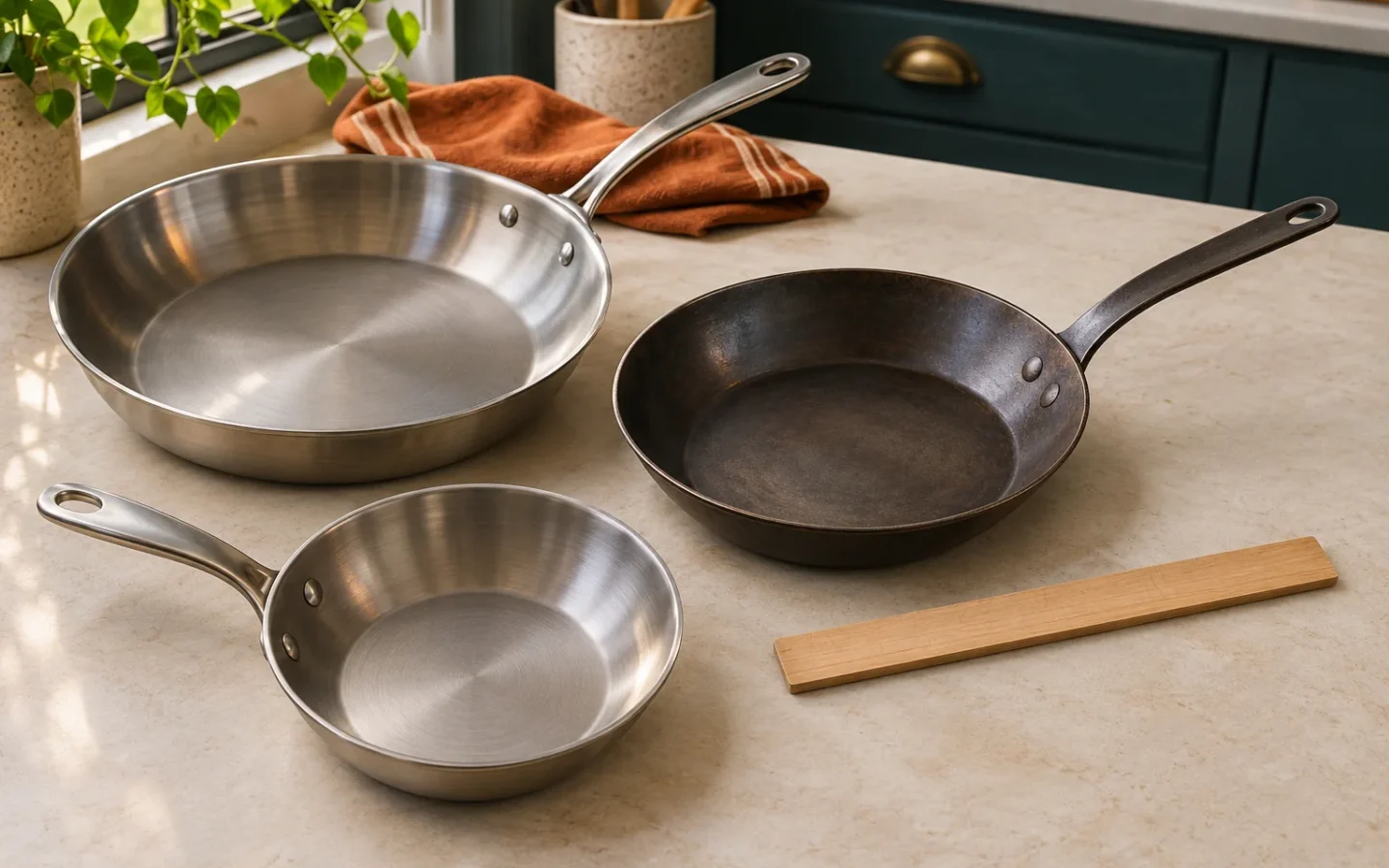
A pan sold as 12 inches wide rarely gives you 12 inches of room to brown food. The advertised number is normally measured across the top rim, while the surface touching your food may be only 9 or 10 inches across. Sloped walls, rolled rims, and manufacturing tolerances consume the rest. That difference is not cosmetic: it determines whether four chicken thighs sear or steam, whether three fish fillets fit without folding, and whether a pan overwhelms the burner beneath it.
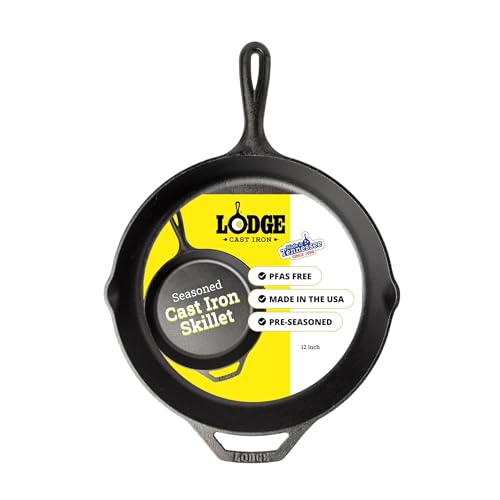
Lodge 12-Inch Pre-Seasoned Cast Iron Skillet
Certain content that appears on this site comes from Amazon. This content is provided “as is” and is subject to change or removal at any time.
Why we picked it
- Twelve-inch rim makes the floor-versus-rim lesson concrete
- Integrated helper handle makes the loaded weight manageable
- Cast iron works on gas, electric, induction, grill, and oven
Reported drawbacks
- Usable cooking floor is smaller than the advertised diameter
- Heavy enough to be awkward one-handed when full
- Requires prompt drying and occasional seasoning maintenance
The useful measurement is the flat floor
Measure the level area inside the pan, stopping where the base begins to curve into the sidewall. That is the usable cooking surface. A tape pulled across the upper rim measures capacity and lid fit, not browning area. Two pans with the same rim diameter can differ by more than an inch at the floor because one has gently flared sides and the other has a tight corner.
An inch sounds trivial until you calculate area. A 9-inch circle provides about 64 square inches. A 10-inch circle provides about 79—roughly 23 percent more room from one extra inch of diameter. That is enough space to stop pieces of meat touching, which lets surface moisture escape instead of collecting between them.
Why sloped sides are not wasted space
A skillet sacrifices floor area for access. Its flare gives a spatula a shallow path under an omelet, lets steam move away from food, and makes tossing possible without a vertical wall catching the contents. A sauté pan keeps more of its stated diameter at the floor, but the straight sides are less forgiving when you turn delicate food.
Neither shape is automatically more efficient. For cutlets, pancakes, and fried eggs, the open slope is part of the tool. For braises, pan sauces, and shallow frying, the extra floor and contained liquid of a straight-sided pan may matter more. Compare usable diameter only after deciding which wall geometry suits the job.
Match the floor to the burner, not the rim
The pan floor should be reasonably close to the active heating zone. On gas, flames that curl around the side waste heat and can overheat handles or scorch exterior finishes. On electric coils and radiant glass, a base much larger than the element develops a cooler perimeter. Induction is less visually obvious, but the magnetic field still has a defined working diameter; the center can heat aggressively while the outer ring lags.
Do not use the printed ring on a glass hob as an exact boundary. Check the appliance manual for element sizes, then compare them with the external flat base of the pan. A one-inch mismatch is usually manageable with preheating and modest heat. A small six-inch element under a broad twelve-inch floor is a structural mismatch, not a technique problem.
Use food as a sizing template
Before buying, arrange the portions you commonly cook on a dinner plate or a circle marked on parchment. Leave roughly half an inch between pieces that need browning. Four average chicken thighs usually need more floor than a nominal ten-inch skillet provides. Two eggs need much less. A pan sized for an imaginary dinner party becomes heavy storage for the other 350 days of the year.
- Eight-inch skillet: one or two eggs, a single cutlet, toasted spices, or a small serving of leftovers.
- Ten-inch skillet: two portions of protein, three eggs, or vegetables for two when the floor is at least eight inches.
- Twelve-inch skillet: four portions or a full batch of vegetables, provided your burner can heat its base evenly.
Those are starting points, not standards. A compact twelve-inch skillet may have the same floor as a generous ten-inch sauté pan. Ask for the interior base diameter or measure a display model. If a seller lists only rim diameter, depth, and total capacity, the most important fit measurement is missing.
Capacity can expose misleading dimensions
Published quart capacity provides a useful cross-check. If two pans share a rim diameter and depth but one holds noticeably less, it probably has a smaller floor or more heavily curved sides. Capacity will not reveal the exact geometry, yet it can warn you that two apparently equal pans are not interchangeable.
Depth also needs context. A pan measured from the counter includes base thickness; a cooking-depth measurement starts inside. Rolled rims and domed floors complicate the number further. For shallow cookware, photographs taken directly from the side are often more informative than a capacity claim rounded to the nearest quart.
A larger pan carries hidden costs
Every added inch increases mass, cabinet width, and leverage at the handle. A twelve-inch fully clad skillet can weigh several pounds before food is added. Cast iron makes that weight problem sharper. Hold it at the end of the handle and the center of mass moves farther from your wrist. A helper handle becomes genuinely useful, especially when the pan contains hot oil or a finished meal.
Large pans also demand more preheating time. Turning the burner higher does not make thick metal heat evenly faster; it makes the zone above the element hotter while the perimeter catches up. Moderate heat and an extra minute are safer than chasing an instant response from a wide, heavy base.
How to compare pans in a store
Bring a flexible tape measure. Record the interior floor, exterior base, top rim, overall length including handles, and weight. Set the pan flat and press opposite edges to check for rocking. Hold it as if pouring with one hand, then with a folded towel in it to imitate food weight. Confirm that the handle clears neighboring burners and the pan fits your oven and dishwasher if those uses matter.
Online, look for technical drawings and customer photographs showing a ruler across the base. Do not estimate from styled images; wide-angle lenses exaggerate the foreground, and a small pan can look substantial beside miniature ingredients. Return policies matter when dimensions are incomplete.
Make a paper template before you buy
When a manufacturer publishes the interior floor diameter, draw that circle on parchment or cut it from scrap paper. Place the template on your usual burner, then arrange real portions or similarly sized objects inside it. This exposes a mismatch that capacity charts hide: four compact burger patties may fit where four long fish fillets do not.
Next, mark the outer base diameter on a second sheet. Center it on the heating zone and check nearby controls, walls, and other burners. A pan can technically sit on the grate while its body blocks the saucepan beside it. On a thirty-inch cooktop, two wide pans may compete for the same center space even though four burners are advertised.
Food shape changes the area you can use
The circular area calculation assumes food can fill every edge. Rectangular cutlets, asparagus, bacon, and fish leave crescent-shaped gaps, so their practical capacity is lower. Round meatballs and sliced vegetables pack differently. The half-inch spacing rule also belongs between pieces, not necessarily around the entire perimeter.
Curved wall sections are useful for small loose ingredients but unreliable for searing a flat piece of meat. Oil pools differently on the slope, and food there receives less direct conduction. Count only the level floor for tasks that require full contact. For sautéing diced vegetables, you can use more of the curve because the food moves continuously.
Repeat the template test with the pan’s full handle length marked on the counter. The cooking surface may fit while the grip projects into a walkway or strikes a backsplash. A technically correct diameter becomes a poor choice when safe handle orientation is impossible.
The practical buying rule
Start with your burner and usual portion count. Choose skillet or sauté-pan geometry for the cooking action, then compare flat-floor diameter within that shape. Treat the rim measurement as a lid and storage dimension. A pan is correctly sized when its working surface holds the food with breathing room, its base matches the heat source, and its loaded weight is still comfortable to control.