
As an Amazon Associate I earn from qualifying purchases. CookwareCompass is a participant in the Amazon Services LLC Associates Program, an affiliate advertising program designed to provide a means for sites to earn advertising fees by advertising and linking to Amazon.com.
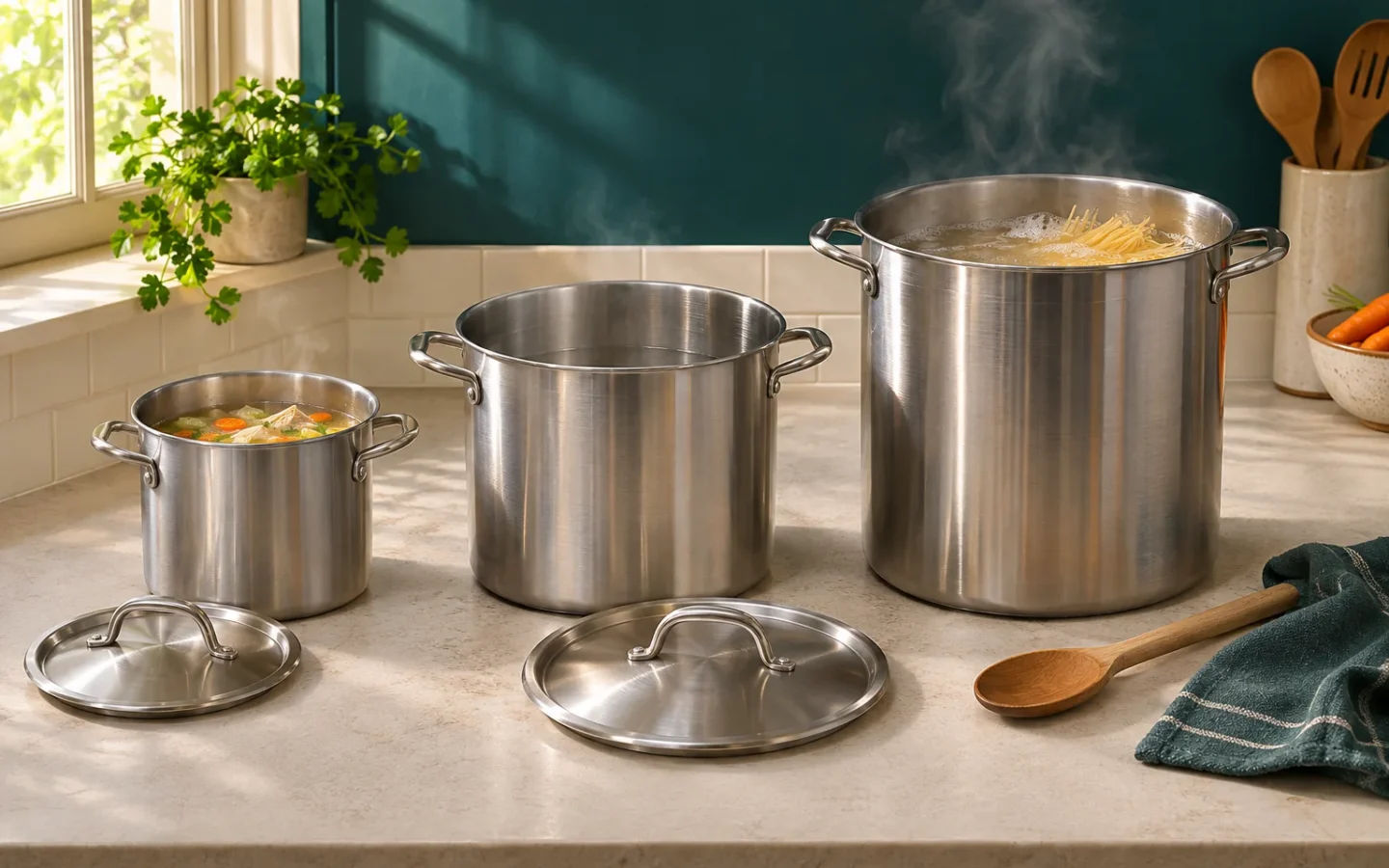
A stockpot is sold by volume, but volume alone tells you surprisingly little about how it cooks. An eight-quart pot can be tall and narrow or low and broad. Both hold the same amount at the brim; one fits long pasta and limits evaporation, while the other browns meat more effectively and may not fit on a crowded stove. The right size starts with the food, the burner, and the amount of safe headroom—not the largest number that fits in a cabinet.

Cuisinart Chef’s Classic 8-Quart Stockpot with Cover
Certain content that appears on this site comes from Amazon. This content is provided “as is” and is subject to change or removal at any time.
Why we picked it
- Eight-quart capacity covers stock, pasta, and batch soup
- Loop handles keep the carrying width compact
- Marked capacity is large without becoming a canning vessel
Reported drawbacks
- Full pot can weigh more than twenty pounds
- Tall walls make sink clearance worth checking first
- Disc base prioritizes bottom heat over heated sidewalls
Usable capacity is smaller than labeled capacity
Manufacturers usually measure to the brim. You cannot cook at the brim without sloshing hot liquid over the edge. For soup and stock, plan to use roughly two-thirds to three-quarters of the stated capacity. Foamy foods such as pasta, beans, and potatoes need more headroom because starch stabilizes bubbles and turns a gentle boil into a rising cap.
An eight-quart pot is therefore comfortable with about five to six quarts of active cooking liquid. A twelve-quart pot may be appropriate for eight quarts of stock, but it becomes heavy: eight quarts of water alone weigh nearly seventeen pounds before the vessel, bones, or vegetables are counted. Capacity is also a lifting decision.
Diameter controls evaporation and browning
A wider opening exposes more liquid to moving air. That speeds evaporation, which is useful when reducing stock but wasteful when simmering beans for hours. A narrow pot slows water loss and reduces the amount of burner area it occupies. It also gives you less floor for sweating vegetables or browning meat before liquid is added.
If a recipe begins with “brown in batches,” pot diameter decides how many batches. Meat packed tightly releases moisture faster than the surface can evaporate it, so the pot steams. A twelve-inch floor has far more area than a ten-inch floor, even when the two vessels have the same nominal capacity because their heights differ.
Height changes access, circulation, and storage
Tall walls contain splatter and accommodate bones, corn, or upright pasta. They also make it harder to reach the bottom with a short spoon and harder to see whether onions are browning or burning. In a very tall, narrow vessel, thick food circulates poorly unless you stir along the floor and corners.
Check the complete height with the lid knob attached. A pot that fits beneath a cabinet without its lid may not fit with it, and a twelve-inch vessel can exceed the clearance under a range hood when you lift the lid. Measure shelf depth and dishwasher rack spacing too. The largest pot often becomes the least-used pot because it is awkward to retrieve and clean.
Choose by the largest routine task
Do not size a stockpot for an annual party unless that event justifies dedicated storage. Size it for the largest thing you cook at least monthly, then borrow or use two pots for exceptional occasions. A pot used for weeknight pasta and six servings of soup earns its space; a restaurant-scale vessel waiting for one holiday does not.
- Six quarts: pasta or soup for two to four, blanching a moderate batch of vegetables, and compact kitchens.
- Eight quarts: a flexible household size for four to six servings, chicken stock, or a pound of pasta with headroom.
- Twelve quarts: larger stock batches, boiling corn, preserving prep, or regular cooking for a crowd.
- Sixteen quarts and above: specialized batch cooking; verify burner strength, sink clearance, and safe lifting before buying.
These ranges assume conventional proportions. A low eight-quart Dutch oven behaves differently from a tall eight-quart stockpot. Compare actual diameter and height, not only the label.
Match the base to your heat source
A stockpot full of cold water asks a burner to deliver sustained energy. If the base extends far beyond the heating zone, the center warms first and the boil may remain uneven. On gas, flames should stay beneath the base rather than climbing the wall. On induction, verify that the magnetic base covers the coil and that the cooktop supports the vessel’s diameter and weight.
A thick bonded disc is often sensible here. Water circulation does most of the work after heating begins, so expensive cladding to the top rim adds less value than a broad, flat, stable base. For thick chili or tomato sauce, even base coverage matters more because convection is weaker and solids settle.
Handles determine whether capacity is usable
Side handles must accept a secure grip while you wear dry oven mitts. Small decorative loops are inadequate when the pot is full. Look for clearance between handle and wall, smooth edges, and a shape that prevents a wet hand from sliding toward the hot vessel. Rivets or welds should show no movement.
Practice the route from stove to sink with the empty pot. Can you turn without hitting an island? Does it fit flat in the sink, or will you have to hold it while pouring? For a large pot, a ladle or heatproof measuring jug is safer than moving boiling liquid across the room. Capacity you cannot handle safely is not useful capacity.
The lid needs a deliberate venting plan
A close-fitting lid speeds the initial boil and limits evaporation during long simmering. It also lets foam rise unnoticed. A small steam vent prevents pressure flutter but will not stop starchy boil-over. For pasta and beans, leave the lid off or ajar once boiling and reduce heat to the lowest setting that maintains circulation.
Glass shows activity without lifting but adds weight and can collect water around its rim. Metal is lighter and more durable but opaque. Whichever you choose, the knob must stay clear of neighboring handles and remain graspable with a mitt. Confirm the lid has a stable place to rest; a large wet lid sliding across the counter is an avoidable hazard.
Pasta inserts consume room
An insert looks convenient because it lifts food without carrying the whole pot. It also reduces interior diameter and raises the effective floor, sometimes substantially. Water trapped outside the basket does not help pasta move. Check the insert’s usable volume, hole size, and distance from the base rather than assuming it preserves the pot’s stated capacity.
For ordinary portions, a spider or colander often drains faster and uses the full pot. An insert earns its space when you routinely blanch multiple batches in the same water or need to lift a large quantity at once. It is a workflow tool, not a free accessory.
A simple sizing exercise
Record the volume of your largest regular recipe, add at least one-third for headroom, and note whether it needs browning space or mostly liquid depth. Measure your strongest burner, cabinet, sink, and dishwasher. Finally, calculate the loaded weight using roughly two pounds per quart of water, then add the pot and ingredients.
The correct stockpot is the smallest one that handles that routine job without crowding, foaming over, or becoming unsafe to lift. Buying beyond that point gives you more metal to heat, wash, and store—not better stock.
Stock ingredients need geometry too
Bones and vegetable trimmings displace water, so an ingredient list described by weight does not translate directly into liquid capacity. Long poultry bones can bridge across a narrow pot and sit partly above the water. A wider vessel may cover them with less liquid, producing a more concentrated stock without hours of reduction.
Do a cold rehearsal for large batches. Put the bagged ingredients into the clean pot, add measured water to the intended level, and confirm several inches of headroom before lighting the burner. Remove the ingredients and dry the pot if you are not cooking immediately. This simple check is safer than discovering the limit while hot foam rises.
Frequently asked questions
What size stockpot do I need?
Start from your largest regular recipe, then add at least one-third for headroom. Six quarts suits pasta or soup for two to four, eight quarts is a flexible household size for four to six servings or a pound of pasta, and twelve quarts is for larger stock batches or a crowd.
Is an 8-quart stockpot big enough?
For many households, yes. An eight-quart pot is comfortable with about five to six quarts of active cooking liquid, which is enough for four to six servings, chicken stock, or a pound of pasta with headroom.
Should I use a stockpot or a Dutch oven for soup?
Two pots with the same labeled capacity can cook very differently. A tall stockpot limits evaporation and fits bones, corn, or long pasta; a lower, wider Dutch oven browns meat more effectively before liquid goes in. Choose by whether the recipe starts with browning or mostly needs liquid depth.
Cleaning burden rises faster than capacity
A pot that barely fits the sink is difficult to angle without striking the faucet or flooding the counter. Measure the sink basin diagonally and account for handles. Brushed stainless interiors hide fine scratches better than mirror finishes, while a smoothly rounded corner releases residue more easily than a tight seam.
After stock, cool and portion the food safely rather than putting a massive hot pot directly into the refrigerator. Large volumes cool slowly. The cookware purchase does not solve that food-handling problem; shallow storage containers and an intentional cooling plan do.