
As an Amazon Associate I earn from qualifying purchases. CookwareCompass is a participant in the Amazon Services LLC Associates Program, an affiliate advertising program designed to provide a means for sites to earn advertising fees by advertising and linking to Amazon.com.
A lid that chatters, spits droplets, or welds itself to the rim is not behaving randomly. Steam production, fit, weight, vent area, and temperature difference are interacting. The lid’s job is not to create an airtight pressure vessel; ordinary cookware should let excess vapor escape. Its job is to slow evaporation and redirect condensation without making the pan unpleasant or unsafe to use.

Lodge 6-Quart Enameled Cast Iron Dutch Oven
Certain content that appears on this site comes from Amazon. This content is provided “as is” and is subject to change or removal at any time.
Why we picked it
- Heavy fitted lid makes steam and condensation behavior easy to observe
- Wide loop handles give both hands a secure lifting point
- Enamel surface handles acidic braises without seasoning concerns
Reported drawbacks
- Heavy lid can still chatter when steam production outruns venting
- Condensation gathers around the lid rim when heat is excessive
- Enamel can chip from hard impacts or careless stacking
Why a lid rattles
Water becomes vapor at the hot food surface. If vapor reaches the rim faster than it can escape through gaps or a vent, pressure beneath the lid rises slightly and lifts it. Vapor rushes out, pressure falls, and the lid drops. Repeating that cycle produces the familiar chatter. It is a flow signal, not proof that the pot is defective.
Lowering the burner usually fixes it because a simmer requires much less energy than reaching the boil. Once the contents are hot, high power mostly creates more vapor. A heavy lid may rattle less because it takes more pressure to lift, but it can hide an unnecessarily violent boil. A pot filled close to the rim leaves vapor and foam little room before they reach the lid, which is one reason stockpot size should leave headroom.
A vent changes the escape route
A small hole gives vapor a predictable exit and reduces lid lifting. It does not make the vessel boil-over proof. Starch and protein create stable foam that can block the hole or rise faster than it drains. Pasta, beans, milk, and oatmeal still need headroom, lower heat, and attention.
Vent placement matters. A hole near the edge can aim hot vapor toward a side handle. Rotate the lid so the vent faces away from your grip and from the front of the stove. When lifting any lid, tilt the far edge up first so steam moves away from your face and hand.
Fit is a controlled gap, not a seal
Most lids locate themselves with a stepped rim, a metal band, or a flange that sits inside the vessel. A small amount of clearance lets the lid go on when both parts expand with heat and provides an escape path for vapor. Too much clearance loses heat and lets condensation spray. Too little can make a hot lid bind.
Test a cold lid by setting it in place and sliding it gently. A little lateral movement is normal. It should not fall deep enough to touch food, rock on one point, or require pressure to seat. Rotate it through a full turn; binding in one position suggests the lid or rim is out of round.
Condensation explains the spitting
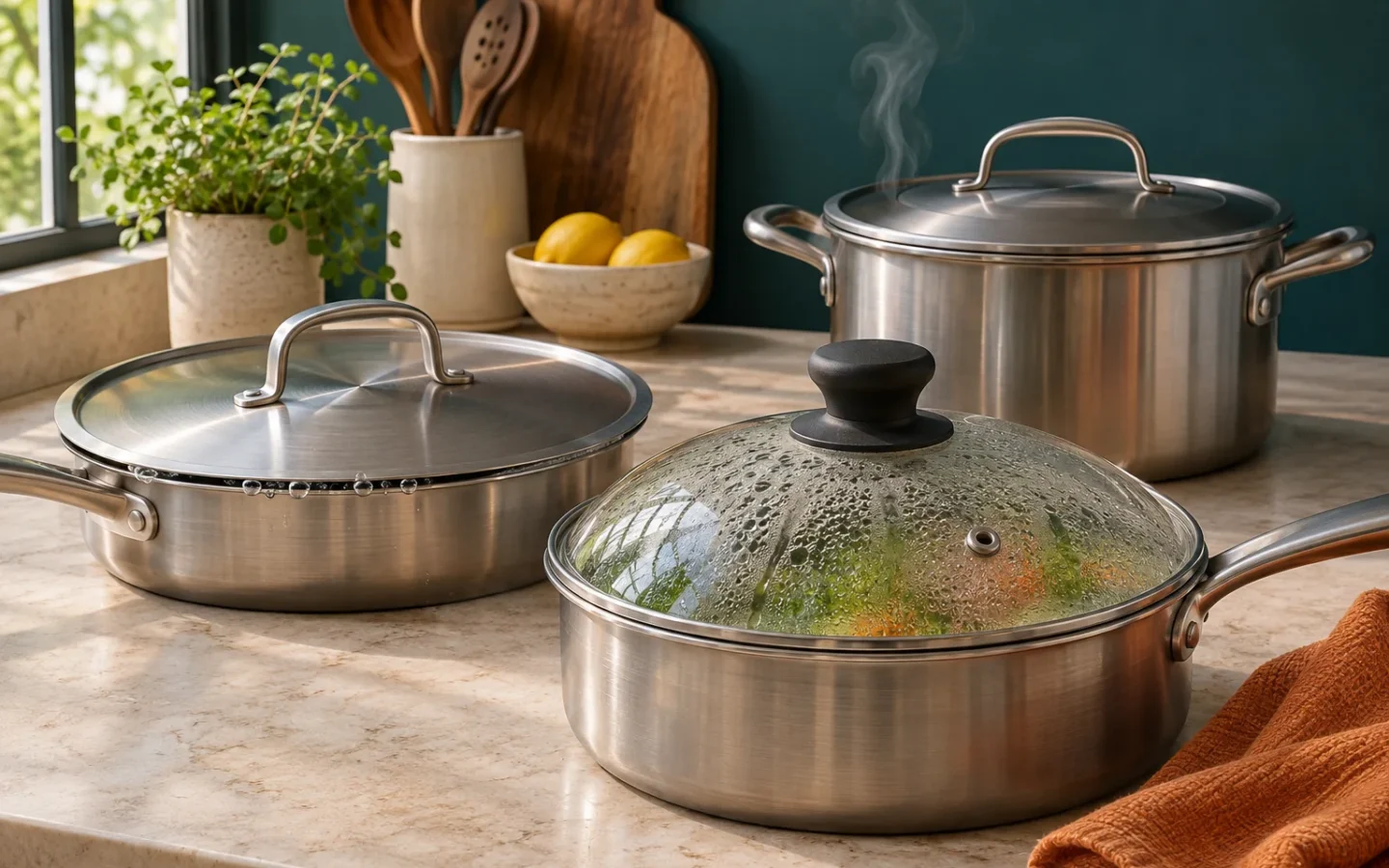
Steam condenses when it meets the cooler lid. Water runs toward the edge and returns to the pan. If the lid rim forms a clean inward drip line, most of that water falls inside. If it bridges across a loose metal band or flat edge, bubbling vapor can throw droplets outward. Grease mixed with condensation makes those droplets more noticeable.
A domed lid encourages condensate to move toward the perimeter and provides space above food. A flat lid stores more droplets across its underside and may release a sheet when tilted. Neither is universally better, but the rim should direct water into the vessel rather than along the handle.
Glass and metal manage heat differently
Glass lets you check activity without lifting, although condensation quickly obscures the view. It is usually thicker and heavier than sheet metal and commonly limited by its knob, rim, or thermal-shock tolerance. Never place a hot glass lid on a wet or cold stone surface; a dry towel or wooden board avoids abrupt local cooling.
Metal lids are lighter, opaque, and resistant to breakage. Thin ones can flex or resonate as steam pulses beneath them. A heavier stainless lid feels stable but adds meaningful weight when you drain or move the pot. For oven use, the handle material and stated limit matter more than opacity.
Why lids sometimes seem vacuum locked
When a covered pan cools, steam condenses and occupies far less volume. If the rim is wet and fits closely, outside air may enter slowly, creating a temporary pressure difference that holds the lid down. Starchy sauce can strengthen the seal. Do not pry toward yourself or strike a glass lid.
Let the pan cool in a stable place, then warm it gently on low heat to expand the trapped air and soften residue. Use dry protection on the handle and stop if the vessel contains food that should not be reheated. A lid that repeatedly locks may fit too tightly or have a blocked vent.
Universal lids trade fit for flexibility
A stepped universal lid spans several rim sizes. It saves storage and can cover an orphaned pan, but only one narrow ring contacts each vessel. Condensate may collect on unused steps, and a broad silicone edge can retain odors or flex near high heat. Check that the selected step sits securely without the handle making the lid top-heavy. Flared skillet rims are the hardest to cover well; straight-sided pans seat a lid more reliably.
Measure the outside rim of the pan and compare it with the lid’s actual seating ranges, not the product’s broad headline range. A lid advertised for eight through twelve inches may fit some intermediate rims poorly. It is a useful backup, not automatically the best lid for daily braising.
Care points that preserve fit
- Do not use an upside-down lid as a trivet; concentrated weight can bend a thin rim.
- Clear vents with a soft brush rather than enlarging them with a metal tool.
- Dry beneath metal bands and around knob hardware where water collects.
- Store lids vertically or with protection so metal edges do not strike glass.
- Check screws periodically and tighten only until movement stops.
If a tempered-glass lid is chipped at the edge, retire it. The edge is a highly stressed part of the panel, and damage there is more serious than a superficial scratch in the middle. Replacement lids must match both diameter and seating profile.
When no matching lid exists
A flat baking sheet can cover a wide skillet briefly for melting cheese or wilting vegetables, provided it is stable, heat-safe, and larger than the opening. Slide it sideways with protected hands so steam escapes away from you. Do not use a plate unless its maker explicitly rates it for direct stovetop heat and thermal shock.
Foil can reduce splatter but should not be crimped into an airtight seal, and it is awkward to remove above active steam. A lid borrowed from another pot is acceptable when it sits securely on the rim and cannot fall into the food. If improvisation becomes weekly routine, buy a measured replacement rather than normalizing an unstable cover.
Condensation can be part of the recipe
In a covered braise, condensed water returns flavor and moisture instead of letting the cooking liquid disappear. For steamed rice, the lid helps maintain a predictable water balance after the burner is lowered. Repeatedly lifting it releases heat and vapor, extending the cooking time that the recipe assumes.
For crisping, condensation works against you. Covering browned potatoes or cutlets traps moisture that softens the surface. Use the lid only for the covered phase, then remove it and let water escape. The same pan can braise and crisp, but not at the same moment.
When you remove a wet lid, hold it level until it reaches its resting place. Turning it vertical above the stove sends condensed water toward your wrist or into hot oil. A nearby plate or spoon rest large enough for the full rim keeps that water off the cooktop.
Choose the lid for the cooking pattern
For long simmering, prioritize a stable fit, durable handle, and controlled condensation. For pasta, a lid is mainly useful for reaching the boil; headroom and heat control prevent overflow afterward. For oven braises, verify the complete assembly’s temperature limit and choose a knob you can grasp with a mitt.
Rattle is usually solved at the burner, not at the store. Spitting is influenced by rim geometry and condensation. Binding points to fit, residue, or cooling pressure. Read those behaviors as diagnoses, and a simple lid becomes much easier to choose and use. When you are still choosing pieces, count lids as part of the set rather than as extras.