
As an Amazon Associate I earn from qualifying purchases. CookwareCompass is a participant in the Amazon Services LLC Associates Program, an affiliate advertising program designed to provide a means for sites to earn advertising fees by advertising and linking to Amazon.com.
“Oven safe to 500°F” looks like permission to use a pan anywhere inside an oven. It is not. Conventional baking surrounds cookware with hot air and radiation from several surfaces. A broiler directs intense radiant energy from one element at close range. The pan body may tolerate both while a handle coating, lid knob, nonstick layer, or decorative part becomes the limiting component.

Lodge 10.25-Inch Pre-Seasoned Cast Iron Skillet
Certain content that appears on this site comes from Amazon. This content is provided “as is” and is subject to change or removal at any time.
Why we picked it
- One-piece iron construction removes handle-joint uncertainty
- No coating, glass lid, or plastic grip sets a lower heat limit
- Moves from burner to oven, broiler, grill, or campfire
Reported drawbacks
- Entire handle becomes dangerously hot in the oven
- Weight makes a dry, secure two-hand transfer important
- Thermal shock and moisture can still damage the pan
The weakest part sets the real limit
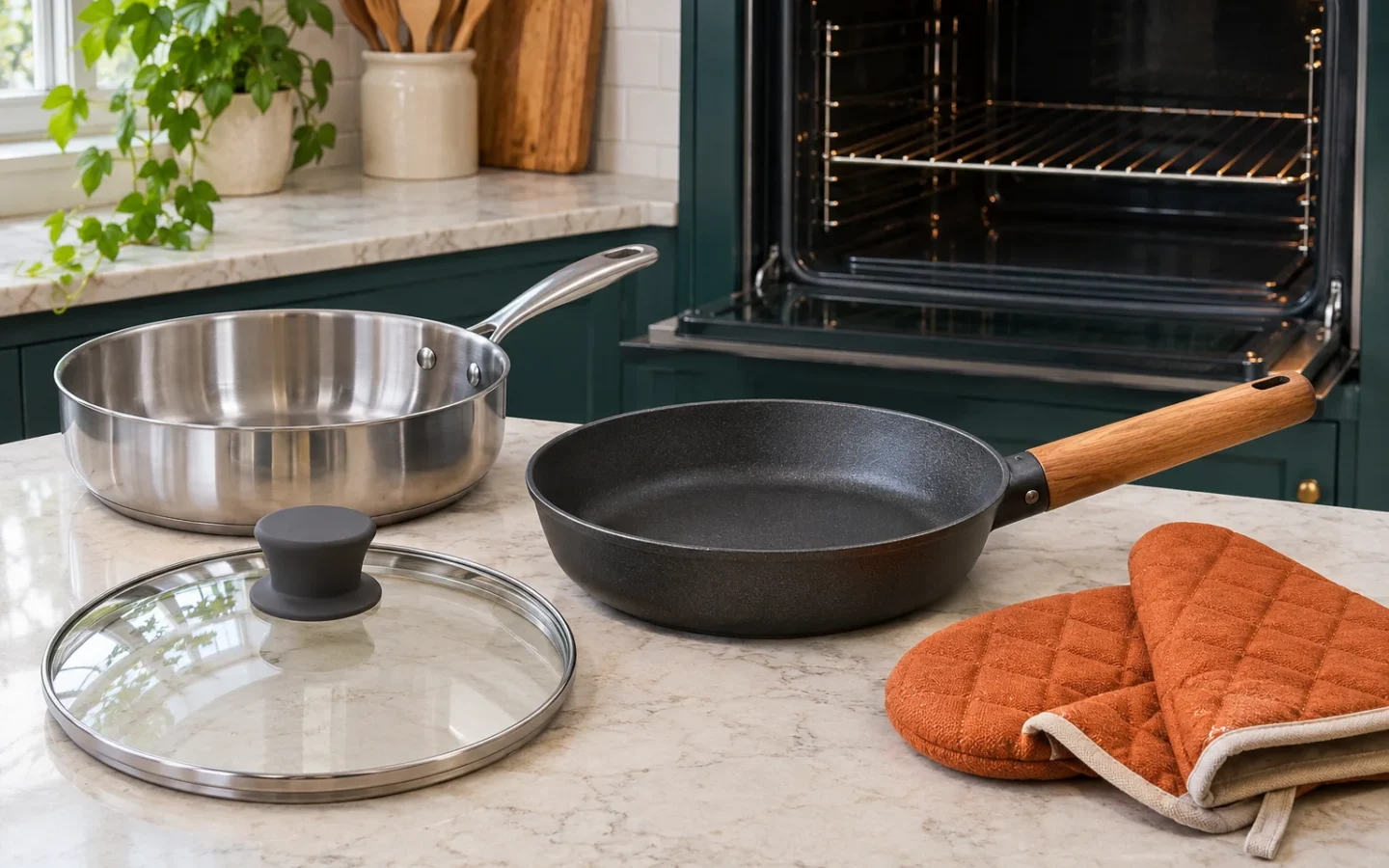
A stainless vessel can withstand temperatures far above normal cooking, but cookware is an assembly. Silicone sleeves, phenolic knobs, wood grips, bonded base plates, glass lids, and coatings have separate limits. Marketing often prints the highest pan-body number prominently and places lid or accessory restrictions in the manual.
Build a component list before using unfamiliar cookware: body, interior coating, exterior finish, long handle, helper handle, lid, knob, seals, and any removable grip. The lowest stated limit governs the assembled pan. Removing a low-temperature lid does not make an attached handle safe unless its rating is known too.
Why a broiler is different
Broiler elements can glow red and send strong infrared energy directly into whatever faces them. A dark knob or coating absorbs that radiation quickly. The air around the pan may be below the published oven limit while the exposed component becomes much hotter. Distance from the element changes the load dramatically.
That is why an oven-safe claim does not imply broiler safety. Look for the word “broiler” in the manufacturer’s instructions. If it is absent, do not infer permission from the temperature number. Move the food to a known broiler-safe vessel or finish it with a different method.
Glass lids need their own decision
Tempered glass handles normal oven heat when designed and rated for it, but direct broiler radiation and thermal shock are separate risks. A lid may also contain a silicone gasket, bonded metal rim, or plastic knob with a lower limit than the glass. Never broil under glass unless the manufacturer explicitly approves the complete lid.
A hot lid should land on a dry towel, wood board, or stable trivet—not a wet sink or cold stone counter. Local cooling creates stress between the hot center and cooler contact area. Edge chips are especially serious because the tempered panel carries high internal stress there.
Nonstick ratings are operating boundaries
A nonstick pan’s listed oven limit is not a target. It describes the highest permitted environment under the maker’s conditions. Broilers can create local surface temperatures beyond that limit before food browns. Empty sections of a coated pan heat faster than areas covered by moist food.
Use uncoated stainless steel, cast iron, carbon steel, or another explicitly approved vessel for close broiling. If a recipe asks you to sear in nonstick and finish under a broiler, transfer the food. The extra dish is cheaper than damaging a coating or overheating a handle.
Handles become hot even when they stay cool on the stove
“Stay-cool” describes reduced conduction from the pan body during stovetop use. Hollow grips and forked brackets slow that heat path. Inside an oven, hot air and radiant surfaces surround the handle, so the design advantage disappears. A stainless grip can look unchanged while being hot enough to burn immediately. How the handle is attached also changes how heat travels toward the grip.
Use dry mitts that fully cover the hand. Wet fabric converts water to steam and transfers heat rapidly. After the pan returns to the cooktop, leave a mitt or purpose-made handle cover on it as a visual warning, but do not place a fabric cover into an active flame.
Wood and removable grips require explicit instructions
Wood darkens, dries, cracks, and can ignite under enough heat. Some short oven exposures may be permitted by a maker, but appearance alone does not establish safety. A screwed-on wooden grip can hide adhesive or an insert with a lower limit.
Removable handles make oven use possible only when they are actually removed before heating and reattached according to instructions. Food in the latch or a partially engaged mechanism can fail under load. Never carry a full hot vessel by a clip-on handle without supporting the opposite side.
Position in the oven matters
Measure the pan including handle and helper grip before preheating. The vessel should sit fully on a rack without touching walls, door glass, or heating elements. Turn long handles inward so they cannot catch as the rack moves, while keeping them clear of another pan’s hot surface.
Under a broiler, follow the appliance manual’s rack positions. Closer is not simply faster; it reduces the margin between browning and burning. Stay present, keep the oven light on if available, and use a timer measured in minutes rather than assuming the recipe’s timing transfers to your element.
Watch for residues and exterior finishes
Oil film on the exterior can smoke long before the metal is threatened. Clean the base and walls before high-temperature oven use. Painted colors, silicone logos, and decorative wraps may discolor even when the structural pan remains sound. A cosmetic warranty exclusion does not raise their heat tolerance. Heat tint on stainless after oven use is usually cosmetic and can be cleaned.
Cookware with a bonded disc should sit flat and show no separation before it enters the oven. Heat expands different metals at different rates; a damaged joint should not be stressed further. Retire a vessel with a lifting base, cracked weld, loose handle, or chipped glass.
A pre-oven checklist
- Read the current manual for the exact model, not a retailer’s generic bullet list.
- Confirm separate limits for vessel, coating, lid, knob, and removable parts.
- Find an explicit broiler statement before using direct top heat.
- Check rack clearance and keep all parts away from elements and oven walls.
- Remove exterior grease and verify handles, welds, rivets, and base are sound.
- Prepare dry mitts and a heat-safe landing place before the pan becomes hot.
These limits are easier to check before you buy than after, especially when you are planning a small set.
When the specification is missing
Do not estimate from material alone. Contact the manufacturer with the model number and ask for the assembled oven limit, lid limit, and broiler permission in writing. If the model cannot be identified, keep it on the stovetop or transfer food to a known oven-safe dish.
The practical rule is simple: oven-safe is a system rating, and broiler-safe is a separate claim. Use the lowest confirmed limit and treat unknown components as limits, not opportunities to experiment.
Thermal shock can damage metal assemblies too
Glass receives most thermal-shock warnings, but a layered metal pan also expands and contracts. Running cold water into a hot vessel can warp its floor or stress the bond between dissimilar metals. Let the pan cool until it can be handled safely, then add warm wash water. Do not use the sink as an emergency cooling station.
Likewise, do not move cookware directly from a cold refrigerator into a fully heated oven unless the maker approves that transition. Food may tolerate it while glass, enamel, or a bonded assembly does not. Gradual temperature change protects both the vessel and the food from a violently hot exterior with a cold center.
Plan the hot-pan landing before you lift
Clear a dry, heat-safe surface large enough for the entire base. Stone counters vary in thermal-shock resistance, and laminate can scorch, so use a stable trivet or board. Keep children, pets, cords, and loose towels out of the route between oven and landing place.
Grip both handles before the pan leaves the rack and keep it level. If a long handle makes the oven door awkward, slide the rack partly out rather than reaching deep into the cavity. Once landed, leave the mitt on the handle as a warning and say clearly that the pan is hot when other people share the kitchen.
Do not place a hot pan across two uneven burner grates as a temporary landing spot. The vessel can rock, and an accidentally activated burner adds concentrated heat. A dedicated trivet on a clear counter is a small preparation that removes several failure points at once.
Keep the manufacturer’s temperature guidance with the pan’s model record. Memory is a poor safety label when several similar-looking lids and handles share one cabinet.