
As an Amazon Associate I earn from qualifying purchases. CookwareCompass is a participant in the Amazon Services LLC Associates Program, an affiliate advertising program designed to provide a means for sites to earn advertising fees by advertising and linking to Amazon.com.
A cast iron skillet is one of the few pans that can outlast its buyer, which is exactly why the purchase deserves more thought than the price tag or the logo. The pan you choose will be heavy, slow to change temperature, and nearly impossible to wear out, so a bad fit does not fail quickly. It simply sits in the cabinet. Choose the size by the burner and the food, the weight by the hands that will lift it, and the handle by how the pan has to move when it is hot. The brand comes last.

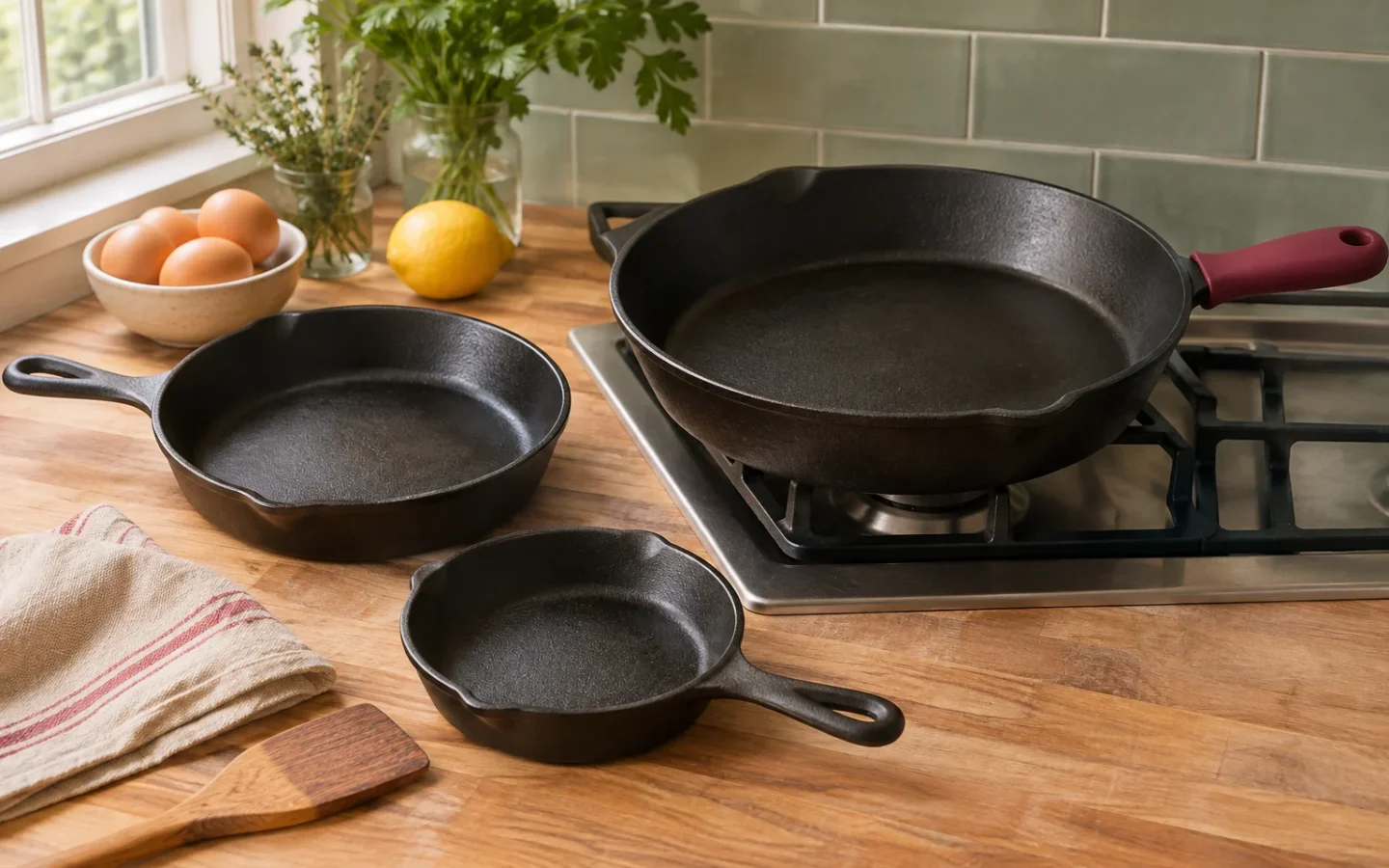
Lodge Pre-Seasoned Cast Iron Skillet with Silicone Handle Holder, 12 Inches
Certain content that appears on this site comes from Amazon. This content is provided “as is” and is subject to change or removal at any time.
Why we picked it
- Twelve-inch size gives a large floor for searing several pieces without crowding
- Includes a silicone handle holder for moving the hot pan after cooking
- Pre-seasoned with vegetable oil and listed as usable on stovetop, oven, and induction
Reported drawbacks
- Heavy for one-handed lifting, especially when the pan is full
- The silicone holder is for transport, not for staying on the handle in the oven or over high heat
- Seasoning needs routine drying and oiling to stay rust-free
Start With the Food, Then Find the Burner That Can Heat It
Most people shop cast iron by rim diameter because that is the number printed on the box. The rim is not the cooking floor. Cast iron skillets have sloped walls and a radius where the wall meets the base, so the flat area where a steak, a row of chicken thighs, or a pan of cornbread actually sits is noticeably smaller than the advertised size. We covered the measuring method in detail in Pan Diameter Is Not Cooking Surface; the short version is to measure the flat floor, not the top edge.
Once you know the floor you need, check it against the burner you own. Cast iron is a poor lateral conductor compared with aluminum or copper. Heat travels from the burner into the iron above it and spreads outward slowly. A large skillet on a small burner develops a hot center ring and cooler edges, and food at the rim cooks noticeably slower than food in the middle. Preheating longer helps because the iron eventually evens out, but it never fully erases a large mismatch between pan and flame.
- Small skillets (around 6 to 8 inches): one or two eggs, a single grilled sandwich, toasting spices, or a small cornbread. They heat quickly and fit any burner, but they crowd fast.
- Medium skillets (around 10 inches): the everyday size for one or two people. Enough floor for two chops or a pair of chicken breasts, and it usually matches a standard large burner.
- Large skillets (around 12 inches): family searing, roasting a spatchcocked chicken, or browning meat in one batch instead of three. It needs a large burner and a long preheat to perform evenly.
- Extra-large skillets (13 inches and up): often more pan than a home burner can heat edge to edge. Many owners end up using them in the oven or over a grill instead of on the stove.
If you cook for one or two people and own only one skillet, a 10-inch pan is the safest single choice. If you regularly cook for three or more, or if most of your searing is meat that sheds liquid, a 12-inch pan earns its weight because crowding is the main reason food steams instead of browning.
Weight Is a Feature on the Stove and a Cost Everywhere Else
Cast iron is heavy because thick iron is how it stores heat. That stored heat is what lets a skillet keep its temperature when cold food lands in it, and it is why cast iron is so good at searing and shallow frying. The same mass is what you lift every time you drain fat, pour a pan sauce, carry the pan to the sink, or slide it out of a hot oven.
Do not judge weight from photos. Read the item weight on the product listing, then add the food. A large skillet full of braised chicken thighs and liquid can weigh far more than the empty pan, and that load sits at the end of a short handle, so the strain on your wrist is greater than the number on the scale suggests. Leverage, not just mass, is what makes a full cast iron pan hard to tip with control.
A practical test before you buy: think about the heaviest thing you lift from the stove to the counter in a normal week, such as a full pasta pot or a loaded sheet pan. If that already feels awkward, a 12-inch cast iron skillet will feel worse, and you should either choose a smaller size, make sure the larger one has a helper handle, or plan to leave it on the stove and serve from it.
Diameter and Depth Change the Kind of Cooking the Pan Is Good At
Skillets are designed for food that needs to be turned, flipped, or slid, which is why their walls flare outward. If you mainly braise, make stews, or cook with a lot of liquid, a cast iron skillet is not always the right shape. That trade-off between flared and straight walls is the subject of Sauté Pan vs. Skillet, and it applies to cast iron as much as it does to stainless.
Within skillets, depth varies more than shoppers expect. A deeper skillet holds more oil for shallow frying and contains splatter better, but it also traps more steam and makes it harder to get a spatula under food at the edge. A shallower skillet releases moisture faster, which helps browning, but it spills more easily when you carry it. Look at the listed depth or a side-profile photo, and match it to whether you fry more often or sear more often.
Also look at the pour spouts. Many cast iron skillets have two small lips on opposite sides. They are useful for draining fat, but only if you can tip the pan with control, which brings the conversation back to weight and handles.
The Handle Decides Whether You Can Move the Pan Safely
Traditional cast iron skillets have a handle cast as one piece with the body. There are no rivets to loosen, no welds to crack, and no screws to back out, which removes the failure points discussed in Riveted, Welded, or Screwed Handles. The trade-off is heat. A one-piece iron handle gets hot on the stove and fully hot in the oven, because it is the same metal as the pan.
When comparing handles, look at three things rather than the overall look of the pan:
- Length: a longer handle gives more leverage and keeps your hand farther from the heat, but it takes up more room on a crowded range and in the oven.
- Shape and thickness: a thin, sharp-edged handle concentrates load into your fingers. A wider handle with a rounded profile spreads it out and feels steadier when the pan is full.
- Helper handle: the small loop or lip on the opposite side of the pan matters more on large sizes than any other feature. It lets you lift with two hands, which turns an awkward one-handed tip into a controlled two-handed carry.
A silicone handle holder, sometimes called a hot handle sleeve, is a convenience for gripping the pan briefly after cooking. It is not the same as a cool handle. Silicone sleeves have their own temperature limits, so treat them as something you slide on to move the pan, not something that stays on the handle in a hot oven or under a broiler. Read the care notes that come with the holder and keep a dry, thick towel or mitt as your default. If you plan to finish dishes in the oven regularly, our guide on oven-safe versus broiler-safe cookware explains why the weakest part of any setup sets the real heat limit.
Surface Finish: Smooth, Pebbled, and What Pre-Seasoned Actually Means
Most cast iron sold today comes pre-seasoned, which means the factory has applied oil and baked it into a thin polymerized layer. That layer prevents rust out of the box and gives food something to release from, but it is a starting coat, not a finished nonstick surface. It builds with use, especially when you cook with fat and dry the pan properly.
New cast iron from many mass-market makers has a slightly pebbled surface texture from the sand casting process. Some boutique and vintage pans are machined smooth. A smoother surface can make early releases a little easier, but a pebbled surface builds seasoning well over time and is not a defect. Do not pay a premium for smoothness unless you understand what you are paying for and you plan to cook delicate foods such as eggs regularly.
If you are buying a pre-seasoned skillet, the first few weeks of care matter more than the finish. Our step-by-step guide to seasoning and maintaining a pre-seasoned cast iron skillet covers how to wash, dry, and oil it without stripping the factory coat.
Check Stovetop Compatibility Before You Buy
Cast iron is ferromagnetic, so it works on induction. That is the easy part. The harder parts are flatness and scratching. A cast iron skillet needs a flat base to make full contact with an induction or smooth glass surface. A slightly rocking pan heats unevenly on induction and can be noisy. Set a new pan on a flat counter and check that it sits steady before you rely on it.
On glass and ceramic cooktops, the rough base of cast iron can scratch the surface if you slide it. Lift the pan rather than dragging it, and do not drop it onto the cooktop. A heavy pan landing a few inches above the glass can crack it. On gas, cast iron is forgiving, but match the flame to the base so it does not lick up the sides and heat the handle more than necessary.
If you cook outdoors, cast iron is one of the few pans that can go from a home burner to a grill or campfire. That is a real advantage, but it is also a reason to think about weight again: carrying a large skillet to a campsite is a different job from moving it across a kitchen.
One Large Skillet or Two Smaller Ones?
For many households, the better purchase is not one perfect size but a pair. A 10-inch skillet handles daily cooking for one or two people, and a larger 12-inch pan handles batch searing, roasting, and family meals. Owning both means you heat only as much iron as the food needs, which shortens preheating and reduces how often you lift the heavier pan.
If you can only buy one, decide by your most common meal, not your largest occasional one. A pan that is right for Sunday dinner but too heavy and too big for Tuesday eggs is a pan that sits unused most of the week. A 12-inch skillet makes sense as the only skillet when you routinely cook for a household, roast whole chickens, or sear meat in large batches, and when you are comfortable lifting it with two hands.
Sets that include several sizes can be good value when you know you will use each piece. They are less useful if one size will rarely leave the cabinet. Before buying a boxed set, write down which meals each size would cook. If one pan has no clear job, the set is not a bargain for you. We make the same argument for all cookware in Build a Small Cookware Set Around Meals.
What a Good 12-Inch Cast Iron Skillet Should Get Right
If you have decided that a large skillet fits your cooking, here is what to verify on the listing and in hand, without relying on star ratings or marketing language:
- The cooking floor fits your food. Estimate the flat area, not the rim, and compare it to the number of pieces you usually cook at once.
- The base matches your largest burner. A large pan on a small burner will cook unevenly no matter how long you preheat.
- There is a helper handle. On a 12-inch pan this is not optional for most cooks. Two-handed lifting is safer when the pan is hot and full.
- The main handle gives a stable grip. Look for a shape you can hold with a towel or mitt without the pan rotating in your hand.
- The base sits flat. Especially on induction and glass, a steady base matters more than a polished surface.
- The care requirements are realistic for you. Cast iron needs drying and occasional oiling. If you will not do that, a different pan may serve you better.
The Lodge skillet in the box above is a straightforward example of this category: a 12-inch pre-seasoned cast iron skillet with a one-piece teardrop handle, a helper handle on the opposite side, and a silicone handle holder included for moving the pan after cooking. The listing describes it as pre-seasoned with vegetable oil and suitable for stovetop, oven, and campfire cooking, and lists compatibility with smooth-surface induction. It is also heavy, which is the honest trade-off for any cast iron skillet of this size, so check the listed weight against the lifting test above before you buy.
Common Mistakes When Buying a First Cast Iron Skillet
Most disappointing cast iron purchases come from a few predictable mistakes:
- Buying the biggest size by default. Bigger feels more useful in the store, but it is heavier, slower to heat, and often too wide for a home burner.
- Expecting nonstick performance on day one. Factory seasoning is a base layer. Eggs and delicate fish get easier as the seasoning builds with use.
- Ignoring the handle. A pan you cannot lift with control is a burn and spill risk, no matter how well it sears.
- Treating a silicone sleeve as oven-proof protection. Use it as a short-term grip, and keep proper mitts for the oven.
- Choosing by brand story instead of fit. Cast iron is a simple material. Size, weight, handle design, and flatness matter more than the logo cast into the bottom.
Frequently asked questions
What size cast iron skillet do I need?
If you cook for one or two people and want only one skillet, a 10-inch pan is the safest choice. A 12-inch pan earns its weight when you regularly cook for three or more or sear meat in large batches, and when you are comfortable lifting it full with two hands.
Can you use cast iron on a glass top or induction stove?
Yes. Cast iron is ferromagnetic, so it works on induction, but it needs a flat base to make full contact with induction or smooth glass. Lift the pan instead of sliding it, because the rough base can scratch glass, and do not drop it onto the cooktop: a heavy pan landing on glass can crack it.
Is smooth or rough cast iron better?
Neither is a defect. A smoother, machined surface can make early releases a little easier, while a pebbled sand-cast surface builds seasoning well over time. Pay extra for smoothness only if you plan to cook delicate foods such as eggs regularly.
The Short Version
Measure the cooking floor you need, then make sure your largest burner can heat it. Read the listed weight and imagine lifting the pan full of food. Look for a helper handle on anything larger than about 10 inches, and treat a silicone holder as a convenience, not a cool handle. Accept that pre-seasoning is only a starting coat, and be ready to dry and oil the pan after use.
A 10-inch skillet is the most versatile single pan for small households. A 12-inch skillet is the right step up when you cook for more people or sear in larger batches, and when you can comfortably manage the weight with two hands. Choose the size that matches the meals you actually cook most often, and the pan will repay you for decades.