
As an Amazon Associate I earn from qualifying purchases. CookwareCompass is a participant in the Amazon Services LLC Associates Program, an affiliate advertising program designed to provide a means for sites to earn advertising fees by advertising and linking to Amazon.com.
A pre-seasoned cast iron skillet arrives with a factory oil film already baked onto the iron. That film is a starting layer, not a finished nonstick coating and not a surface you must strip before the first meal. Ordinary cooking can strengthen it. Soaking, a dishwasher, trapped moisture, or a thick sticky coat of oil can weaken it. The work that protects the pan is mostly thorough drying, a very thin wipe of oil, and measured heat—not a demanding ritual.

Lodge 10.25-Inch Pre-Seasoned Cast Iron Skillet
Certain content that appears on this site comes from Amazon. This content is provided “as is” and is subject to change or removal at any time.
Why we picked it
- One-piece iron construction removes handle-joint uncertainty
- No coating, glass lid, or plastic grip sets a lower heat limit
- Moves from burner to oven, broiler, grill, or campfire
Reported drawbacks
- Entire handle becomes dangerously hot in the oven
- Weight makes a dry, secure two-hand transfer important
- Thermal shock and moisture can still damage the pan
Pre-seasoned means a starting film, not a permanent coating
Under the dark surface, the pan is still bare iron. The factory seasoning is a thin layer of polymerized vegetable oil bonded to that iron. It gives the skillet a usable release when new and is meant to improve as fats cook on it. It is not a PTFE or ceramic coating, and it is not immune to rust if the pan stays wet.
That distinction changes how you treat the pan. You do not baby it like a coated nonstick skillet, and you do not treat a dull or slightly mottled surface as a failure. Uneven color is common, especially on a new pan and around the walls. What matters is whether food releases reasonably, whether the surface is dry after cleaning, and whether rust is forming.
A 10.25-inch pre-seasoned skillet is a typical everyday size: large enough for a small family meal, small enough to heat on a mid-size burner. The same care applies to an 8-inch or 12-inch pan. Only the heating time, loaded weight, and drying effort change.
Seasoning is a polymer, and extra oil works against you
When a thin film of oil is heated past the point where it begins to smoke, the molecules can cross-link into a hard, dry layer that adheres to the iron. That polymer is the seasoning. It is built in thin coats, not in one heavy application.
A thick wipe of oil does not season faster. It pools, stays wet, and bakes into a sticky or gummy varnish. The pan then looks shiny in a way that feels like success, but food and towels pick up oil, and later coats sit on a soft layer instead of on a hard film. If a recently oiled pan is tacky after it cools, the usual cause is too much oil, too little heat, or both.
Any neutral cooking oil you already use can maintain a pan. The useful properties are a thin spread and enough heat to dry and polymerize the film. Fancy single-oil theories matter less than wiping the pan until it looks almost dry before you heat it. If a coat smokes heavily and then remains sticky, wipe harder next time and give the heat more time.
Start with the first meal, not a strip-and-rebuild
A new pre-seasoned skillet is sold ready to use. Wash it by hand with warm water to remove packing dust or a factory protective residue, then dry it completely. The sure way to finish drying is to set the pan on a burner over low or medium-low heat until every bead of moisture is gone, including around the handle junction and the helper pour lips if the pan has them.
The first meals should be ones that use some fat: sautéed vegetables, a grilled cheese, bacon, or a seared cutlet. Eggs and pancakes can wait until the surface has seen a few oily cooks. Those foods are not forbidden; they are simply a harder test of a young film. If they stick, it is information about preheat and fat, not a reason to strip the factory seasoning.
Stripping a new pan back to raw silver iron and rebuilding the seasoning from scratch is a repair method, not a commissioning ritual. It is appropriate after severe rust, a ruined sticky buildup, or a coating of rancid oil you cannot clean off. Doing it on arrival discards a usable factory layer and creates extra work the pan did not ask for.
Clean while warm, and stop at dry metal
Clean the skillet shortly after cooking, while it is still warm but not dangerously hot. Warm residue loosens more easily than cold, hard fat. Use hot water and a stiff brush, a coarse-salt scrub, or a chain-mail scrubber for stuck bits. A small amount of mild dish soap will not dissolve a well-bonded seasoning layer. Soap becomes a problem mainly when it is used as part of a long soak, or when the film is already soft and incomplete.
Avoid the dishwasher, and avoid leaving the pan in a sink of water. Both keep iron wet long enough for rust to start, especially on the cooking floor and in the corners where the wall meets the handle. Do not use a dishwasher “just this once” after a messy meal; that is a common way a reliable pan turns orange overnight.
Stuck food is better loosened with a little water simmered in the warm pan, then scraped, than with aggressive soaking. If you add water to a very hot empty skillet, do it with care. A sudden flood of cold water on iron that has been sitting over a high flame is a thermal shock. In severe cases, thermal shock can crack a pan. Let the heat drop, then deglaze with a modest amount of water.
Once the food is gone, drying is the actual maintenance step. Towel the pan, then return it to a low burner until it is fully dry. Moisture left in a pore or along a rim is enough to start rust after the pan goes in a cabinet. This takes a minute or two and prevents most of the damage people later blame on “high-maintenance” iron.
A thin oil film is maintenance; a glossy coat is a problem
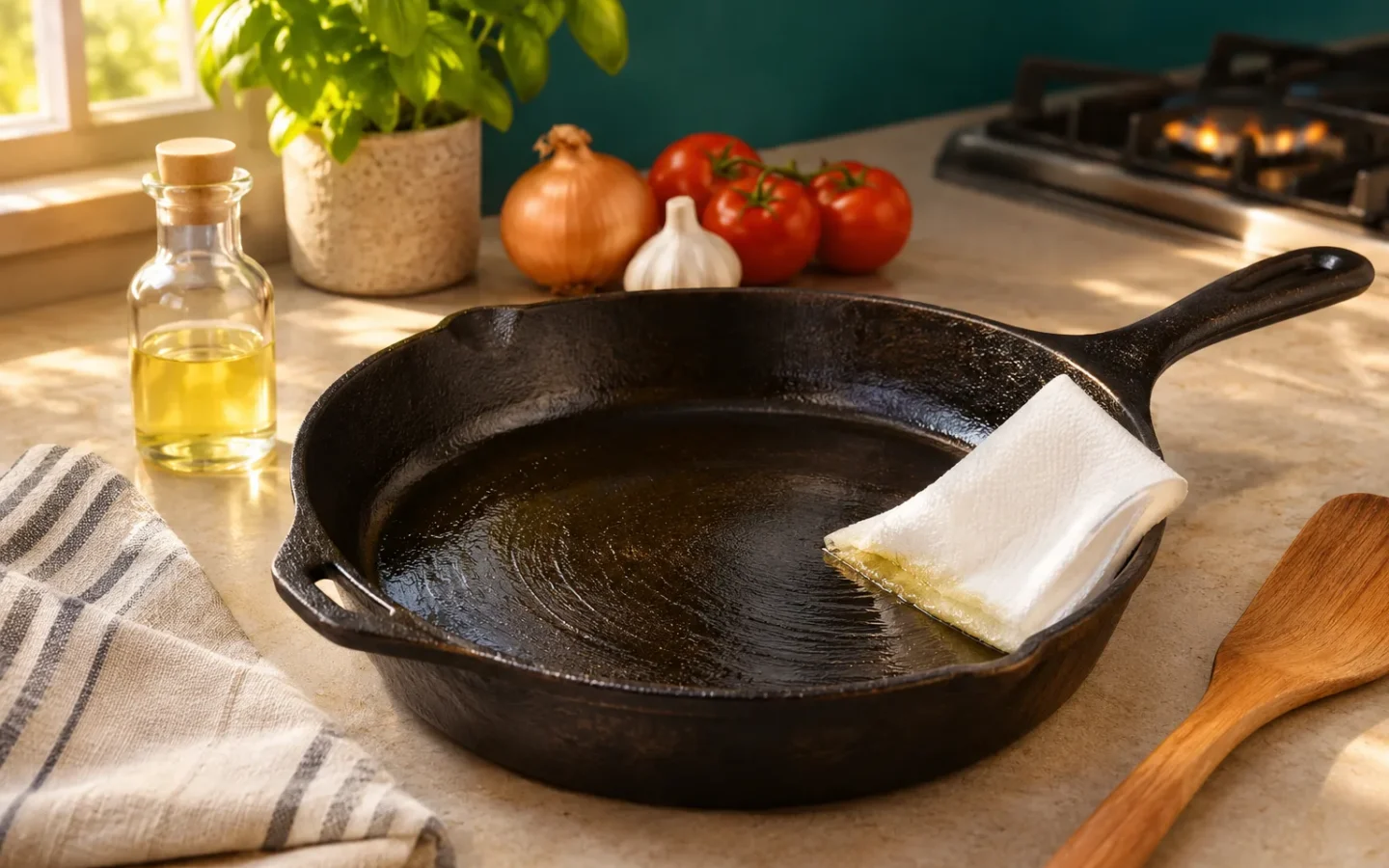
After the pan is dry and still slightly warm, wipe on a few drops of cooking oil with a cloth or paper towel, then wipe almost all of it back off. The surface should look satiny, not wet. If your towel leaves obvious streaks of oil, keep wiping. Heat the pan briefly so the film can set, then cool and store it.
You do not need to do a full oven seasoning after every meal. Daily cooking already deposits fat and heat. The thin wipe is there to replace oil you washed off and to keep bare spots from sitting dry and exposed to humid air. If you cooked a fatty meal and the surface already looks even and dry, a wipe may be optional that night. If you cooked something watery or acidic, the wipe is worth doing.
Oil that is applied and left thick will go rancid or sticky in a closed cabinet. That smell and tack are signs of leftover oil, not of a pan that “needs more seasoning.” Remove the gummy layer with a scrub and hot water, dry thoroughly, and start again with a thinner film.
Occasional oven seasoning is optional reinforcement
If the cooking surface is dull, patchy, and starting to grab food even when preheated with fat, a deliberate seasoning cycle can help. Wash and dry the pan completely. Apply a very thin coat of oil to the cooking floor, the walls, and the exterior if those areas are also dry or rusty, then wipe the surplus away. Place the skillet upside down in a hot oven, with a sheet of foil on a lower rack to catch any drip, and hold it at a temperature high enough for the oil to smoke and dry. Let the pan cool in the oven before you judge the result.
One thin cycle is better than one long, oily cycle. You can repeat a thin coat after the pan cools if the surface still looks starved. Because the handle of a one-piece iron skillet becomes fully hot in the oven, plan a dry, two-handed removal with a proper mitt. Do not grab the handle with a damp towel.
Stovetop seasoning is a smaller version of the same idea: a thin film, moderate heat, and enough time for the oil to stop looking wet. It is convenient for a single pan and a single side, and it is easier to overheat an empty pan on a burner than in an oven. Stay with the pan, and do not leave an empty skillet over a high induction boost or a large gas flame unattended.
Rust is a moisture problem you can usually reverse
Orange or brown dust on the floor or rim is iron oxide, not a failed brand of skillet. It forms when moisture sits on iron that is not fully protected by a dry oil film. A lid stored tight on a barely dried pan, a pot rack in a steamy kitchen, or a wet stack of skillets will produce it. Light rust is a cleaning job, not a reason to discard the pan.
Scrub the rust off with a brush, coarse salt, or a chain-mail scrubber until you are back to a stable, dark or raw-metal surface and the orange dust is gone. Wash, dry over heat until no moisture remains, and apply a thin oil film. If the bare metal is showing, follow with a proper seasoning cycle so the exposed iron is not left raw. Deep pitting from long neglect may leave a rough floor, but the pan can still cook if the structure is sound.
Preventing rust is easier than removing it. Never put a damp skillet away. If you stack pans, place a dry cloth or paper towel between surfaces so condensation has a place to go. If you cook in a humid climate, the post-wash burner-drying step matters more, not less.
Acid, heat shock, and the dishwasher are the usual failures
A well-established seasoning can handle a tomato sauce or a wine deglaze for a normal cooking time. Problems appear when a young or thin film sits in contact with a long, wet, acidic simmer, or when leftovers are stored in the pan overnight. The acid and the moisture both work on the film and on any exposed iron. Cook the sauce, serve it, and clean the skillet. Use a separate container for storage.
Heat should rise gradually. Cast iron is a large thermal mass. A high flame under a cold pan, or an induction boost on a dry empty floor, creates a hot center and a cooler rim. That stress is one path to warping or, with a sudden cold quench, to cracking. Preheat over medium or medium-low until the floor is evenly hot, then add fat and food. You rarely need the burner at its maximum setting once the pan is up to temperature, because the iron holds heat.
Metal spatulas are appropriate on bare iron. They will not peel a polymer film the way they scrape a PTFE coating. If a metal tool leaves a bright mark, that is often a thin smear of metal or a scuff in the oil film, and it usually blends back in with cooking. What you should avoid is cutting repeatedly on the floor with a sharp knife, which is a job for a board, and dropping the pan on a hard surface, which can crack iron.
The dishwasher remains the fastest way to ruin a pre-seasoned skillet. Prolonged soaking is a close second. Abrasive oven cleaner or a rust-removal bath will strip seasoning on purpose; use those only when you have already decided to rebuild the surface. Everyday cleaning does not need them.
Store the pan so it can stay dry
After oiling, let the pan cool, then store it in a dry cabinet or on a hook. If a lid belongs with the skillet, do not lock a cold, tight lid onto a pan that is still warm and slightly moist from residual steam. A paper towel between lid and rim gives leftover moisture a path out. The same idea applies when nesting several skillets.
Cast iron can live in the oven if that is your only space, but remember that the entire pan, handle included, will be hot whenever the oven is on. Do not store anything on the handle that would tempt a bare-handed grab. A hanging pan needs a hook that can carry the weight and a path so the rim is not knocked against a hard edge.
Multiple sizes need the same routine
If you keep more than one skillet, the care does not change with diameter. Each piece still has to be cleaned, fully dried, and put away without trapped moisture. A set of 8-inch, 10.25-inch, and 12-inch pre-seasoned skillets can cover a single egg, an everyday sauté, and a crowded family sear, but it also triples the drying work after a day when all three were used. The 12-inch pan in particular needs a burner that can heat its floor; a small element will leave a hot center and a cooler perimeter, which is harder on both food and seasoning.

Lodge Pre-Seasoned Cast Iron Skillet 3-Piece Set: 8, 10.25 & 12 inch
Certain content that appears on this site comes from Amazon. This content is provided “as is” and is subject to change or removal at any time.
Why we picked it
- The 8, 10.25, and 12-inch skillets share one care routine and one material
- Pre-seasoned vegetable-oil film arrives ready to use and improves with cooking
- Same one-piece iron construction moves from burner to oven, grill, or campfire
Reported drawbacks
- Three pans multiply drying and storage work; a damp stack rusts faster than a single skillet
- The 12-inch pan is heavy and needs a burner wide enough to heat its floor
- Factory seasoning is still a starting film and can be left sticky or rusted by poor drying
Choose extra sizes only when the meals actually require them. An 8-inch pan is handy for a small job and heats faster than a large one. A 12-inch pan is useful only if you can lift it when it is full, wash it in your sink, and heat it evenly. A single 10.25-inch skillet remains a sensible starting point, and it is the piece whose seasoning you will learn first. If you are still deciding which other pans belong beside it, start from the meals you cook.
Frequently asked questions
Do you need to season a pre-seasoned cast iron skillet?
No. A pre-seasoned skillet is sold ready to use. Wash it by hand, dry it completely, and start with meals that use some fat, such as sautéed vegetables, a grilled cheese, bacon, or a seared cutlet. Stripping and re-seasoning on arrival throws away a usable factory layer.
Can you wash cast iron with soap?
Yes. A small amount of mild dish soap will not dissolve a well-bonded seasoning layer. Avoid long soaks and the dishwasher, then dry the pan completely.
Why is my cast iron sticky after seasoning?
Usually too much oil, too little heat, or both. Next time, wipe the oil off until the pan looks almost dry and give the heat more time.
Why does my cast iron rust after washing?
Moisture left in a pore or along the rim starts rust. Finish drying on a low burner until every bead of moisture is gone, then wipe on a very thin film of oil. Light rust is a cleaning job: scrub it off, dry, and oil thinly.
Restore more often than you replace
A sticky pan, a rusty pan, or a pan with a dull, grabbing floor is usually restorable. Scrub to a stable surface, dry over heat, and rebuild thin layers of seasoning. Replacement is for structural failure: a crack through the floor or wall, a broken handle on a one-piece pan that cannot be made safe, or a warp so severe that the pan no longer sits stable on the burner. Cosmetic mottling and a few dark blotches are not structural failure.
Keep the care consistent rather than intense. Wash soon after cooking, dry completely, oil thinly when the surface needs it, and keep the pan out of standing water. The factory pre-seasoning is a head start. The film that makes the skillet pleasant to use years later is the one you maintain in small steps after ordinary meals.