
As an Amazon Associate I earn from qualifying purchases. CookwareCompass is a participant in the Amazon Services LLC Associates Program, an affiliate advertising program designed to provide a means for sites to earn advertising fees by advertising and linking to Amazon.com.
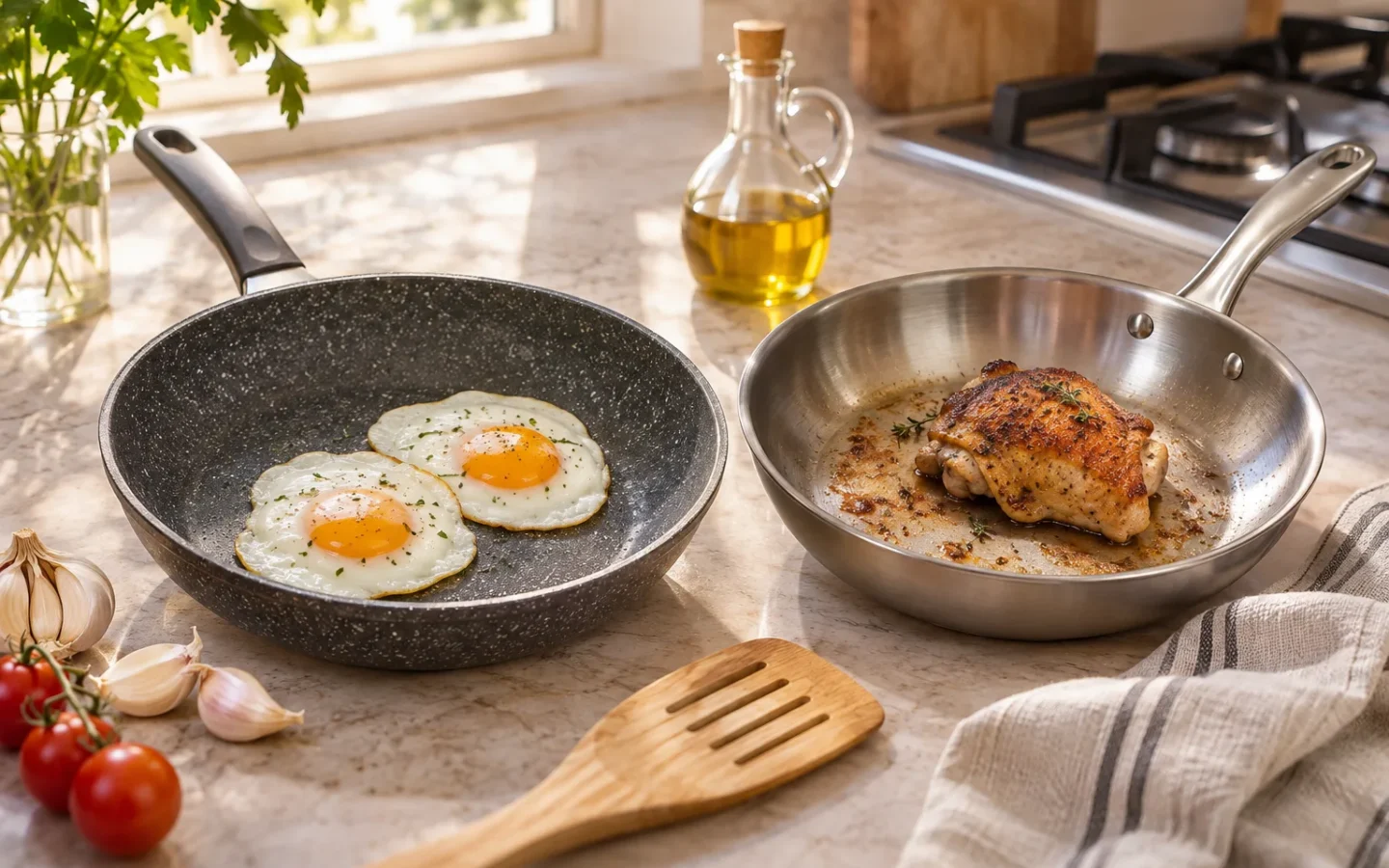
The nonstick vs. stainless skillet question is usually framed as healthy versus toxic, or cheap versus forever. Neither framing helps you buy the right first pan. The useful question is mechanical: when food touches hot metal, do you want it to release on its own, or do you want it to stick briefly, brown, and leave flavor behind? Nonstick is built for the first job and stainless is built for the second, and the pan you should buy first is the one that matches the food you cook most often.

CAROTE Nonstick Frying Pan, 8 Inch Classic Granite Skillet
Certain content that appears on this site comes from Amazon. This content is provided “as is” and is subject to change or removal at any time.
Why we picked it
- Listed as compatible with all cooktops, including induction, through a stainless steel base
- Compact 8-inch size suits eggs and single portions
- Maker describes the granite-style nonstick coating as PFOA and PFOS free
Reported drawbacks
- Small floor area gets crowded beyond two eggs
- Listing gives a 482°F maximum temperature and warns against dry heating
- Like any coated pan, the surface wears over time and the pan will need replacing
Sticking is a chemistry problem before it is a skill problem
Protein sticks to bare metal because it bonds with the surface as it heats. An egg white or a fish fillet starts out wet and soft, and as its proteins set they grip microscopic irregularities in the pan floor. On stainless steel, that grip loosens only after the contact layer has dried and browned enough to let go. That is why a properly heated stainless pan can release a chicken thigh after a few minutes but will tear a delicate fillet that you try to move too early.
A nonstick coating changes the surface instead of asking you to manage timing. The coating gives food very little to grab, so eggs, pancakes, crepes, and flaky fish release at temperatures where they would bond hard to bare steel. You are not buying a better cook; you are buying a wider margin of error for foods that never get a crust strong enough to free themselves.
Once you see sticking that way, the buying decision gets simpler. Ask which of your regular meals depend on release and which depend on browning. Most kitchens have both, which is why the honest long-term answer is often one of each. The first-pan question is about which job comes up more in your week.
Buy nonstick first if your week is eggs, fish, and quick low-heat cooking
Nonstick earns its place when the food is fragile, the heat is moderate, and cleanup speed matters. If breakfast is your most frequent pan meal, nonstick is the right first purchase. The same is true if you cook for one or two people, use little fat, or reheat leftovers that tend to scorch onto bare metal.
- Eggs in every form. Scrambled, fried, omelets, and frittatas all release cleanly with a small amount of butter or oil.
- Delicate fish. Thin fillets such as sole or tilapia can be turned without tearing.
- Batters. Pancakes, crepes, and fritters release without a heavy film of fat.
- Sticky sauces and cheese. Quesadillas, glazes, and anything with sugar are easier to clean off a coated surface.
Size matters more than most buyers expect. An 8-inch nonstick pan, like the CAROTE skillet above, is an egg and single-portion pan. Its usable floor is noticeably smaller than its rim measurement, which is the point of our guide to pan diameter versus cooking surface. Two eggs fit comfortably; four eggs crowd it. If you routinely cook for three or more, a 10-inch or larger nonstick pan is a better first choice, and the small pan becomes a second purchase.
Read the listing before you assume anything about the coating. The CAROTE pan is described by its maker as a “granite” nonstick that is PFOA and PFOS free, with an aluminum body and a stainless steel base for induction. “Granite” describes the speckled look rather than a slab of stone, and the listing does not spell out the full coating chemistry. That is common across the category, so judge any coated pan by its stated heat limit, its care instructions, and its warranty terms rather than by the marketing name of the finish.
Buy stainless first if you sear, deglaze, and cook at high heat
Stainless steel does the opposite job well. When meat or vegetables stick briefly and then release, they leave browned residue on the pan floor called fond. A splash of wine, stock, or water dissolves that fond into a pan sauce. Nonstick makes fond weak or absent by design, so a cook who makes pan sauces will feel the difference immediately.
Stainless also tolerates the kinds of heat and handling that wear down coatings. You can preheat it empty, sear at high heat, move it into a hot oven if the handle allows, scrape it with a metal spatula, and scrub it with an abrasive cleanser. None of that shortens its working life in a meaningful way. A clad stainless skillet bought today can still be in service decades from now, while a coated pan is a consumable on a much shorter clock.
The trade is a learning curve. Stainless needs proper preheating, enough fat, dry food, and patience before the first flip. If those habits sound like a chore rather than a skill you want, buying stainless first can make cooking feel harder than it is. If you already know you want to sear steaks, brown chicken thighs, and build sauces, stainless is the better first pan, and our guide to reading stainless cookware specs will help you avoid paying for marketing instead of construction.
Heat limits decide more than the coating name does
Every nonstick pan comes with a temperature ceiling, and that ceiling shapes how you can use it. The CAROTE listing gives a maximum temperature of 482°F and a care instruction to avoid dry heating. That number is a coating-and-handle limit, not a cooking target. Medium heat is the normal working range for a coated pan, and an empty coated pan on a high burner can climb past its limit quickly because there is no food to absorb the energy.
Stainless has no coating to protect, so its practical limit is usually the handle, the lid, or the oven rather than the cooking surface. That difference matters if you like to start a dish on the stove and finish it under high heat. As we explain in oven-safe versus broiler-safe cookware, the weakest part sets the limit. A coated pan with a plastic-type handle is a stovetop pan first. A stainless pan with a steel handle is usually the only one of the two you should consider putting near a broiler.
Practical rules for a coated pan:
- Add fat or food before the pan gets hot. A thin film of oil gives you a visual cue, since it shimmers well before the pan reaches dangerous territory.
- Stay at low to medium heat. Coated pans release food at moderate temperatures, so high heat rarely improves the result.
- Use the burner that fits the base. A small pan on a large gas flame lets heat wrap up the sides and the handle.
- Follow the maker’s oven guidance exactly. If the listing does not state an oven rating, treat the pan as stovetop-only.
Expect a nonstick pan to be replaced, and plan for it
A coated pan is not a lifetime purchase, no matter what the price. The coating wears with heat, utensils, abrasive cleaning, and dishwasher cycles. You will notice it gradually: eggs start to grab at the center, a spot looks dull or scratched, or you need more fat to get the same release. Those are signs the surface is changing, and once release is gone, the main reason to own the pan is gone with it.
How long that takes depends far more on use than on brand. A pan used gently a few times a week at medium heat with soft utensils can last several years. A pan that is preheated empty on high, cleaned with scouring pads, and run through the dishwasher can lose its release much sooner. The best way to stretch its life is boring: wooden or silicone tools, hand washing with a soft sponge, cooling before washing, and stacking with a pan protector or a towel between pans.
This is also why a modest first nonstick pan is a reasonable choice. Paying more for a coated pan can buy a thicker body, a better handle, or a stronger warranty, but it does not turn the coating into a permanent surface. Spend on the body and the warranty if you want, but budget for replacement either way.
Match the pan body to your stove, not just the surface
The surface decides release; the body decides heat. Most nonstick pans have an aluminum body, which heats fast and spreads heat well for its weight. Aluminum alone is not magnetic, so induction compatibility depends on a steel plate bonded to the base. The CAROTE listing describes a stainless steel base and states compatibility with all cooktops, including induction. Many coated pans do not have that plate, so induction cooks should check this line before anything else.
Stainless skillets come in two broad builds. A disc-bottom pan has a conductive plate under the floor, and a fully clad pan has aluminum or copper running through the base and up the walls. For a skillet that sears and builds fond, even heat across the floor matters most. If you want to go deeper, our comparison of disc bottom versus fully clad cookware explains where each build makes sense.
Weight is part of the decision too. A light aluminum nonstick pan is easy to lift and tilt with one hand, which suits omelets and quick flips. A clad stainless skillet is heavier and holds heat better when cold food hits the floor. Neither is better in general; each one fits a different kind of motion. If tossing food is part of how you cook, that also connects to wall shape, which we cover in sauté pan versus skillet.
When a larger coated pan makes more sense than a small one
If you cook for a family, or you want one coated pan that handles omelets and a skillet dinner, a 10-inch nonstick pan is the more flexible first purchase. The Tramontina Professional 10-inch pan is a useful example of how a different build changes the trade-offs. Its listing describes a heavy-gauge aluminum body, a reinforced PFOA-free nonstick coating, NSF certification, and a removable silicone sleeve over the handle.

Tramontina Professional 10-Inch Non Stick Frying Pan
Certain content that appears on this site comes from Amazon. This content is provided “as is” and is subject to change or removal at any time.
Why we picked it
- Heavy-gauge aluminum body with a reinforced PFOA-free nonstick coating, per the listing
- Listed as oven-safe to 400°F with a removable silicone handle sleeve
- NSF-certified and backed by a lifetime warranty, according to the maker
Reported drawbacks
- Not compatible with induction cooktops
- 400°F oven limit rules out broiling
- Coated surface wears over time even with careful use
Read its limits as carefully as its strengths. The maker lists it as oven-safe to 400°F, which is a moderate oven rating that suits finishing a frittata but not broiling. It is listed for gas, electric, and ceramic glass cooktops but not induction, so it is the wrong pan for an induction kitchen no matter how well it releases. It is also listed as dishwasher-safe, though hand washing is still the gentler choice for any coated surface over the long run.
Use the coating claims as a starting point, not a verdict
Coated cookware listings lean on phrases like PFOA free, non-toxic, healthy, or eco-friendly. Some of those statements are specific and useful. PFOA free, for example, tells you a particular processing chemical was not used. Others are broad marketing words that do not describe a measurable property. When you compare pans, separate the specific claims from the general ones and give weight only to the specific ones.
The safety habits that matter most are the same for nearly every coated pan: do not overheat it empty, ventilate your kitchen, and replace the pan when the coating is visibly damaged or flaking. Stainless avoids the coating question altogether, which is one reason some buyers choose it first. If that peace of mind matters to you more than easy release, it is a legitimate reason to start with stainless and learn the technique.
Make stainless easier before you decide it is too hard
Many people who think they hate stainless are fighting a few fixable habits. Preheat the empty pan over medium heat for a couple of minutes, then add oil and let it shimmer. Pat food dry, because surface water lowers the pan temperature and slows browning. Do not crowd the pan, and wait for the food to release before you try to move it. If it resists, it usually needs more time rather than more force. And if a well-used pan shows rainbow tint and white spots on stainless, those marks are usually cosmetic and clean off with a mild acid.
Eggs on stainless are possible, but they demand a well-heated pan and a generous amount of fat. That is exactly the kind of daily friction that pushes many cooks to keep a small nonstick pan for breakfast even after they love their stainless skillet. Owning both is not a failure of technique; it is assigning each pan the work it handles best.
A simple decision path for your first skillet
If you want a quick answer, work through these questions in order:
- What do you cook most often in a skillet? Eggs, pancakes, and fish point to nonstick. Steaks, chicken, chops, and pan sauces point to stainless.
- How hot do you like to cook? If you regularly use high heat or finish dishes in a hot oven, start with stainless.
- How do you clean? If everything goes in the dishwasher and gets scrubbed hard, stainless will hold up and a coating will not.
- What stove do you have? On induction, confirm a magnetic base before you compare anything else.
- How many people do you cook for? An 8-inch pan is a one-to-two-person pan. Choose a 10- or 12-inch skillet if you cook for more.
Most kitchens end up with two skillets: a small coated pan for release-dependent foods, and a larger stainless pan for browning and sauces. If you are building that pair over time, our guide to building a small cookware set around meals shows how to add pieces in the order your cooking actually needs them. If you are drawn to cast iron instead, a pre-seasoned skillet needs only a short routine to stay ready.
Frequently asked questions
Is stainless steel better than nonstick?
It depends on the food. Nonstick suits eggs, fish, and quick low-heat cooking; stainless suits searing, deglazing, high heat, and finishing in the oven. Buy first for the food you cook most often. Many kitchens end up with one of each.
Can you use stainless steel on high heat?
Yes. Stainless has no coating to protect, so you can preheat it empty and sear at high heat. Its practical limit is usually the handle, the lid, or the oven rather than the cooking surface. A nonstick pan, by contrast, should not be heated empty.
How long does a nonstick pan last?
A coated pan is a consumable, and how long it lasts depends far more on use than on brand. Used gently a few times a week at medium heat with soft utensils, it can last several years. Replace it when the coating is visibly damaged or flaking.
Why does food stick to stainless steel?
As proteins set, they grip the pan floor, and they let go only after the contact layer dries and browns. Preheat the empty pan, add oil, pat food dry, avoid crowding, and wait for the food to release before moving it.
The bottom line: buy for the food that has to let go
Nonstick and stainless are not rivals so much as tools for opposite physics. A coated pan prevents a bond from forming, which is ideal for eggs, batters, and delicate fish at moderate heat. A stainless pan lets a bond form and break, which is ideal for searing, browning, and sauces at higher heat. Pick your first skillet by the meals you make most, respect the coating’s heat limit if you choose nonstick, and accept that the coated pan will someday be replaced while the stainless one keeps working.
If breakfast and quick weeknight meals dominate your stove, start with a small nonstick pan and treat it gently. If you already know you want crust and fond, start with stainless and give yourself a week to learn the preheat. Either way, the right first pan is the one that removes friction from the cooking you actually do.