
As an Amazon Associate I earn from qualifying purchases. CookwareCompass is a participant in the Amazon Services LLC Associates Program, an affiliate advertising program designed to provide a means for sites to earn advertising fees by advertising and linking to Amazon.com.
A boxed cookware set is organized around manufacturing and shelf appeal: matching finishes, nested sizes, and a large piece count. A useful home set is organized around meals. It gives each recurring cooking job an appropriate shape without buying three vessels that solve the same problem. Start with what happens on your stove during an ordinary week, then add the smallest number of pans that cover those actions.

Cuisinart MultiClad Pro 12-Piece Stainless Cookware Set
Certain content that appears on this site comes from Amazon. This content is provided “as is” and is subject to change or removal at any time.
Why we picked it
- Core saucepan, sauté pan, stockpot, and skillet roles are represented
- Tri-ply stainless construction keeps the durable pieces consistent
- Steamer insert adds a function without another burner footprint
Reported drawbacks
- Twelve-piece count includes lids and the steamer insert
- Matched construction cannot optimize every cooking task
- Full bundle demands more storage than a role-by-role starter kit
Audit meals before materials
For two weeks, note what you cook and which vessel you reach for. Record portion count and technique: boil, sear, shallow fry, simmer, braise, steam, or finish in the oven. Repeated actions reveal the core set. Aspirational dishes cooked once a year belong in a later purchase or a borrowed pan.
Also note conflicts. If rice simmers while sauce cooks, those jobs need separate vessels even if one saucepan could perform both in isolation. If every meal uses only one burner, a large matched collection will not change that workflow.
Piece counts hide lids and fillers
A ten-piece set may contain five vessels and five lids. Some include utensils, steam inserts, or a tiny saucepan to increase the number. Count cooking vessels, then ask what each one does that the others cannot. A second skillet one inch smaller rarely doubles capability.
Matching lids can be valuable if one lid fits multiple pans, but confirm the actual interchangeability. A nominal ten-inch lid may fit the sauté pan and not the flared skillet. Shared parts save space only when the rims match.
Build around four core roles
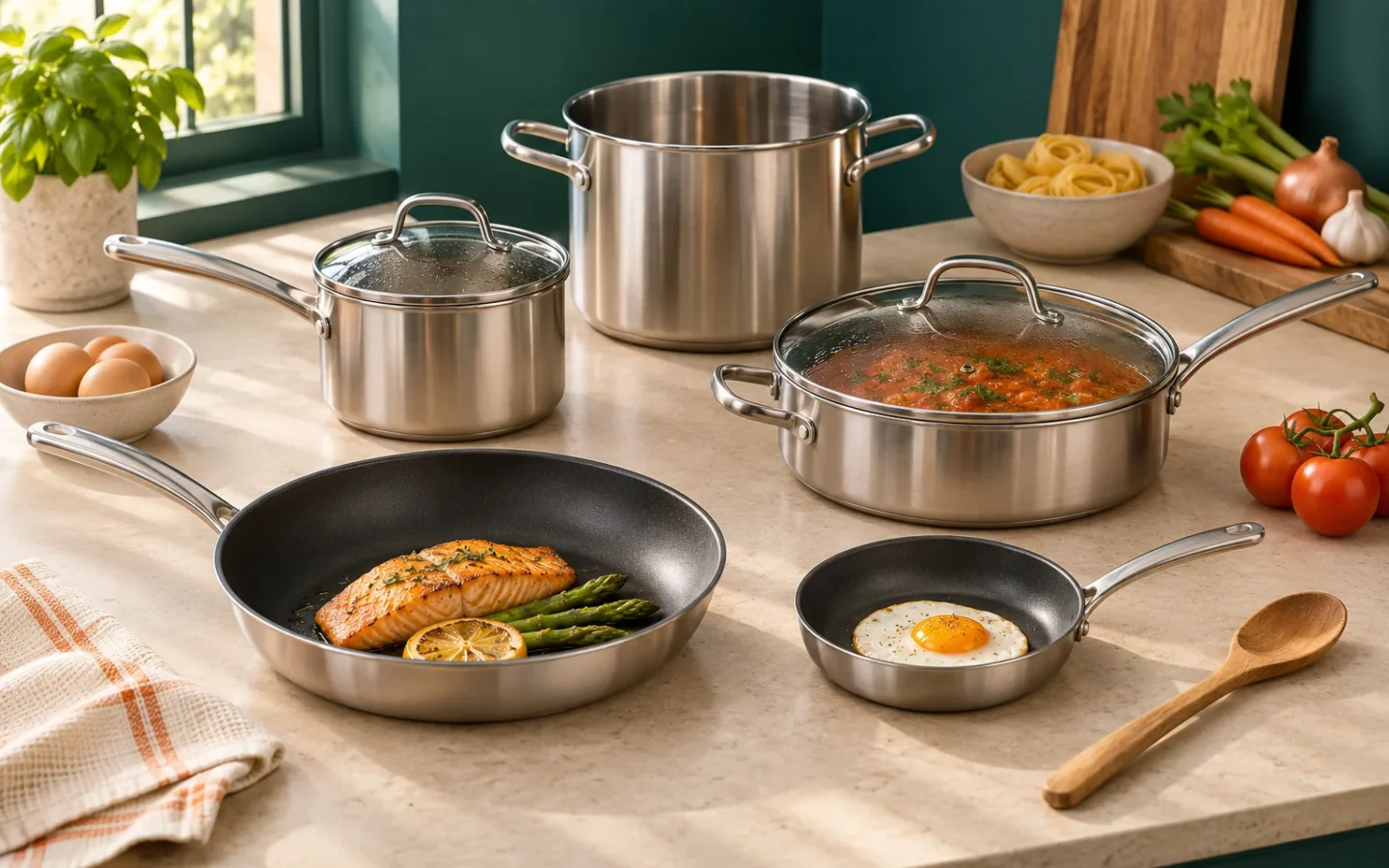
Most small households can cover daily cooking with a skillet, saucepan, deeper covered pan, and stockpot. The exact sizes depend on portions and burner dimensions, but the roles remain distinct.
- Open skillet: browning, eggs, cutlets, fish, toasted sandwiches, and quick vegetables.
- Medium saucepan: rice, grains, reheating, small soups, sauces, and boiled eggs.
- Covered sauté pan or Dutch oven: one-pan dinners, shallow frying, braises, curries, and larger sauces.
- Six- to eight-quart stockpot: pasta, blanching, soup batches, and stock.
A dedicated small nonstick pan can be a fifth tool for eggs or delicate fish. Keeping that role narrow lets you avoid exposing its coating to high-heat searing, metal utensils, and oven jobs better handled by uncoated cookware.
Choose material one vessel at a time
Uniform material is aesthetically tidy and functionally unnecessary. Stainless clad construction suits a general-purpose skillet or sauté pan because it tolerates browning, acidic sauce, and oven finishing. A heavy disc base can be excellent on a stockpot. Enameled cast iron retains heat for braises but is burdensome for boiling pasta. Nonstick earns a place where easy release matters more than a hard sear.
Buying individually also lets you place weight where it helps. A substantial skillet resists temperature drop when food is added. A lighter saucepan responds quickly and pours more comfortably. A stockpot should not carry heavy cladding to its rim unless your cooking actually uses those walls. If an uncoated cast iron skillet is on your list, size, weight, and handle matter more than the brand.
Size from portions and burner zones
Measure the flat cooking floor, not only the top rim. A ten-inch skillet can have less than eight inches of usable floor, which may be enough for two servings and crowded for four. Match the exterior base to a burner that can heat it evenly. A broad pan on a small element creates a hot center and cool perimeter.
For saucepans and stockpots, work with usable capacity rather than brim capacity. Leave at least one-quarter empty for stirring and more for foamy foods. The largest vessel must fit the sink, cabinet, dishwasher, and oven if you plan to use it there.
Map simultaneous cooking
Imagine three common dinners from start to finish. Pasta with tomato sauce may need a stockpot and sauté pan at the same time. Rice bowls may use a saucepan while vegetables cook in a skillet. A braise may occupy the deep pan while a saucepan handles a side.
This exercise reveals duplicate needs more accurately than a generic checklist. A household that meal-preps grains might need two saucepans. One that cooks sheet-pan dinners may need only one. Add the duplicate after the conflict appears, not before.
Handles, lids, and storage are part of the set
Hold each pan with realistic weight inside. Long handles should clear adjacent burners, and side handles should accept oven mitts. A helper grip becomes important on wide pans holding liquid. Check that lids have stable handles and a sensible storage position.
Nesting can save space but may scratch coatings or trap handles at awkward angles. Use protectors between surfaces and confirm the stack is easy to retrieve. A low cabinet favors nested skillets; a narrow vertical rack favors lids and sheet pans. Buy for the storage you own.
Spend where failure would be expensive
Prioritize flatness, secure handles, even base coverage, comfortable balance, and a warranty with reachable service. A stockpot used for water does not need a luxury wall. A skillet used nightly benefits from better construction and ergonomics. A nonstick pan is a wear item; paying collector prices does not make its coating permanent.
Replacement parts extend life. Check whether lids, knobs, handles, and inserts are sold separately. A familiar brand name is less useful than a parts page that still supports models after several years.
What not to buy at the start
- A very small saucepan unless you regularly make small sauces or single servings.
- Two nearly identical skillets just because both are included.
- A giant stockpot sized for rare entertaining rather than normal cooking.
- A full set of nonstick cookware when only eggs and delicate fish need the coating.
- Specialty shapes before a recurring recipe proves that a core pan is genuinely inadequate.
Add one piece only when a gap is clear
Cook with the core set for a month. When a pan repeatedly forces overcrowding, an unsafe transfer, or an awkward sequence, write down the missing capability. “Need a wider floor for four cutlets” is actionable. “Need more cookware” is not.
A small mixed set may not photograph like a showroom collection, but every piece earns its shelf space. That is the better definition of a set: not matching metal, but a group of tools whose jobs fit together.
Three households, three sensible variations
A solo cook with one large burner might choose an eight-inch nonstick pan, ten-inch stainless skillet, two-quart saucepan, and five-quart covered pot. A family of four may need a twelve-inch skillet, four-quart sauté pan, three-quart saucepan, and eight-quart stockpot. A household that cooks mostly soups and curries may replace the open skillet with an enameled Dutch oven.
None is a universal recommendation. The examples show how portion count and technique change the mix. Measure the cooking floors and capacities rather than copying nominal sizes, and remember that a wide twelve-inch pan is useful only if the cooktop can heat it and the sink can wash it.
Plan for different replacement cycles
Uncoated stainless, cast iron, and carbon steel can serve for decades if their structures remain sound. Nonstick coating is consumable, so the nonstick piece should be easy to replace without disturbing the rest of the set. Buying everything as one matched bundle makes the collection feel incomplete when one coated pan wears out.
Keep a record of model numbers, diameters, and lid fits. When a saucepan eventually needs replacement, you can look for a vessel that accepts the existing lid rather than discarding a useful part. A modular collection ages more gracefully than a set whose identity depends on every logo matching.
Budget by uses per week
Divide attention and budget according to frequency. A skillet used five nights a week deserves the most careful handle and heat-distribution decision. A stockpot used twice a month can be simpler while still safe and flat. The specialty pan used twice a year should wait until the core tools stop creating a genuine limitation.
This does not require buying the premium option. It means spending research time where poor fit would be felt repeatedly. Comfort, floor size, and burner match usually return more value than an extra decorative layer or another piece in the box.