
As an Amazon Associate I earn from qualifying purchases. CookwareCompass is a participant in the Amazon Services LLC Associates Program, an affiliate advertising program designed to provide a means for sites to earn advertising fees by advertising and linking to Amazon.com.
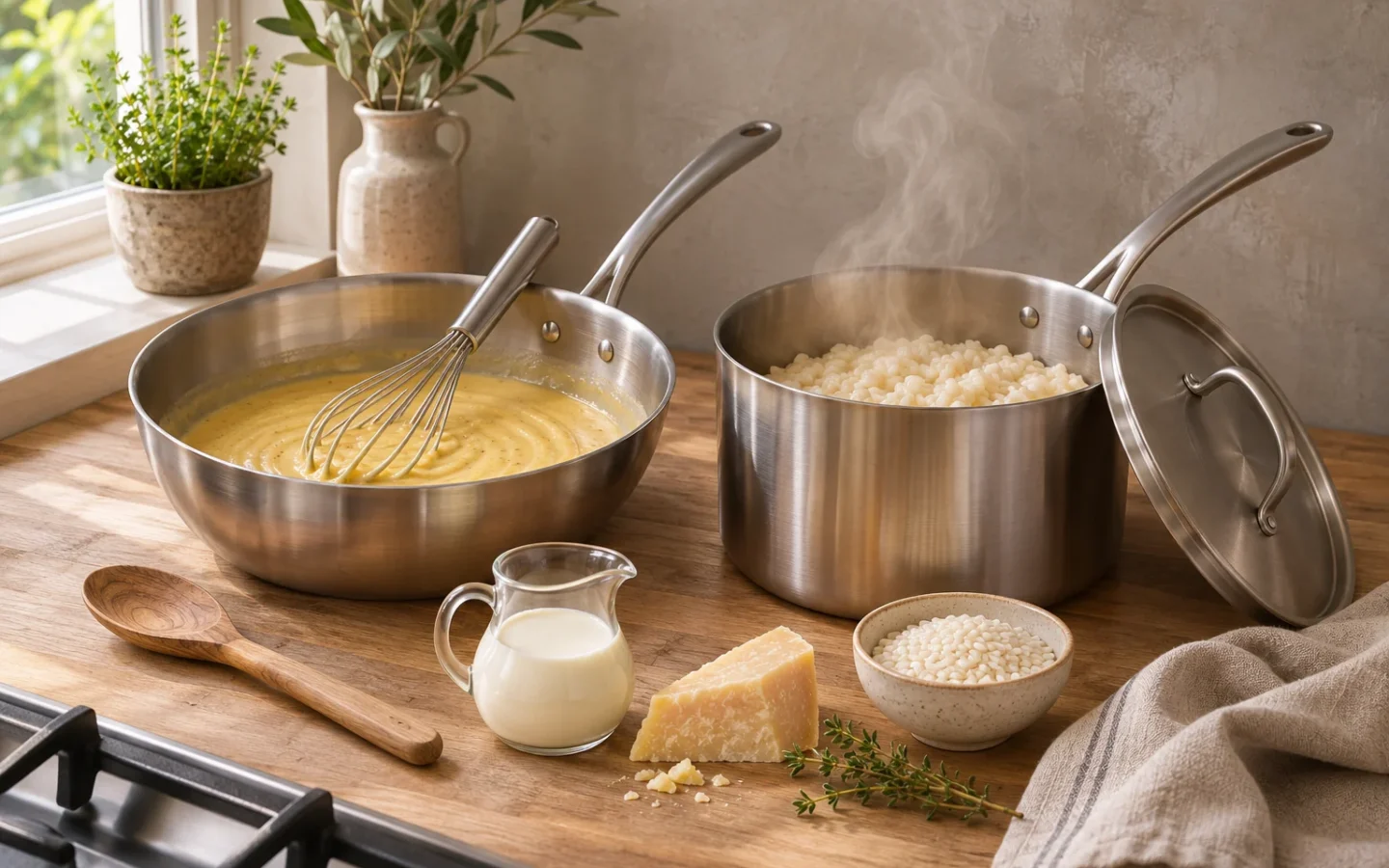
A saucier and a saucepan hold the same liquid and sit on the same burner, so they are easy to treat as one tool. The difference is the corner. A saucepan has straight walls that meet a flat floor at a near right angle; a saucier curves from the floor into the wall like a shallow bowl. That single change decides whether a whisk or spoon can reach everything in the pan, how fast liquid reduces, and how the pan behaves with rice, grains, and plain boiling. Choose by the way you stir, not by the name on the box.

Made In Cookware 3 Quart Stainless Steel Saucier Pan, 5 Ply Stainless Clad, Induction Compatible
Certain content that appears on this site comes from Amazon. This content is provided “as is” and is subject to change or removal at any time.
Why we picked it
- Rounded bottom lets a whisk or spatula reach the whole surface, which suits risotto, custards, and whisked sauces
- Listed as 5-ply stainless clad construction through the base and walls, with a 430 stainless layer for induction compatibility
- Includes a lid, has a long stay-cool handle fastened with stainless rivets, and is listed as made in the USA
Reported drawbacks
- Total diameter is listed at 10 inches while the flat cooking surface is 7 inches, so it can feel large on a standard cooktop
- Some owners report staining, water marks, or interior scratches after early use, which need the right stainless cleaner
- Uncoated stainless needs moderate heat and steady stirring; the wide mouth also evaporates liquid faster for covered grains
Look at the Corner First, Because That Is Where Food Gets Left Behind
Every pan has a place the stirring tool cannot reach well. In a straight-sided saucepan it is the seam where wall meets floor. A round whisk or a flat-ended spoon touches the floor and the wall, but not the inside of that right angle, so a thin ring of food sits there undisturbed while the rest keeps moving.
For water, stock, or pasta, that ring does not matter. For anything thickened with starch, egg, or dairy, it matters a lot. A pastry cream, a cheese sauce, polenta, a roux-based gravy, or a stirred custard sets first where the metal is hottest and the food moves least. In a saucepan, that is the corner. The result is the familiar pattern of lumps on the whisk, a scorched line around the base, and a sauce that tastes faintly toasted even when the middle looks fine.
A saucier removes the corner. Because the wall rises from the floor in a continuous curve, a balloon whisk or a silicone spatula can sweep the whole surface in one stroke. Nothing gets parked out of reach, so heat is shared by all of the food instead of punishing the part trapped in the seam. That is the main reason the shape exists, and it is the reason to buy one.
Know What Each Shape Does Better
Neither pan is an upgrade of the other. They are tuned for different movements, and most kitchens that cook sauces regularly end up wanting both.
- Saucier strengths: whisked sauces, custards and puddings, risotto, polenta, oatmeal, caramel, reductions, and anything you stir constantly. The wide mouth also speeds evaporation, which helps when you want a sauce to thicken.
- Saucepan strengths: boiling eggs or potatoes, cooking rice or other grains under a lid, heating stock, blanching vegetables, and holding a batch on low heat. Straight walls keep more volume in a smaller footprint and lose less liquid to evaporation.
- Overlap: both reheat soup, warm milk, and make a simple tomato sauce well. If that is most of what you cook, the shape matters less than the construction and the size.
If you already own a good straight-sided pan, the question is not which shape is better. It is whether you cook enough stirred, thickened food that the corner keeps costing you. If you are still shopping for that first everyday pot, our guide on how to choose a stainless clad saucepan covers size, ply, handle, and lid for the straight-sided version.
Understand Why Rounded Walls Change Evaporation and Volume
The curve that helps stirring also changes geometry. A saucier with the same rim diameter as a saucepan holds less near the bottom, because the curved walls take up the space the corners would have held. To reach the same capacity, a saucier usually has a wider mouth and a shallower body.
That trade has consequences you can predict:
- Faster reduction. More exposed surface means steam leaves faster. Reducing a pan sauce, a wine reduction, or a stock for glaze goes quicker in a saucier than in a tall saucepan with the same volume.
- Faster loss when you do not want it. Rice, grains, and long simmers that depend on a fixed amount of water can run dry sooner in a wide pan, especially without a tight lid.
- Small batches behave better. A cup of sauce pools in the rounded floor instead of spreading into a thin film across a flat base, so it is less likely to scorch.
- Large batches are harder. Filling a saucier close to the rim makes it awkward to whisk without splashing, because the walls flare outward instead of rising straight up.
The listed capacity of either pan is measured to the brim. For anything you plan to stir hard, use about half to two-thirds of the rated volume. In a 3-quart saucier, that is roughly six to eight cups of working space, which covers sauces and grains for a small household.
Separate the Rim Diameter From the Floor You Can Heat
The geometry gets tricky when you compare diameters. Sauciers are often sold by capacity, while the spec sheet lists a top diameter that can look generous. The floor that actually touches the burner is much smaller, because the walls start curving almost immediately.
The Made In 3-quart saucier is a clear example. Its listing gives a total diameter of 10 inches but a cooking surface diameter of 7 inches, with a depth of 3.5 inches. That 3-inch gap is the curve. It is also why a saucier can feel large on a cooktop while heating a fairly modest flat area. We cover this measurement problem in more detail in pan diameter vs. cooking surface, and it applies to sauciers more than to almost any other pan.
Two practical effects follow from it:
- Match the burner to the floor, not the rim. A flame or coil much wider than the flat base sends heat up the curved sides. On gas, that heat can climb past the food line and scorch whatever splashes there. On induction, the pan only heats where the magnetic base sits over the coil.
- Expect the rim to crowd neighbors. A 10-inch rim on a small pan can bump into the pot on the next burner, and some owners mention that the shape feels large for a standard cooktop. Check the spacing on your range before you assume it will fit beside a stockpot.
Insist on Cladding That Climbs the Walls
In a straight-sided saucepan, a thick disc on the bottom does most of the work, because the food sits mostly on the floor. In a saucier, much of the food is in contact with curved metal that rises from that floor. If the conductive layer stops at a disc, the curve becomes a thin, slow, uneven zone exactly where a whisked sauce spends its time.
That is why a saucier is a pan where fully clad construction earns its keep. When aluminum or copper runs from the base through the walls to the rim, the curve heats with the floor and sauces cook evenly as they move. Our comparison of disc bottom vs. fully clad cookware explains the physics; for sauciers, read the spec sheet and confirm the layers continue up the sides.
Ply count is a description, not a score. A tri-ply pan has one conductive core between two steel layers. A five-ply pan splits the core into more layers, often alternating aluminum grades or adding a thin stainless interlayer. More layers can add evenness and weight, but the thickness of the conductive metal matters more than the number of layers. If a listing gives total thickness, weight, or core material, compare those. Our guide on how to read stainless cookware specs walks through what each line on a spec sheet really tells you.
For induction, check the outer layer. Induction needs a magnetic exterior, usually a ferritic grade such as 430 stainless. The Made In listing names a 430 stainless layer for this purpose. If a pan’s listing is vague, a refrigerator magnet that grips firmly on the base is a quick test in the store.
Decide What Size Fits the Way You Actually Cook
Sauciers usually come in a narrower range than saucepans. Common sizes run from about 1.5 to 5 quarts, and the right one depends less on household size than on the job.
- 1.5 to 2 quarts: hollandaise, beurre blanc, caramel, chocolate, or a small custard. Easy to handle with one hand while you whisk with the other.
- 3 quarts: the general size. Risotto for two to four people, a batch of cheese sauce for pasta, polenta, oatmeal, or a pudding. This size is where the shape is most versatile.
- 4 to 5 quarts: large risotto, a big pot of polenta, or gravy for a holiday table. Heavier and harder to whisk with control, so it works best for cooks who already know they need the volume.
If you are building a small set around real meals, as we suggest in build a small cookware set, a 3-quart saucier and a 2- or 3-quart straight-sided saucepan cover nearly every small-pot job without overlap. The saucier handles anything you stir; the saucepan handles anything you cover and leave alone.
Check the Handle and the Balance When the Pan Is Full
A saucier is a pan you hold onto while you work. You whisk with one hand and steady the pan with the other, sometimes for twenty minutes of risotto. That makes the handle more important than on a pot you fill and walk away from.
Look at three things:
- Length and angle. A long handle keeps your hand away from the heat and gives leverage, but it also makes the pan longer than it looks. The Made In listing gives a length of 18.25 inches to the end of the handle, so measure your counter and drawer space as well as the cooktop.
- Fastening. Riveted handles are the norm on clad stainless and are the most durable option over decades of use, though the rivet heads sit inside the pan and collect a little residue. Our comparison of riveted, welded, and screwed handles covers what fails first.
- Weight distribution. A full 3-quart pan of sauce is heavy. The Made In 3-quart saucier is listed at 3.7 pounds empty. If you plan to pour from it often, a helper handle or a pouring rim makes that easier; if the pan has neither, practice the pour over the sink first.
“Stay-cool” handles are designed to slow heat transfer, usually through a hollow or narrowed section near the pan. They stay comfortable for most stovetop cooking, but they still get hot in the oven, under a broiler, or when a flame wraps around the side. Treat any metal handle as hot unless you have checked it.
Use a Lid When the Recipe Needs Moisture, Not by Habit
Many sauciers ship without a lid, because the pan is meant for open cooking where evaporation is the point. Some include one, and the Made In 3-quart listing includes a lid with the saucier. Either way, think about when you will actually cover it.
A lid is useful in a saucier for holding a finished sauce warm, for steaming a few vegetables, or for cooking grains when you want the pan’s even heat but not its fast evaporation. It is much less useful while whisking a sauce or stirring risotto, where moisture needs to escape. A well-fitting lid that sits flat without rocking is what matters; our guide on why pan lids rattle, spit, and stick explains what a poor fit is telling you.
Cook With the Shape Instead of Fighting It
A saucier rewards a slightly different technique than a saucepan. A few habits make the most of it:
- Choose the right tool. A balloon whisk or a flexible silicone spatula follows the curve. A flat-ended wooden spatula does not, so it gives up some of the shape’s advantage.
- Use medium heat and patience. Fully clad stainless spreads heat well, but it is still uncoated steel. Starches and dairy stick when the metal is too hot for the amount of liquid in the pan.
- Keep the food line below the curve’s top. Splashes that land on the upper wall, above the food, dry and brown quickly. Wipe them back down with the spatula as you stir.
- Reduce in the saucier, simmer in the saucepan. When you want liquid to disappear, use the wide pan. When you want it to stay put, use the tall one.
Risotto is the classic case. Stirred in a saucier, the grains roll along the curved wall instead of piling into a corner, so they release starch evenly and the bottom layer is less likely to glue itself to the floor. Polenta and grits behave the same way.
Expect Stainless to Stain, and Know What It Means
Any uncoated stainless saucier will show marks. Heat tint, rainbow discoloration, cloudy white spots from mineral deposits, and fine scratches from whisks are normal on clad stainless and do not affect cooking. Some owners of the Made In saucier report staining or water marks after the first uses and scratches on the interior; those are the same surface effects you see on most polished or brushed stainless.
Before you scrub, diagnose. A rainbow tint is a thin oxide layer from heat and responds to a mild acid or an oxalic-acid cleanser. White spots are usually minerals from hard water or starchy cooking water and come off with vinegar. Our guide to rainbow stains and white spots on stainless covers each mark and the right fix. Steel wool and harsh pads can leave more visible scratches than the stain itself.
Dishwashers are usually allowed for stainless clad pans, but detergent and heat dull the finish faster. Hand washing with a soft sponge keeps the interior easier to read, which matters in a pan where you want to see when a sauce starts to catch.
Know Where the Made In Saucier Fits
The Made In 3-quart saucier shown above is a fully clad, five-layer stainless pan with a rounded bottom, sold in 2-, 3-, and 5-quart sizes. Its listing describes the curved floor as a way to keep risotto from catching in the corners and to make whisking easier, which is exactly the job the shape is built for. It is listed as induction-compatible through its 430 stainless layer, made in the USA, with a stay-cool handle fastened by stainless rivets.
It fits best for cooks who already make stirred sauces, risotto, polenta, or custards often enough that a saucepan’s corners get in the way. It is a less obvious buy if most of your small-pot cooking is boiling, steaming, or rice under a lid; a straight-sided saucepan handles those jobs with less evaporation and a smaller footprint.
Before you buy, check the 10-inch rim against your burner spacing, measure the handle length against your storage, and accept that the interior will mark with use. Owner reports of stains after early use are common across uncoated stainless; they come off with the right cleaner, but they will come back.
Make the Final Call With Three Questions
If you are still deciding between the two shapes, answer these:
- Do you whisk or stir a thickened food at least once a week? If yes, the saucier’s missing corner will pay off. If no, a saucepan is simpler.
- Do you more often want liquid to leave or to stay? Reductions favor the wide saucier. Grains, beans, and long covered simmers favor the tall saucepan.
- What will the pan sit next to? A wide rim and long handle need space on the cooktop, in the drawer, and on the drying rack. Measure before you choose.
For most kitchens that cook regularly, the answer is not one or the other. A straight-sided saucepan handles the covered, set-and-leave jobs; a saucier takes over anything you would otherwise stand over, scraping the corners. Buy the second one when the first keeps leaving a ring of food you cannot reach.