
As an Amazon Associate I earn from qualifying purchases. CookwareCompass is a participant in the Amazon Services LLC Associates Program, an affiliate advertising program designed to provide a means for sites to earn advertising fees by advertising and linking to Amazon.com.
A steamer is the cheapest piece of cookware most kitchens are missing, and the easiest to buy wrong. The choice usually comes down to two designs: a dedicated steamer insert that nests in a matching pot, or a collapsible petal basket that opens inside whatever pot you already own. Neither is better in the abstract. The right one depends on the diameter and height of your pots, how much food you steam at once, and whether you want a single-purpose piece or a small tool that disappears into a drawer. Measure the pot first, then choose the steamer that fits it.

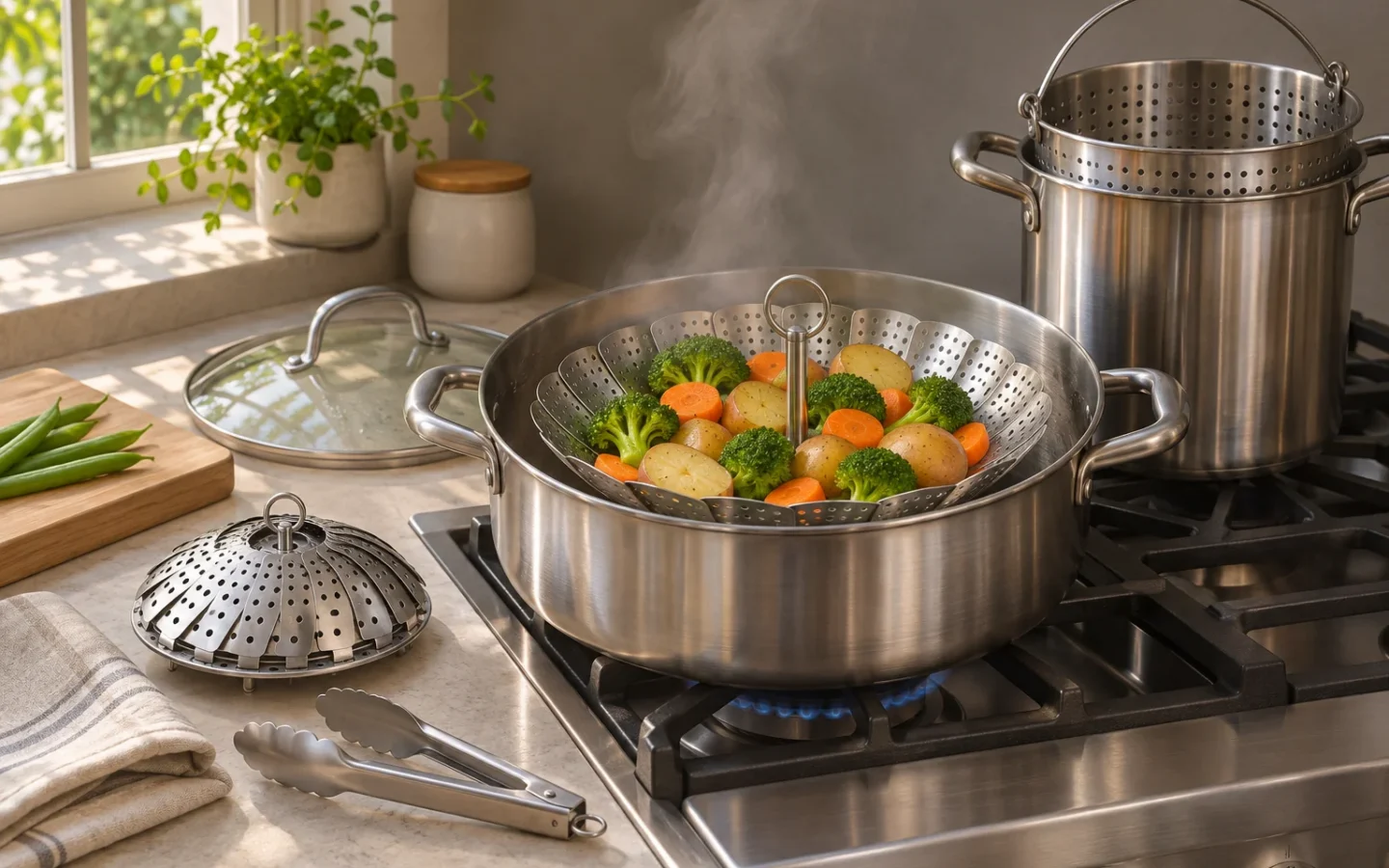
SAYFINE Vegetable Steamer Basket, 304 Stainless Steel, Extra Large, Folding Expandable, Fits 6.5 to 11 Inch Pots
Certain content that appears on this site comes from Amazon. This content is provided “as is” and is subject to change or removal at any time.
Why we picked it
- Listed as food-grade 304 stainless steel, a common corrosion-resistant grade for wet, everyday kitchen use
- Folds to about 6.5 inches and opens to about 11 inches, so one basket can work across several pot sizes and stores flat in a drawer
- Three legs hold food off the pot floor, and the removable 2.6-inch center post lifts the basket out or comes off for wider foods
Reported drawbacks
- Short fixed legs leave little room for water, so long steams need the level checked and topped up
- Shallow single-layer basket sized for a meal for two; larger batches need a second round or a deep insert
- Overlapping petals leave edge gaps for small pieces and spots where food and minerals collect; lift it hot with tongs or a towel
Steaming Is Simple Physics, and the Steamer Only Has Three Jobs
Steaming cooks food with water vapor instead of liquid water. A shallow layer of water boils below the food, the vapor rises, condenses on the cooler surface of the food, and releases its heat as it turns back into liquid. That condensation is why steaming is fast and gentle at the same time: the temperature at sea level stays close to the boiling point of water, but the heat transfer is efficient because vapor keeps condensing on whatever is coolest.
Seen that way, a steamer has only three jobs. It must hold the food above the water so it does not boil. It must let steam pass freely around and through the food. And it must fit the pot well enough that a lid can trap the vapor. Every difference between an insert and a collapsible basket is really a difference in how well each design handles those three jobs in your particular pot.
- Clearance: the distance between the water surface and the bottom of the food. Too little, and the bottom layer simmers instead of steams.
- Open area: holes, slots, or gaps that let vapor rise through the food rather than only around the edges.
- Fit: how closely the steamer matches the pot walls and how much room is left for a lid to seat.
A Steamer Insert Is Built for One Pot
A steamer insert is a deep, perforated basket with a rim that hangs on the top edge of a specific pot, or sits on a shoulder just inside it. Pasta pot sets and multi-piece stainless sets often include one. Because it is made for a known diameter, the insert can be deep, straight-walled, and perforated across the bottom and sometimes the sides, with a lid that fits the pot and the insert together.
That design solves clearance and fit almost automatically. The insert hangs at a fixed height, so the water underneath has room to boil without touching the food, and you can keep more water in the pot for long steams. The tall walls also let you load food in a deep layer, which matters when you steam a whole head of broccoli, a batch of dumplings on parchment, or tamales standing upright.
The catch is that the insert only fits the pot it was made for, or pots with exactly the same rim diameter. A 5-quart insert hung on a different 5-quart pot may sit too low, rock, or leave a gap where steam escapes. It is also a bulky, single-purpose item that needs cabinet space roughly equal to a second pot. If you already own a set that includes a matching insert, it is usually the best steamer you have. If you are shopping separately, an insert only makes sense when you are buying it with, or exactly for, the pot you will use most.
A Collapsible Basket Is Built for the Pots You Already Have
A collapsible basket, often called a petal or folding steamer, is a round stainless disc with a ring of overlapping perforated leaves around the edge. Short legs hold it above the pot floor. Pressed down into a pot, the leaves fold up against the walls; in a wider pot they spread open, so one basket covers a range of diameters. Many have a center post you use to lift the basket out.
Its strength is adaptability. One basket can work in a 3-quart saucepan on Tuesday and a wide 6-quart Dutch oven on Sunday, and it folds into a disc that fits in a drawer. For a small kitchen, or for anyone who steams vegetables a few times a week but does not want another pot, that flexibility usually wins.
The trade-offs follow from the same design. The legs are short, so clearance is fixed and small, which limits how much water you can use. The basket is shallow, so food sits in one or two layers. The leaves leave gaps at the edges where small pieces like peas or diced carrot can slip through. And the center post takes up space in the middle of the food, which matters when you want to steam a whole fish fillet or a wide piece of chicken. Some baskets let you remove the post for exactly that reason.
Measure Diameter, Height, and Lid Clearance Before You Choose
Most steamer mistakes are sizing mistakes, so take three measurements of the pot you plan to use. The same habit that helps when you choose a stockpot by diameter and height applies here: the number printed on a box rarely tells you what fits inside.
- Inside floor diameter: a collapsible basket’s folded size must be smaller than this, or the legs will not sit flat. Measure the floor, not the rim, because many pots flare outward. Our guide to pan diameter versus cooking surface explains why the two numbers differ.
- Inside diameter at the height where the basket will sit: this sets how far the leaves can open and how much food area you actually get.
- Interior height: add the water depth, the basket’s clearance, the height of the food, and room for the lid. A tall pile of vegetables in a short saucepan can keep the lid from seating.
For an insert, the test is even simpler: the rim of the insert must match the rim of the pot. If you cannot confirm that from the manufacturer’s listing, assume it will not fit perfectly.
The Lid Decides How Well Either Steamer Works
A steamer without a good lid is a pot of boiling water with vegetables nearby. The lid traps vapor so the temperature around the food stays high, and it keeps the water from boiling away as quickly. If the lid sits crooked on a mound of food or on the hooked rim of an insert, steam escapes through the gap, the food cooks unevenly, and the pot can boil dry faster than you expect.
With a collapsible basket, the usual problem is the center post or the food itself pushing against the lid. Lay food in an even layer, keep it below the rim of the pot, and check that the lid sits flat before you start timing. With an insert, the fit depends on whether the original lid was designed to sit on the insert or on the pot. If a lid rattles or spits, our explainer on why pan lids rattle, spit, and stick covers what the noise is telling you about pressure and fit.
Water Depth and Clearance Set the Limit on Long Steams
Most vegetables steam in a few minutes, but potatoes, whole artichokes, beets, and some dumplings need much longer. That is where the two designs separate most clearly.
A collapsible basket on short legs leaves only a shallow pool of water under the food. If you fill above the basket floor, the bottom layer boils and turns soggy. If you fill too little, the pot can run dry on a long steam. The practical answer is to keep the water just below the basket, check it partway through, and top it up with water that is already hot so the boil does not stall. Never let a pot boil dry with the lid on; an empty pan over a burner heats very quickly and can discolor stainless or damage the pot.
A hanging insert sits higher above the water, so you can start with more water and steam longer without refilling. If you regularly steam dense foods for twenty minutes or more, that extra reservoir is the most practical advantage an insert offers.
Load the Food for Steam Flow, Not for Volume
Both designs work best when steam can move through the food. A heaped pile of broccoli steams unevenly: the pieces touching the basket and the outside of the pile cook first, while the center stays raw. Cut food into similar sizes, spread it in a loose layer, and leave the outer gaps open so vapor can rise.
- Dense vegetables: cut potatoes, carrots, and squash into even pieces so they finish together. Put the densest pieces where the steam is strongest, usually at the center and bottom.
- Delicate vegetables: add spinach, peas, or snow peas on top of a sturdier layer near the end, or steam them separately for a minute or two.
- Fish and dumplings: a sheet of parchment with a few holes, or a few leaves of cabbage, keeps them from sticking to the metal and falling through gaps. Leave room around the edges so steam can still pass.
- Shrimp and shellfish: spread them in one layer and lift the lid only when you expect them to be done, because every peek dumps heat.
The basket’s capacity is the real limit here. A typical expanding basket comfortably handles vegetables for two to four people in one layer. If you regularly steam for a crowd, a deep insert or a second batch will serve you better than overloading a shallow basket.
Stainless Is the Default Material for a Reason
Most metal steamers, inserts and collapsible baskets alike, are stainless steel. Stainless tolerates constant moisture, does not react with acidic foods, and can go in a dishwasher. Grade 304 (often labeled 18/8) is the common food-contact grade and resists corrosion well in normal kitchen use. If a listing names the grade, that is useful information; if it only says “stainless,” you know less about how it will hold up.
Bamboo steamers are the other common choice. They sit on top of a wok or a pot of matching size, absorb some of the condensation so less water drips back onto the food, and stack in tiers for dumplings and buns. They need to dry fully between uses to avoid mold, and they only work on a pot or wok whose rim matches their diameter. Silicone collapsible steamers exist too; they are gentle on nonstick pots but are usually less rigid and can be harder to lift when full.
For a single steamer that works across ordinary stainless and aluminum pots, stainless steel remains the straightforward choice. If you also want a sense of how stainless performs and wears, our guide on how to read stainless cookware specs covers grades, finishes, and the claims worth questioning.
Use the Basket Without Damaging Nonstick or Burning Your Hands
A metal basket’s legs and edges can scratch a nonstick pot, especially if you twist the basket or drag it across the floor. If your only suitable pot is nonstick, set the basket down gently and lift it straight up, or use a silicone steamer in that pot instead. Stainless, enameled cast iron, and plain aluminum pots tolerate metal baskets much better.
The other risk is heat. The basket, the center post, and the escaping steam are all at roughly boiling temperature, and steam burns quickly. Open the lid away from you so the first rush of vapor goes toward the back of the stove. Lift a collapsible basket by the post with tongs, a fork through the ring, or a folded towel, rather than bare fingers. Tilt the basket over the pot for a moment so condensed water drips back before you carry it to a plate.
Clean the Hinges and Perforations Before Spots Set In
Steamers get wet every time you use them, and the water carries minerals. If you let a basket air-dry with droplets on it, hard water can leave white spots and a dull film on stainless. Starchy foods like potatoes and dumplings can also leave a thin residue in the perforations.
- Rinse right after use: warm water loosens starch before it dries in the holes.
- Open the leaves fully: food bits and mineral deposits collect in the overlap between petals and around rivets or hinges. Wash them in the open position.
- Dry before folding: water trapped between closed petals is where spots and stains start.
- Treat white film with a mild acid: a short soak in diluted vinegar usually lifts mineral deposits from stainless. Our guide to rainbow stains and white spots on stainless explains which marks are minerals, which are heat tint, and how to treat each.
Many collapsible baskets are listed as dishwasher safe, which helps. Even so, dishwasher detergent can leave the same spotting if the basket stays wet in a closed machine, so open the door and let it dry.
When an Insert Makes More Sense
Choose a dedicated insert when one or more of these is true:
- You already own the matching pot: if a set came with an insert, use it. It is designed for that rim and lid.
- You steam large batches often: a deep insert holds more food in a taller layer and keeps it clear of a larger water reservoir.
- You steam dense foods for a long time: potatoes, artichokes, corn, and tamales benefit from the extra clearance and water capacity.
- You also want a pasta or blanching insert: many deep inserts double as a pasta basket, lifting cooked pasta or blanched vegetables out of the water in one motion.
When a Collapsible Basket Makes More Sense
Choose a collapsible basket when these describe your kitchen better:
- Your pots are mixed: a basket that opens across a range of diameters will work in more than one pot you already own, provided its folded size fits each pot’s floor.
- Storage is tight: a folded basket fits in a drawer beside other utensils.
- You steam vegetables for one to four people: a single layer in an expanded basket is usually enough.
- You want an inexpensive first steamer: a basket lets you learn how often you actually steam before committing to a larger, single-purpose piece.
If you are building a pared-down kitchen, our guide to building a small cookware set around meals explains how a few flexible pieces cover most cooking. A steamer basket fits that approach well, because it borrows a pot you already need. A good 3- to 4-quart saucepan, like the ones in our guide on how to choose a stainless saucepan, is often the pot that steamer lives in.
What the SAYFINE Basket Tells You About This Category
The product shown above is a typical example of the collapsible design. According to its listing, it is made of 304 stainless steel, folds to about 6.5 inches across, and opens to about 11 inches. It sits on three legs that keep food off the pot floor, and it has a removable center post about 2.6 inches tall for lifting. The listing describes it as dishwasher safe and large enough to cook a meal for two.
Those numbers translate directly into the checks above. The 6.5-inch folded size means the pot’s inside floor needs to be at least that wide for the legs to sit flat, so very small saucepans may be too narrow. The 11-inch open size covers most wide pots and Dutch ovens. The removable post means you can take it out to steam a wider piece of fish or chicken, but you will then need tongs or a towel to lift the basket. And the short legs mean the usual collapsible-basket rule applies: keep the water below the basket floor and check it on long steams.
The Short Version: Fit the Steamer to the Pot You Own
A steamer insert is the better tool when it was made for a pot you use often, when you steam large batches, or when long steams need extra water and clearance. A collapsible basket is the better tool when your pots vary, storage is tight, and you mainly steam vegetables for a few people.
Before you buy either, measure the inside floor and the interior height of the pot you plan to use, and confirm the lid can still sit flat with food loaded. Get the fit right, keep the water below the food, and either design will do the three jobs a steamer has: hold the food above the water, let the steam through, and keep it trapped under a lid until the food is done.