
As an Amazon Associate I earn from qualifying purchases. CookwareCompass is a participant in the Amazon Services LLC Associates Program, an affiliate advertising program designed to provide a means for sites to earn advertising fees by advertising and linking to Amazon.com.
A stovetop griddle promises a short-order counter on a home range: pancakes for four at once, a row of smash burgers, a full pan of peppers and onions without crowding. Whether it delivers depends less on the brand than on three physical facts. The griddle has to bridge two burners that were never designed to work together, its material has to carry heat across the cold gap between them, and its surface has to tolerate the temperatures you actually cook at. Choose for your range first, then the material, then the details, and a double-burner griddle becomes one of the most-used pieces in the kitchen instead of a heavy plate in the back of a cabinet.

Lodge Pro-Grid Reversible Grill/Griddle, PFAS-Free, 20 x 10.5 Inches
Certain content that appears on this site comes from Amazon. This content is provided “as is” and is subject to change or removal at any time.
Why we picked it
- Reversible plate with a flat griddle side and a ribbed grill side, sized at 20 x 10.5 inches to span two burners
- Pre-seasoned cast iron listed as made without PFAS, compatible with induction and other stovetops, plus oven, grill, and campfire use
- Grease channel and two cast loop handles for draining fat and lifting with both hands
Reported drawbacks
- Listed at 13.5 pounds, so lifting, flipping, and washing it takes real effort and care on glass cooktops
- Like any plate spanning two burners, the middle and the ends can run cooler than the areas over the flames until you balance the heat
- Hand wash only; bare cast iron needs drying and a light coat of oil after use, and the ribbed side takes more scrubbing
A Double-Burner Griddle Is a Bridge, Not a Bigger Pan
A skillet sits over one burner, and the burner is roughly sized to the pan. A double-burner griddle is different. It is a long rectangle laid across two burners, usually a front and back pair on the same side of the range. Each burner heats the area directly above it, and the stretch between them gets heat only by conduction through the plate itself.
That gap is the single biggest reason people are disappointed with griddles. On many ranges the middle runs noticeably cooler than the two burner zones, and the ends past each burner run cooler still. The plate does not have one temperature; it has a heat map. Good griddle cooking starts with accepting that map and using it, the way a short-order cook uses a hot side and a holding side.
So the first question is not “cast iron or nonstick?” It is “what does my range do to a long plate?” The answer narrows the material choice more than any product listing will.
Measure Your Range Before You Look at Griddles
Pull out a tape measure and check four things before you compare models.
- Burner spacing. Measure from the center of the front burner to the center of the back burner on the side you plan to use. A griddle that is much longer than twice that spacing will have long, cool overhangs; one that is barely longer than the spacing will leave the burners near the ends.
- Burner sizes. Many ranges pair a large burner with a small one on the same side. A griddle over mismatched burners will have one hot end and one mild end unless you compensate with the knobs.
- Clearance. Check that the griddle will clear the backsplash, the control knobs on a front-control range, and any neighboring pot you want to run at the same time. Handles and raised edges add length.
- Surface type. Gas grates, a smooth glass-ceramic top, induction zones, and exposed electric coils each change how a griddle sits and heats, which the next sections cover.
It also helps to read the pan the way you would read a skillet. As our guide to pan diameter versus cooking surface explains, the listed size of a pan is not the size of the floor food can use. On a griddle, raised edges, handles, and a grease channel all take some of the nominal footprint. Think of the listed length and width as the outside of the plate, not the cooking area.
Gas Ranges Are the Easiest Match
Gas is the most forgiving surface for a griddle. Flames heat whatever is above them regardless of contact, the grates support the plate, and you can see and adjust the flame on each burner separately. Most double-burner griddles were designed with gas ranges in mind.
Two things still matter. First, the plate must sit flat and stable across the grates. Continuous grates make this easy; individual grates with gaps between them can leave a long griddle rocking or resting on only a few points. Second, gas burners on home ranges vary widely in output, so a griddle on two different burners will heat unevenly until you balance the flames. Set the smaller burner a little higher than the larger one and check the surface after the preheat rather than trusting the knob positions.
Glass, Induction, and Coil Tops Need More Care
A smooth glass-ceramic radiant top heats by contact and radiation, so the griddle bottom needs to sit flat against the glass. A plate with a rough cast underside can scratch glass if it is slid around, and a heavy griddle dropped even a short distance can crack the top. Lift it, set it down gently, and check the range manual, because some manufacturers limit cookware that spans two elements or that is much heavier than a typical pan.
Induction adds its own logic. An induction cooktop heats only ferromagnetic metal directly over an active coil. Cast iron and carbon steel work; plain aluminum does not, so a nonstick griddle needs a magnetic base plate to work at all. Even with a compatible griddle, only the areas over the coils are heated electromagnetically. The middle of the plate depends entirely on conduction, and the gap can be pronounced. Some induction cooktops have a bridge function that links two zones into one long element, which is the best case for a griddle. If yours does not, expect two distinct hot spots and plan around them.
Exposed electric coils are the hardest match. Heat transfers mostly where the coil touches the plate, the coils can sit at slightly different heights, and a long griddle may not rest evenly on both. Coil ranges can still run a griddle well, but a thick, heat-holding plate helps much more there than it does on gas.
Cast Iron Carries Heat Across the Gap by Holding It
Cast iron is not a fast or highly conductive metal. What it has is mass. A thick, heavy plate stores a lot of heat, and once it is fully preheated it evens out slowly across its length. That stored heat also means the surface does not crash when cold food lands on it. A row of chilled burger patties or a ladle of batter pulls heat out of the iron, but a thick plate has enough reserve to keep searing.
That makes cast iron the natural choice for a two-burner bridge, especially on electric and induction tops where the middle receives no direct heat. The trade-offs are just as physical:
- Weight. A full double-burner cast iron plate is heavy enough that lifting, flipping it to the other side, and washing it are real tasks, not afterthoughts.
- Slow preheat. The mass that holds heat also takes time to absorb it. Rushing the preheat on high usually produces hot rings over the burners and a cool center.
- Seasoning upkeep. Bare or pre-seasoned iron needs to be dried promptly and lightly oiled. If you already own a cast iron skillet, the routine in our cast iron seasoning and maintenance guide applies to a griddle as well, just with more surface to cover.
- No acid soaks. Long contact with acidic sauces can strip seasoning; a griddle is mostly a dry-heat tool anyway, so this rarely becomes a problem in practice.
What cast iron does not need is a temperature ceiling for the cooking surface itself. A well-seasoned plate can take high heat for searing, and pre-seasoned iron can move to an oven, outdoor grill, or campfire when its listing says so.
Nonstick Griddles Trade Heat Capacity for Easy Release
Most nonstick stovetop griddles are aluminum with a PTFE or ceramic coating. Aluminum conducts heat well, so a thin aluminum plate heats quickly and spreads heat sideways faster than iron of the same thickness. The coating makes pancakes, eggs, and delicate fish release with very little fat, and cleanup is fast. The plate is also far lighter, which matters if you plan to store it in a drawer or lift it often.
The limits come from the same places. A light plate has little stored heat, so it can cool sharply when a big load of cold food goes on. Nonstick coatings carry manufacturer heat limits, and most makers warn against preheating an empty pan on high. That is exactly how many people want to use a griddle for a crust on burgers. Thin aluminum can also warp when it is heated hard in two separate zones, and a warped griddle rocks on glass and loses contact on electric tops. If you are weighing coating types, our comparison of ceramic and PTFE nonstick covers what the labels do and do not tell you.
A nonstick griddle is a good fit for a cook who mostly makes breakfast foods at moderate heat on a gas range and values light weight and quick cleanup. It is a weak fit for searing, for induction without a confirmed magnetic base, and for anyone who wants one plate to last a very long time.
Reversible Grill and Griddle Plates Add a Ribbed Side
Many cast iron double-burner plates are reversible: a smooth griddle surface on one side and a ribbed grill surface on the other. The ribs lift food so fat can drain into the valleys, and they leave seared lines where they touch the food. They are useful for steaks, chicken thighs, thick vegetable slices, and sandwiches you want pressed with marks.
Two cautions keep expectations honest. Ribs do not make indoor food taste like charcoal grilling; there is no smoke from fat dripping onto coals. And ribbed surfaces are harder to clean than flat ones, because residue settles between the ridges. A stiff brush or plastic scraper and hot water handle most of it. Flipping a reversible plate also means one side faces the burner flame, so the bottom side will discolor and collect some residue over time. That is cosmetic, not a defect.
If you mostly want pancakes and smash burgers, the flat side will see nearly all the use, and a reversible plate simply gives you an occasional grill option for the same storage space.
Read the Edge, Channel, and Handle Details
Once range fit and material are settled, small design details decide how pleasant a griddle is to cook on.
- Raised edges. A low lip keeps oil and batter from running off the sides and gives a spatula something to push against. Too tall a wall starts to trap steam and makes it harder to slide a spatula under food at the edge.
- Grease channel or well. A groove around the perimeter collects rendered fat from bacon and burgers so it does not pool under the food. Check that the channel drains toward a corner you can tip safely, and remember that a channel full of hot grease makes the plate dangerous to move until it cools.
- Handles. Short loop handles at each end are the common design on double-burner plates. They let you lift with two hands but get as hot as the plate, so oven mitts or thick holders are needed. Our article on how cookware handles are attached explains why handles that are cast as part of the plate do not loosen over time.
- Thickness and flatness. A thicker plate holds more heat and resists warping. Before the first use, set the griddle on the range and press each corner to check for rocking.
Preheat Slowly and Map the Hot and Cool Zones
The most useful habit for any double-burner griddle is a slow, even preheat. Start both burners on medium-low and give a cast iron plate around ten minutes or more before raising the heat to cooking level. A lighter nonstick plate needs less time, but it should still not be blasted empty on high.
Then learn the heat map of your own setup. One simple method is to sprinkle a thin, even layer of flour across the preheated plate and watch where it browns first. The browning pattern shows the hot zones over each burner and how far the cool middle extends. A few drops of water work too: on hotter areas they skitter and evaporate quickly, while cooler areas let them sit and bubble. Do this once, note the pattern, and adjust the knobs until the zones are closer to what you want.
From there, cook like a short-order line:
- Hot zones over the burners for searing burgers, crisping potatoes, and quickly browning vegetables.
- The middle for pancakes, eggs, and grilled cheese, which want steady medium heat.
- The ends for holding finished food warm without overcooking it.
Clean and Store a Griddle Without Damaging It
Cleaning depends on the surface. For cast iron, let the plate cool until it is warm but safe to handle, scrape off food with a flat metal or plastic scraper, rinse with hot water, and use a brush for the ribbed side. A small amount of mild soap is fine on seasoned iron. Dry it completely, ideally by warming it on the burners for a few minutes, then wipe on a very thin coat of oil and heat until the surface looks dry rather than wet.
For nonstick, let the plate cool before washing so thermal shock does not stress the aluminum, use a soft sponge, and avoid metal scrapers unless the manufacturer says they are safe. Follow the maker’s guidance on dishwashers, since many coated pans last longer with hand washing.
Storage is where size becomes a daily issue. A long, heavy plate will not fit in most drawers and is awkward to stack. Many cooks leave a cast iron griddle on the back burners full time or hang it from one handle. Put a paper towel or pan protector on top of iron if anything is stacked on it, and keep it somewhere dry so the surface does not rust between uses.
Choose the Griddle That Matches How You Cook
Put the decisions in order and the choice gets simple.
- You cook on gas, mostly breakfast, at moderate heat, and want light weight: a well-made nonstick aluminum griddle is reasonable, provided it sits flat across your grates and you respect its heat limits.
- You cook on induction, glass, or electric coils: cast iron’s stored heat is the better bridge across burners, and for induction it must be magnetic, which cast iron is. On induction, check for a bridge zone first.
- You want searing, smash burgers, and an occasional grill-marked steak: a reversible cast iron grill and griddle covers both jobs in one storage footprint.
- You can’t comfortably lift a heavy plate: that is a real limit, not a preference. Choose a lighter griddle, or plan to leave a cast iron plate on the range rather than moving it every day.
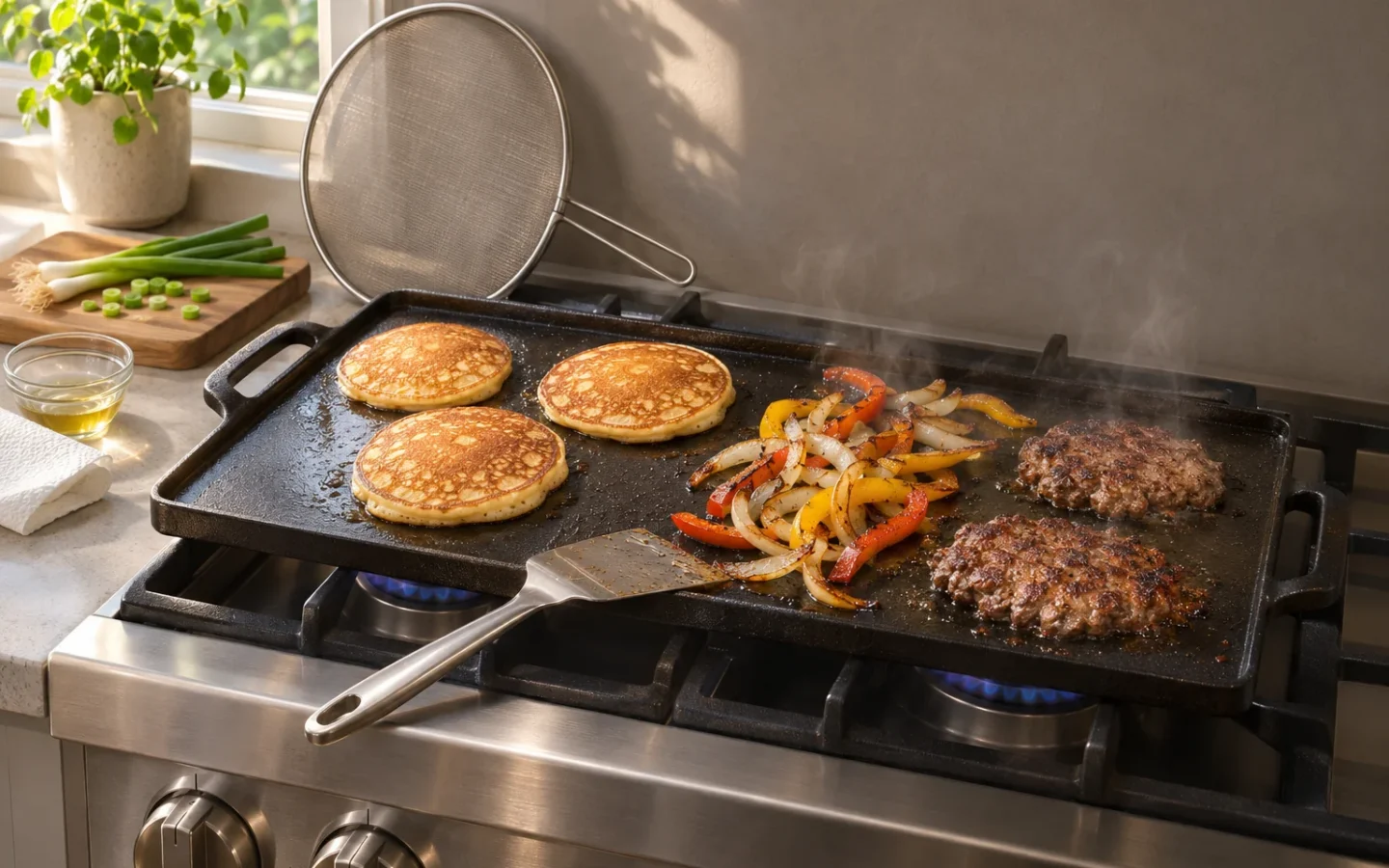
The product box above is a reversible cast iron double-burner plate: a flat griddle side, a ribbed grill side, a grease channel, and two loop handles, made to span two burners and also listed for oven, grill, and campfire use. It suits the cook who wants heat retention and searing more than light weight. If you are still deciding between cast iron and other materials for everyday pans, our cast iron skillet buying guide and nonstick versus stainless skillet comparison cover the same trade-offs at single-burner scale.
Whatever you buy, measure your burners, preheat slowly, and spend one morning learning where the hot and cool zones are. That single habit does more for griddle results than any feature on the box.