
As an Amazon Associate I earn from qualifying purchases. CookwareCompass is a participant in the Amazon Services LLC Associates Program, an affiliate advertising program designed to provide a means for sites to earn advertising fees by advertising and linking to Amazon.com.
A pair of tongs does more work on a stovetop than almost any other tool, and most people buy them by grabbing whatever hangs near the register. That is a mistake, because tongs are not interchangeable. The length decides how close your hand gets to the heat, the tips decide which pan surfaces they are allowed to touch, the spring and lock decide whether they are comfortable for ten minutes of turning, and the metal decides how they age in a dishwasher. Choose tongs for the cookware you actually own: all-metal tongs belong with cast iron, carbon steel, stainless, and the grill, while coated pans need softer tips.
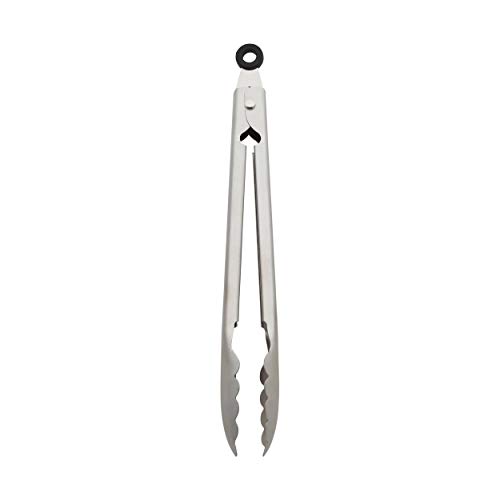
KitchenAid Stainless Steel Utility Tongs, 12 Inch
Certain content that appears on this site comes from Amazon. This content is provided “as is” and is subject to change or removal at any time.
Why we picked it
- Listed as a 430 stainless steel frame with no coating on the tips, so it suits cast iron, carbon steel, stainless pans, and the grill
- About 11.6 inches long, a practical stovetop length for turning food in a large skillet or lifting from a Dutch oven
- Locking mechanism for drawer or crock storage, dishwasher safe, and a listed one-year replacement plus lifetime limited warranty
Reported drawbacks
- Bare metal tips can scratch PTFE or ceramic nonstick coatings; use silicone-tipped tongs on coated pans
- 430 stainless is less corrosion resistant than 304, so dry the tongs after washing instead of leaving them wet
- Shorter than dedicated grill tongs, so the hand stays closer to the heat over a large open grill
Tongs Are a Lever, So Length Changes Both Reach and Control
Tongs are a pair of class-three levers joined at a hinge. Your hand squeezes near the hinge, and the tips move farther and with less force than your fingers apply. That geometry is why longer tongs feel less precise: the same small movement of your hand becomes a bigger, weaker movement at the tips. It is also why short tongs feel strong and accurate but put your knuckles closer to the pan.
For most stovetop work, a length of around 9 to 12 inches is the practical middle. It keeps your hand a comfortable distance above a hot skillet or the rim of a stockpot, yet the tips still respond to small corrections when you turn a scallop or lift one piece of chicken out of a crowded pan. Shorter tongs, around 7 inches, are serving tools: good at the table or for plating, too short for reaching across a large pan of hot oil.
Longer tongs, 16 inches and up, belong to the grill. Over a charcoal bed or a wide gas grill, radiant heat rises well above the grate, and the extra length keeps your forearm out of it. Indoors, that same length is clumsy: the tips wander, the tongs hit the range hood, and turning a thin fillet becomes a balancing act.
- Plating and serving: short tongs, where precision matters more than distance from heat.
- Skillet, sauté pan, and Dutch oven work: the 9 to 12 inch range, where reach and control are balanced.
- Open grill and large roasting pans in a hot oven: longer tongs that keep your arm away from radiant heat.
If you only buy one pair, buy for the stovetop. A 12-inch pair also handles a sheet pan or a roasting pan in an oven, and it is long enough for a gas grill if you work quickly.
The Tips Decide Which Pans the Tongs May Touch
The working end of the tongs matters more than the handle. There are three common tip types, and each pairs with different cookware.
Bare stainless steel tips are thin, rigid, and easy to clean. They slide under a seared crust, grip a slippery noodle, and tolerate any temperature a stovetop or grill can produce. Their weakness is the coating on nonstick pans. A hard metal edge pressed against PTFE or ceramic nonstick can scratch or nick the surface, and repeated scraping wears the coating faster. On cast iron and carbon steel, stainless tips are fine; the worst they do to a well-built seasoning layer is leave a mark that disappears with the next oiling and heating.
Silicone-tipped tongs cover the metal ends with heat-resistant silicone. That makes them the right choice for nonstick, and for enameled interiors where you want to avoid metal scuffs. The trade-off is thickness. Silicone tips are fatter and softer, so they do not slide under a delicate sear as easily, and they are less precise with thin foods. The silicone itself has a temperature limit set by the manufacturer, so check the stated rating rather than assuming the tips can rest on a hot grill grate.
Nylon or plastic tips are the cheapest coated option. They are gentle on nonstick, but nylon has a lower heat tolerance than silicone and can soften or deform if left against a hot pan edge. They are best treated as a light-duty tool.
The honest rule is simple: if your main pan is a nonstick skillet, buy coated tips for it. If you cook mostly in stainless, cast iron, carbon steel, or over a grill, bare stainless tongs are the more versatile and durable choice. Many kitchens end up with one of each, which is cheaper than replacing a scratched pan.
Scalloped, Flat, and Serrated Edges Grip Food Differently
Look closely at the edges of the tips. Most utility tongs have scalloped ends, with shallow waves that interlock when the tongs close. Scallops give a good grip on round or irregular foods such as broccoli florets, potatoes, sausages, and chicken thighs, because the waves spread the contact over several points.
Flat, thin tips are better for sliding under food. They act more like a spatula edge and are useful for flipping fish skin-side up or lifting a fried egg without breaking the yolk. Tongs with very deep teeth hold onto heavy cuts and corn, but they can tear tender food and are harder to clean, since bits of meat and cheese lodge in the grooves.
Whatever the shape, close the tongs and look at the tips against the light. A good pair meets evenly along the whole edge. If one arm closes before the other, or the tips cross, the tongs will pinch food at a single point and let it twist out of the grip.
Spring Tension and the Lock Decide Comfort Over a Long Cook
Most tongs are spring-loaded so the arms open on their own. The strength of that spring is a comfort question, not a quality badge. A stiff spring tires your hand when you turn a full skillet of meatballs one by one. A weak spring makes the tongs feel limp, and they do not open wide enough to grab a large piece of food.
The opening angle matters as much as the spring. Tongs that open too narrowly cannot grab a whole chicken leg or a thick pork chop; tongs that open very wide are awkward in a small pan. A moderate opening, enough to grip a large potato, covers most cooking.
The lock is the other half of the design. Locking tongs close and stay closed, which makes them easier to store in a drawer or crock and keeps them from springing open across the counter. The common types are a pull-ring at the hinge end, a sliding collar, and a small lever or button. Pull-rings are simple and easy to clean, but some can lock by accident when you tip the tongs upward. Levers are quick to operate with one hand. Check that the lock is easy to release while your other hand holds a pan handle, because that is how you will actually use it.
Stainless Grade Affects Rust Resistance, Not Grip
Stainless tongs are often made from 400-series stainless, such as 430, or from 300-series stainless, such as 304 (often sold as 18/8 or 18/10). The difference is mostly about corrosion resistance and magnetism. Grade 430 is a ferritic stainless with chromium but no meaningful nickel; it is magnetic, firm, and widely used for kitchen tools and appliance trim. Grade 304 adds nickel, which improves resistance to pitting and rust in wet, salty conditions. It is generally not magnetic.
Neither grade changes how well the tongs grip food. What changes is how they age. A 400-series tool left wet in a dishwasher, or soaked in salty brine, is more likely to develop small rust spots over time than a 304 tool. That does not make 430 tongs a bad buy. It means you should unload them from the dishwasher promptly and dry them, the same habit that keeps other kitchen tools in good shape. The diagnostic logic in our guide to rainbow stains and white spots on stainless applies here too: discoloration is often mineral residue, not damage, and a mild acidic cleaner usually removes it.
Construction details matter more than the grade for long-term use. Look at the hinge: a solid rivet or a well-formed spring housing lasts longer than a loose pin. Check that the edges of the arms are rolled or smooth, so the tongs are comfortable to squeeze and have no sharp burrs.
Match the Tongs to the Pans You Own
Tongs should follow your cookware, not the other way around.
Cast iron and carbon steel. Bare stainless tongs are the natural partner. These pans tolerate metal, and the thin tips slide under a crust better than silicone. For a carbon steel wok, tongs are a secondary tool to a spatula, but they are useful for pulling noodles and lifting larger pieces. If your seasoning is new and still building, see our notes on maintaining pre-seasoned cast iron; a fresh seasoning layer is more delicate than a mature one, but tongs rarely harm it.
Stainless steel pans. Stainless tongs are safe on clad stainless. Metal on metal can leave faint surface marks on a polished interior, but they do not affect cooking.
Nonstick, PTFE or ceramic. Use silicone or nylon tips. Our comparison of ceramic and PTFE nonstick covers why ceramic coatings in particular tend to lose their release over time, and metal scraping speeds that up. Do not assume a pair of all-metal tongs is safe because you plan to be gentle; you will not always be gentle when food is about to burn.
Enameled cast iron. Enamel is glass fused to iron. It resists scratches better than nonstick, but metal tools can leave gray marks on light-colored enamel, and a hard knock can chip it. Coated tips are the safer choice for everyday stirring and turning, while metal tongs are acceptable for occasional lifting.
Griddles and the grill. For a cast iron stovetop griddle or an outdoor grate, stainless tips are the better tool. They tolerate high heat, scrape cleanly along a hot surface, and are easier to clean of charred residue. If the griddle is nonstick, switch back to coated tips.
What a 12-Inch Stainless Utility Pair Is Good At
The product featured above, the KitchenAid Stainless Steel Utility Tongs, 12 Inch, is an example of the all-metal design described in this guide. According to the listing, the frame is 430 stainless steel, the tongs measure about 11.57 inches, they have a locking mechanism for storage, the arms are designed to spring open to roughly a 30-degree range when unlocked, and they are dishwasher safe. The listing also describes a one-year hassle-free replacement and a lifetime limited warranty from the manufacturer.
That combination makes it a sensible choice for a kitchen built around cast iron, carbon steel, stainless pans, and occasional grilling. The length sits in the middle of the stovetop range, so it works for turning food in a 12-inch skillet and lifting pieces out of a Dutch oven. The lock helps when the tongs live in a drawer.
It is not the right pair for a kitchen where nonstick is the main pan. Because the tips are bare metal, use a silicone-tipped pair on coated cookware. And because 430 stainless is less corrosion-resistant than 304, dry the tongs after washing rather than leaving them to sit wet. These are not flaws in the product; they are the normal trade-offs of the all-metal design, and they are the reason this guide recommends matching tongs to pans.
How to Test Tongs Before They Become Your Everyday Pair
You can learn most of what you need in a minute with a new pair.
- Pick up a single grain-sized object. Try a dried pea or a grain of rice. If the tips close evenly enough to hold it, they will handle small, delicate food.
- Lift a heavy can. A standard can of tomatoes is close to the weight of a large roast or a whole chicken leg. If the arms flex badly or the can twists out of the grip, the tongs are too light for heavy work.
- Squeeze them twenty times. If your hand is tired, the spring is too stiff for long cooking sessions.
- Operate the lock with one hand. Hold the tongs as if the other hand is on a pan handle, then lock and unlock them. If it takes two hands, it will annoy you while cooking.
- Check the inside edges. Run a finger along the arms and the hinge. Sharp burrs, gaps where food can lodge, or a loose hinge pin are signs of a pair that will not last.
Use Tongs in Ways That Protect Food and Pans
Tongs are only as good as the technique behind them. A few habits make them better tools and protect your cookware.
Let food release before you turn it. On stainless and cast iron, protein sticks until a crust forms and then releases on its own. If you pull with tongs while the food is still stuck, you tear the crust and leave it behind. Wait, nudge, and turn when it moves.
Grip, do not stab. Tongs are used instead of forks partly because they do not pierce meat. Close them firmly enough to hold the food, then lift. Squeezing hard on a tender piece of fish or a sausage can split it.
Keep the tips out of the oil when you are not using them. Tongs resting in hot oil or on the pan rim get hot all the way to the handle. Rest them on a spoon rest or a plate.
Separate raw and cooked. Tongs that turned raw chicken should not plate cooked chicken without washing. Many cooks keep two pairs during a meal for exactly this reason.
Do not use tongs as a scraper on coatings. Even coated tips can damage a worn nonstick surface if you press hard into a corner. Use a spatula for scraping and tongs for lifting.
Care Keeps Stainless Tongs Working for Years
Most stainless tongs can go in the dishwasher, and the featured pair is listed as dishwasher safe. The practical risks are water spots, the slow buildup of mineral residue near the hinge, and small rust spots on 400-series steel if they sit wet.
- Unload and dry promptly. A quick towel dry removes the moisture that leads to spots.
- Open the lock before washing. A locked pair traps food and water inside the arms. Washing them open lets water reach the spring and hinge.
- Remove residue near the hinge. If grease builds up, soak the hinge end in hot soapy water, then scrub with a small brush.
- Treat surface rust early. A paste of baking soda and water, or a stainless cleanser, removes light surface rust. Rinse and dry well afterward.
- Retire tongs that no longer close evenly. Bent arms grip poorly and can drop hot food. A replacement is cheaper than a burn.
Silicone-tipped tongs need one extra check. Inspect the tips for cuts or tears, since a damaged tip can trap food and eventually separate from the metal.
A Short Buying Checklist
Before you buy, run through these questions.
- What pans do you use most? Bare stainless for cast iron, carbon steel, stainless, and grilling; coated tips for nonstick and frequent work in enameled cookware.
- Where will you use them? Around 9 to 12 inches for the stovetop and oven, longer for an open grill.
- What tip shape suits your food? Scalloped for general turning, flat and thin for sliding under food, deep teeth only for heavy cuts.
- Is the spring comfortable? It should open on its own without tiring your hand.
- Can you lock it one-handed? The lock should be easy to engage and release while cooking.
- What is the steel? 300-series resists rust better; 400-series is fine if you dry it after washing.
- Does the manufacturer list a warranty? A clear warranty is a useful sign that the maker expects the hinge and spring to last.
Good tongs are not complicated, but they are specific. Match the tips to the cookware, the length to the heat source, and the spring and lock to the way your hand works. Do that, and a simple pair becomes the tool you reach for first.