
As an Amazon Associate I earn from qualifying purchases. CookwareCompass is a participant in the Amazon Services LLC Associates Program, an affiliate advertising program designed to provide a means for sites to earn advertising fees by advertising and linking to Amazon.com.
A good cast iron cleaning tool removes what is stuck on the pan and leaves what is bonded to it. That is the entire job. Chainmail scrubbers and brushes both do it, but they apply force in different ways, and the right choice depends on what is actually on the surface, how mature the seasoning is, and whether the pan is cast iron at all.

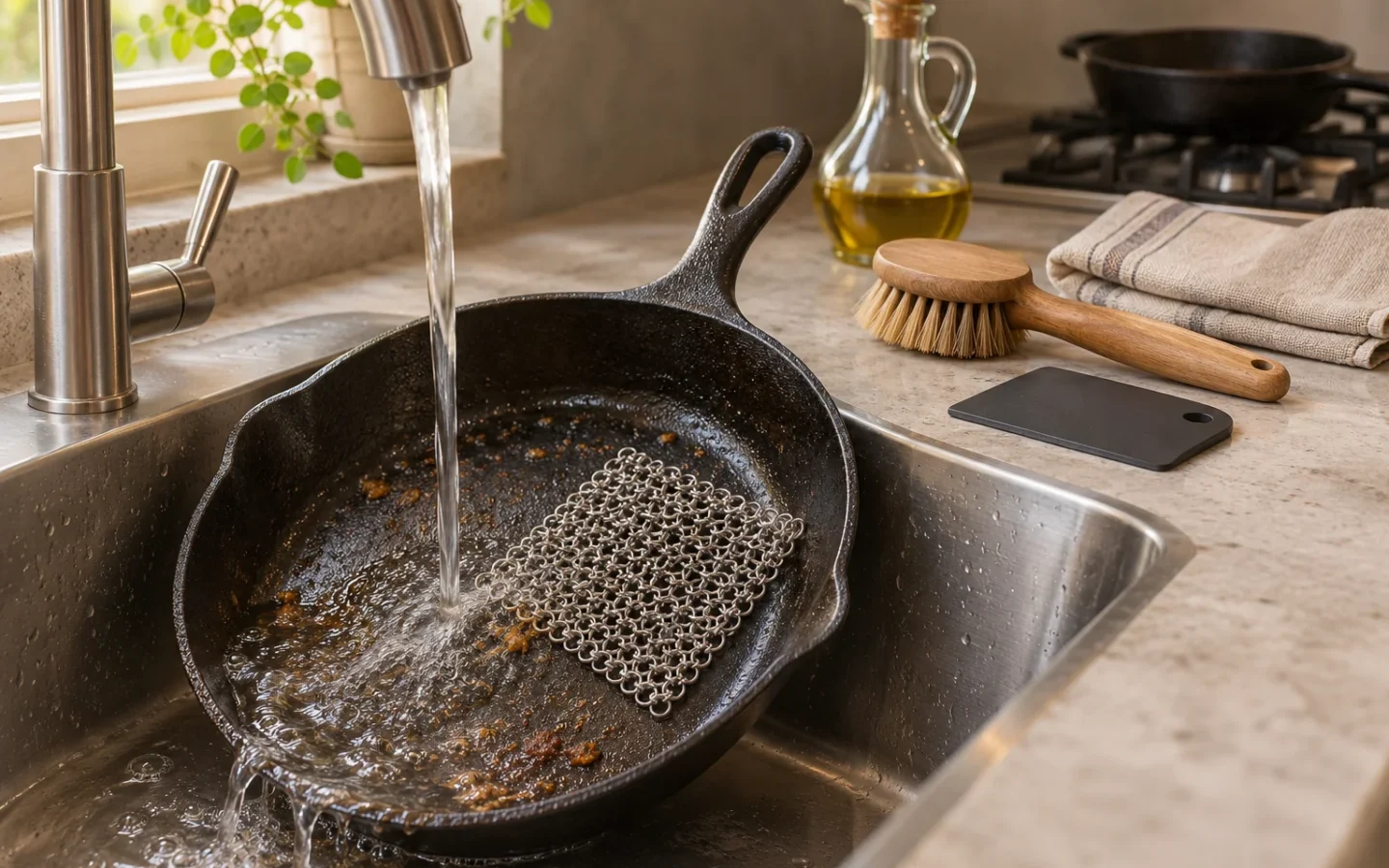
Amagabeli Cast Iron Cleaner 8×6 Inch Stainless Steel Chainmail Scrubber
Certain content that appears on this site comes from Amazon. This content is provided “as is” and is subject to change or removal at any time.
Why we picked it
- Listed as stainless steel chainmail, so the rings themselves are not meant to rust between uses
- Flat 8 x 6 inch pad folds for firmer pressure, wraps around fingers for corners, and lies flat on griddles
- Listed as dishwasher safe for cleaning the scrubber, with a hanging ring so it can dry between uses
Reported drawbacks
- No handle, so a hot pan or a deep pot puts your hand close to heat and hot water
- Not for nonstick, ceramic, or enameled cast iron interiors; metal rings can scratch those surfaces
- Removes weak, sticky, or freshly applied seasoning along with the food, so new layers need a gentler brush
Seasoning Is a Bonded Layer, Not a Coating You Can Scrub Through Casually
Seasoning is oil that has been heated past its smoke point until it polymerizes into a hard, plastic-like film fused to the iron. A mature layer built from many thin coats is tough. It tolerates soap, hot water, and firm scrubbing. A young layer, a single thick coat, or a patch that was applied too heavily and cured soft is a different story. Those flake or wear away under the same pressure.
That distinction matters more than the tool. When people say a scrubber “stripped” their seasoning, the usual cause is that the layer was weak to begin with: sticky from too much oil, never fully cured, or already lifting at the edges. A cleaning tool exposes that weakness quickly. It rarely creates it on a well-seasoned pan.
So before choosing a tool, look at the pan. A dull, even, dark finish that feels smooth and dry is ready for real scrubbing. A tacky, blotchy, or freshly seasoned surface deserves a softer approach for a few weeks. If you are still building that layer, the routine in our guide on how to season a pre-seasoned cast iron skillet matters more than which scrubber you buy.
What Each Tool Actually Does to the Surface
The two tools work through different mechanics, which is why they suit different messes.
- Chainmail scrubber: Interlocking stainless steel rings concentrate your hand pressure on many small, rounded contact points. The rings ride over the bonded seasoning and catch on anything raised above it: fond, carbonized sugar, crusted egg, stuck rice. Because the rings are rounded rather than sharp, they tend to push and roll debris off instead of cutting into the surface.
- Stiff brush: Nylon, natural fiber, or palmyra bristles flex into corners, around pour spouts, and along the wall where it meets the floor. Bristles sweep loose residue and grease away well, but they bend under resistance. A brush moves loose food easily and struggles with anything welded on.
- Steel wool and abrasive pads: These cut with fine, sharp fibers or grit. They are restoration tools for rust and old, failed seasoning. Used for daily cleaning, they remove sound seasoning along with the food.
In short, chainmail is a scraping tool with a rounded edge, and a brush is a sweeping tool. Neither one is a sanding tool, and that is what you want for everyday care.
When Chainmail Is the Better Choice
Chainmail earns its place when food is truly stuck. Seared protein that left a dark crust, potatoes that welded themselves to the floor of the skillet, cornbread edges, or the caramelized ring around a pan sauce all respond better to chainmail than to bristles. You can work with warm water and moderate pressure, and the rings clear the residue in fewer passes, which means less total time with water on the iron.
It also suits textured surfaces. Many modern cast iron skillets have a slightly pebbly as-cast finish rather than the milled-smooth surface of older pans. Bristles can skim over the high points and leave food in the low spots, while chainmail conforms to the texture and reaches more of it. The same logic applies to the ridges of a grill pan, the flat plate of a double-burner griddle, and the floor of a bare cast iron Dutch oven. If you cook on a stovetop griddle, a flat chainmail pad covers that wide surface quickly.
Chainmail also handles a hot pan better than many brushes. Some synthetic bristles soften or deform if you scrub while the iron is still very warm. Stainless steel rings do not care about heat, although your hand still does.
When a Brush Is the Better Choice
A brush wins on routine, light cleaning. After frying eggs in a well-seasoned skillet, there is usually only a film of oil and a few loose bits. A quick sweep under hot water clears that without needing the extra bite of chainmail.
Brushes are also better at geometry. A long handle keeps your knuckles away from hot water and a hot pan. Angled bristles reach the inside corner where the wall meets the floor, which is exactly where a flat chainmail sheet folds and loses contact. A brush is easier in deep vessels, too: scrubbing the bottom of a tall Dutch oven or stockpot with a palm-sized pad puts your hand and wrist inside the pot.
Finally, a brush is the gentler choice for young seasoning. If a pan was re-seasoned last week, or the factory finish is still the only layer, a brush lets you clean daily while the layer builds. Move to chainmail once the surface looks even and feels slick and dry.
Many Kitchens Need Both, Used in Order
The most efficient routine for most home cooks uses both tools in sequence rather than choosing one forever.
- Scrape first if needed: A flat plastic pan scraper lifts large crusts with almost no effort and spares both the seasoning and your scrubber.
- Chainmail for what remains stuck: Rinse with hot water and use the chainmail in small circles until the floor feels smooth to your fingertip.
- Brush for corners and rinse-off: Sweep the wall seam, the pour spouts, and the handle junction, then rinse.
- Dry with heat: Towel the pan, then set it over medium-low heat for a minute or two until any remaining moisture is gone.
- Oil thinly if the surface looks dry: A few drops wiped across the interior and then wiped back off, so the surface looks almost dry, is enough to protect it.
That last step is where cleaning and seasoning meet. A pan scrubbed clean and put away wet is more likely to rust than a pan scrubbed hard and dried on the burner. Most “the scrubber ruined my pan” stories involve water left on the iron afterward.
Soap Is Not the Enemy, but Soaking Is
Modern dish soap does not contain lye and will not dissolve polymerized seasoning. A small amount of soap with chainmail or a brush is fine and helps cut grease that would otherwise go rancid in storage. What does damage cast iron is time in water: leaving a pan to soak overnight, running it through a dishwasher, or letting it drip-dry in a rack. Bare iron starts to show orange rust quickly once the seasoning is thin and the surface stays wet.
So the rule is short contact with water, firm cleaning, fast drying. If a sticky residue does not budge, simmer a little water in the pan for a minute or two to loosen it, pour it off, and scrub while the pan is warm. That is gentler and faster than soaking.
What Not to Use Chainmail On
Chainmail is a tool for bare cast iron and carbon steel. It is the wrong tool for several surfaces that sit beside cast iron in many kitchens.
- PTFE and ceramic nonstick: These coatings are thin and comparatively soft. Stainless steel rings can scratch them, and scratched nonstick loses release. Use a soft sponge. Our comparison of ceramic vs. PTFE nonstick explains why those coatings wear the way they do.
- Enameled cast iron: The glossy interior of an enameled Dutch oven is glass fused to iron. It does not need seasoning protection, and metal can leave gray marks or scratch it. A nylon scrubber, a soak with warm soapy water, or a paste of baking soda is the safer route. The care differences are covered in our guide to enameled vs. bare cast iron Dutch ovens.
- Polished stainless exteriors and glass lids: Chainmail is less aggressive than steel wool, but rings dragged across a mirror finish can still leave fine marks.
Some product listings, including the one in the box above, describe chainmail as usable on glassware, pizza stones, and baking sheets. Treat that as the manufacturer’s claim rather than a guarantee for every surface you own, and test an inconspicuous area first. On this site the recommendation is narrower: use chainmail on bare cast iron and carbon steel, where it clearly helps.
Carbon Steel Is Similar, but Its Seasoning Is Usually Younger
Carbon steel pans and woks build seasoning the same way cast iron does, but the layer is often thinner and gets stressed harder, because these pans see high-heat stir-frying and frequent acidic sauces. Chainmail works on them, especially on the flat floor of a skillet. On a wok, the curved bowl and the narrow base make a stiff bamboo whisk or a long-handled brush more practical for daily cleaning, with chainmail kept for sticky patches.
If a carbon steel pan still shows the blotchy bronze and brown look of early use, keep scrubbing pressure light until the color evens out. Our carbon steel wok buying guide covers the break-in period in more detail.
How to Choose a Chainmail Scrubber
Chainmail scrubbers look similar, but a few details change how they work in a real sink.
- Material: Look for stainless steel stated on the listing. Plain steel rings can rust, and rust deposits on a clean pan defeat the purpose.
- Ring size: Smaller, tightly linked rings give more contact points and a smoother feel. Very large rings can catch on rivets and pour spouts.
- Shape and size: A flat square or rectangular pad can be folded to fit your hand and pressed into corners. An insert shaped around a silicone core makes grip easier but can be harder to fold into tight spots. Match the size to your largest pan: a small pad is quick on an 8-inch skillet and slow on a 20-inch griddle.
- Cleaning the scrubber itself: Grease and food collect between the rings. A scrubber that can go in the dishwasher, or that rinses clean under hot running water, stays hygienic with less work.
- Storage: A hanging loop lets the pad dry fully between uses. A wet chainmail pad stored in a closed drawer stays damp longer than it should.
About the Amagabeli Chainmail Scrubber in This Guide
The product in the box above is the Amagabeli chainmail scrubber in the 8 by 6 inch flat format. According to the listing, it is made of stainless steel, has a hanging ring for storage, and is dishwasher safe for cleaning the scrubber itself. The listing presents it as a cast iron cleaner for skillets, griddles, woks, Dutch ovens, and similar pans, and recommends drying and oiling the pan briefly after use, which matches the routine described above.
The flat rectangular shape is the point. It folds in half for a firmer pad, wraps around two fingers for corners, and lies flat across a griddle. What it does not offer is a handle, so on a hot pan or a deep pot you still want a brush or a towel to keep your hand clear of heat. It also does not replace a scraper for thick crusts. It is a daily scrubbing tool for bare cast iron and carbon steel, and it should be bought for that, not as a universal sink scrubber.
Rust, Flaking, and Black Residue: Diagnose Before You Scrub Harder
When a pan looks wrong after cleaning, the answer is usually not more pressure.
- Orange spots after cleaning: The pan was left wet or the seasoning is thin there. Scrub the rust off with chainmail, dry on the burner, and apply a thin coat of oil. Light surface rust is common and fixable.
- Black flakes coming off: Flakes usually mean a thick, weakly bonded layer of seasoning or carbonized food is lifting. Scrub until the flaking stops and the surface underneath feels firm, then rebuild with thin coats. Do not try to preserve a loose layer; it will keep flaking into food.
- Black residue on a paper towel: Some black residue when wiping a freshly oiled pan is normal carbon and seasoning. It is not a sign that you scrubbed incorrectly.
- Sticky, tacky surface: Too much oil was left on before heating. Chainmail will not fix that. Heat the pan in the oven to finish curing the layer, or scrub the tacky area back and reapply much thinner coats.
If you are still deciding which skillet to clean in the first place, the surface finish, weight, and handle all affect how easy this routine feels day to day. Our cast iron skillet buying guide covers those choices.
The Short Answer
Buy a brush if you mostly cook eggs, pancakes, and other foods that release cleanly, if your seasoning is new, or if you clean deep pots more than flat pans. Buy chainmail if you sear, roast potatoes, bake cornbread, or cook on griddles and grill pans where food bonds to the surface. Many kitchens with a cast iron skillet end up using both: chainmail for what is stuck, a brush for corners and rinsing, and a burner to dry the pan every time.
Whichever tool you use, the seasoning is protected less by the tool than by the habits around it: short contact with water, no soaking, fast drying, and a thin film of oil when the surface looks dry. Get those right, and a stainless chainmail scrubber is a safe, fast way to keep bare cast iron and carbon steel clean.