
As an Amazon Associate I earn from qualifying purchases. CookwareCompass is a participant in the Amazon Services LLC Associates Program, an affiliate advertising program designed to provide a means for sites to earn advertising fees by advertising and linking to Amazon.com.
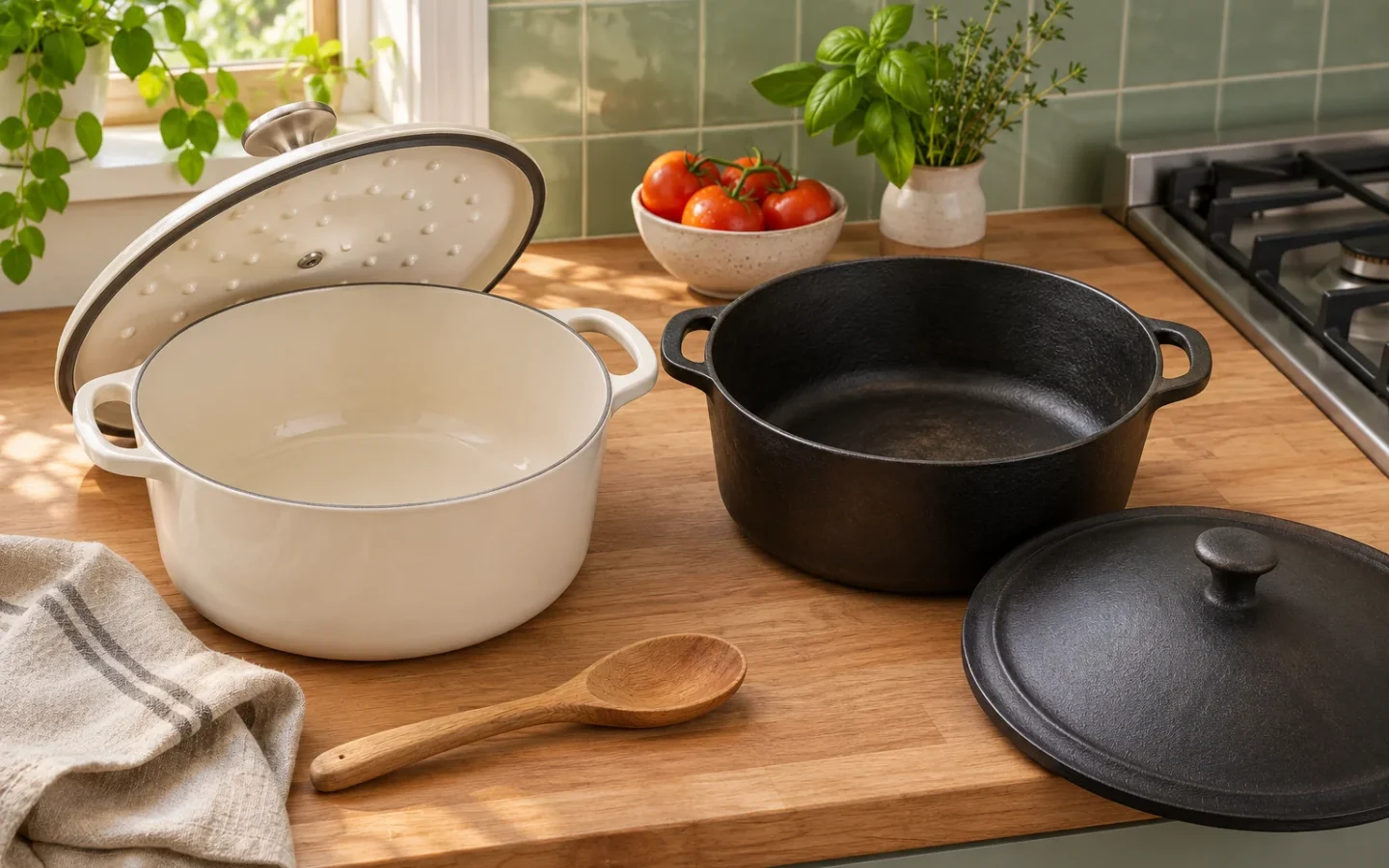
A bare cast iron Dutch oven and an enameled one share the same basic job: a heavy pot and a tight lid that can move from the stovetop into the oven. The difference that actually changes how you cook is the interior. Enamel is a fused glass layer that does not need seasoning and does not mind tomato or wine. Bare iron asks you to maintain a seasoning, rewards fat and dryness, and can be stripped and rebuilt if you mistreat it. Buy the surface that matches the food you cook most, not the color of the pot.

Enameled Cast Iron Dutch Oven – Umite Chef 5QT Pot with Lid & Cotton Potholders (Cream White)
Certain content that appears on this site comes from Amazon. This content is provided “as is” and is subject to change or removal at any time.
Why we picked it
- Enameled cast iron body listed as induction-compatible and usable on gas, electric, and ceramic cooktops
- Oven-safe up to 500°F, with a cast-iron lid and extra-wide stainless steel handles
- 5-quart capacity aimed at family-size stews, soups, and bread baking; includes a lid, user manual, and cotton potholders
- Smooth enamel interior is non-reactive, so tomato sauces and wine reductions do not need a seasoning layer
Reported drawbacks
- The listing warns that thermal shock cracks enamel and says to cool the pot naturally for 45+ minutes before cleaning; care is listed as hand wash only
- Product copy mentions broiling, but the stated oven limit is 500°F; a broiler can exceed that, so do not treat oven-safe as broiler-safe
- Enamel is smoother than bare iron but is not a PTFE-style nonstick coating; light cream interiors can stain, and chips from impact are not repairable the way seasoning is
- The product information table is internally inconsistent on weight and dimensions, so do not trust those numbers as buying facts
Start With What a Dutch Oven Has to Do
A Dutch oven is not a stockpot with a heavier lid, and it is not a skillet with taller walls. It is a thick-walled pot designed to hold heat, limit evaporated moisture, and finish food in the oven after you have started it on a burner. That is why the same vessel is used for a long braise, a pot of beans, no-knead bread, and a roast that needs a covered start.
Cast iron is the usual body material because it stores a lot of heat and releases that heat slowly. Once the pot is fully hot, a stew barely notices when you drop in vegetables or crack the lid. The trade-off is familiar from a cast iron skillet: the pot is slow to preheat, slow to cool, and heavy once it is full. Those traits belong to both the enameled and the bare versions. The interior is what changes care, acidity, and how forgiving the pot is on a weeknight.
If you are choosing a first Dutch oven, decide the interior before you decide the color or the brand. A cream enamel pot and a bare black pot will cook a stew in much the same way once they are hot. They will not treat tomato sauce, leftover storage, or a rushed wash the same way at all.
Understand What Enamel on Cast Iron Actually Is
The enamel on a Dutch oven is porcelain enamel: a glass-forming mixture fused onto the iron at a very high factory temperature. It is a thick, hard, non-porous skin, not a thin sprayed nonstick film, and it is not the same material as the sol-gel “ceramic nonstick” coating used on many aluminum frying pans. Those coatings are thinner and usually fail by losing release. Enamel fails by chipping, crazing, or cracking.
Because the surface is glass, it is non-reactive. Tomato sauce, wine, vinegar, and lemon can simmer in it without attacking a seasoning layer, because there is no seasoning layer to attack. That is the practical reason many cooks buy enameled pots for braises and sauces. Listing language that calls enamel “naturally non-stick” overstates the material. Enamel is smoother than dry bare iron, especially with a film of fat, but it is not a PTFE-style release surface. Food will still stick if you sear wet meat in a cold pot, or if sugars burn onto the floor.
Enamel also cannot be repaired the way a seasoning can. A chip on the floor exposes bare iron, which can rust and give wet, acidic food a metallic taste. A tiny chip on the outside of a lid flange is mostly cosmetic. Inspect a new pot as soon as you unpack it. Enamel can arrive damaged from shipping, which is why some makers pack the lid separately in foam and tell you to check the wrap before you throw it away.
Bare Cast Iron Asks You to Maintain a Seasoning
A bare Dutch oven is the same family of iron as a pre-seasoned skillet, only deeper and usually heavier, with a lid that traps steam. The cooking surface is protected by seasoning: thin layers of oil polymerized by heat into a dry, hard film. That film keeps the iron from rusting and gives food a usable release. It is not a factory coating you can ignore. If you already take care of a skillet, the rules are familiar, and our guide to seasoning and maintaining a pre-seasoned cast iron skillet applies inside a Dutch oven as well.
The lid changes the stakes. A deep pot holds moisture against the walls and the underside of the lid long after cooking. If you put the lid back on a damp pot and shelve it, rust can start in the places you cannot see. Dry the body and the lid thoroughly, including the rim where they meet, and leave the lid slightly ajar until everything is bone-dry. A thin wipe of oil on the interior is still useful after washing.
The advantage of a bare interior is that it is maintainable. If you scorch the seasoning, you can strip it and build it again, and you can usually take the pot to a higher stovetop heat than enamel makers want you to use. The cost is discipline: no long acidic simmers in a weakly seasoned pot, no soaking overnight, no dishwasher, and no storing wet leftovers in the iron. If that care sounds like a chore rather than a habit you already have, enamel is the more honest first choice.
Treat Acid, Water, and Storage as Interior Problems
Acid is the cleanest way to see the difference. In an enameled pot, a tomato-heavy chili or a wine braise can simmer for hours. The glass does not donate a metallic taste and does not lose a protective fat layer. In a bare pot, a short deglaze with wine or a brief tomato simmer in a well-seasoned interior is usually fine. A long, wet, acidic cook is how seasoning thins, especially on a new pot whose film is still building. If most of your Dutch oven meals start with tomatoes or wine, enamel removes a real constraint.
Water splits the two surfaces as well. Enamel does not rust unless the glass is already chipped down to iron, so leftover stew can wait in the pot in the refrigerator more safely than it can in bare iron. That is convenient, not mandatory: lingering food still stains a light interior and can leave odors. Bare iron should be emptied, washed, and dried once the pot is cool enough to handle. Use either pot to cook, then move leftovers into a storage container if they will sit for more than a short stretch.
Respect Heat, Preheat, and Thermal Shock
Cast iron needs time to heat through the wall, not just on the floor. If you drop oil into a pot whose base is hot and whose sides are still cool, you will get hot spots and uneven browning. A useful preheat is moderate and unhurried. One 5-quart enameled pot on the market tells you to allow several minutes for even distribution and to preheat only a couple of minutes on medium-low. That is the right direction even when a listing is less specific: start lower than you would with a thin saucepan, and give the mass time to catch up.
Enamel has a second heat rule that bare iron does not share in the same way. The glass layer and the iron expand at different rates. A sudden temperature jump—an empty pot left on a high burner, a hot pot set under cold water, or a cold pot placed into a ripping-hot oven—stresses that bond. Some manuals are blunt: cool the pot naturally for a long stretch before you clean it, because hot-to-cold contact can crack the enamel. Take that warning at face value. Set a hot pot on a dry towel or a wooden board, not in a wet sink, and wait until you can handle it with protected hands before you wash it.
Oven limits are easy to misread. An enameled Dutch oven with a cast iron lid and stainless handles can reasonably be rated for a hot oven; 500°F is a common stated ceiling and is enough for bread baking and most braises. “Oven-safe” is still not the same as “broiler-safe.” A broiler can push the enamel and any exposed handle far past the number on the oven dial. Some product copy lists broiling alongside baking even when the only number on the page is an oven limit. Unless the maker states a separate broiler rating, stay at or below the oven number and keep the pot out from under the broiler. Bare iron can often take more stovetop heat, but a nonmetal knob still sets its own lower limit. Read the rating for every part, then use the lowest one.
Size the Pot by Meals, Headroom, and How You Will Lift It
Capacity in quarts is the volume to the rim, not the amount of food you should put in. A braise needs headroom so liquid can move and so you can stir without flooding the lid flange. Bread needs space for the loaf to rise under the lid. A 5-quart Dutch oven is a common household size, often described as enough for four to six servings, a pot of soup or stew, or a modest whole chicken. It is a practical everyday pot. It is not automatically the right pot for a large pork shoulder or a double batch of beans.
Look at diameter and height together. A wide, relatively shallow 5-quart pot browns more food at once and evaporates a little faster when the lid is off. A taller, narrower pot of the same volume holds a larger roast but gives you less floor for searing. Listed dimensions help only if they are consistent. On at least one current 5-quart listing, the product table gives a plausible width and height in one field and an impossible 1 × 1 × 1 inch measurement plus an implausibly low weight in others. Ignore those broken fields. Confirm the real size and weight when the pot arrives; do not plan around a number that cannot be true for a cast iron pot of that volume.
Weight matters even when the listing gets it wrong. A loaded 5-quart Dutch oven is heavy, and the lid adds more. You have to lift that mass on and off a burner and in and out of a hot oven. The same thinking we use in our cast iron skillet buying guide applies here: choose a size you can control with oven mitts, not the largest pot that still fits on the rack. A 6- or 7-quart pot can be worth the extra mass if you cook for a crowd; a 5-quart pot is easier to preheat, wash, and store if you usually cook for two to four.
Read the Lid and the Handles Before You Trust the Oven Rating
The lid is half of the tool. A close-fitting, heavy lid keeps steam in, which keeps a braise from drying out and gives bread the trapped moisture that helps the crust form. Some enamel lids have raised nodes on the underside so condensate drips back onto the food instead of running to the rim. That redistributes moisture; it does not prevent overcooking. Marketing that calls the lid “airtight” overstates a close fit. These lids are not canning jars. They should sit flat on a clean rim and feel stable when you lift the pot by the body handles, not by the lid knob alone.
Handles tell you how the pot will behave in the oven. Extra-wide stainless loops are strong and oven-compatible, and they give mitts more to grab than a small tab would. They also get as hot as the pot. A pair of thick cotton potholders in the box is a useful acknowledgment of that fact, not a decoration. Use them or a dry towel when you move the pot. Never leave cotton mitts, a silicone grip, or a folded towel in the oven with the pot; those are handling tools, not oven parts. If a Dutch oven uses a phenolic lid knob, that knob—not the iron—often sets a lower oven limit than the body.
Clean Each Surface the Way It Actually Fails
Enamel’s usual failures are thermal shock, impact chips, staining, and scratched glaze from abrasive pads. The care that follows is often printed as “hand wash only”: let the pot cool, wash with a soft sponge and ordinary dish soap, and skip steel wool, harsh scouring powders, and the dishwasher. Burned-on food usually loosens after a short soak in warm—not cold—water once the pot is no longer hot.
Light-colored interiors, including cream white, show stains from tomato, wine, turmeric, and browned fond more readily than dark interiors do. That staining is usually cosmetic and does not mean the enamel has failed. You can often reduce it with a paste of baking soda, but you should not grind at it. Choose the color for visibility, not for heat performance; the iron does the thermal work either way.
Bare iron fails by rust and by stripped seasoning. Wash it promptly, dry it over low heat, and oil it lightly. If rust appears, remove it and reseason that area; do not cook around it and hope it disappears. Do not put a bare Dutch oven through a dishwasher, and do not store it with the lid sealed over a damp interior. The work is modest if you do it every time, and it piles up if you don’t.
Choose the Interior for the Food You Cook Most
Once you separate the shared iron body from the cooking surface, the choice is straightforward.
Choose enamel if you often cook with tomatoes, wine, or other acids; you want to park leftovers in the pot for a short time; and you would rather follow chip and thermal-shock rules than maintain a seasoning. A 5-quart enameled pot with a close lid, metal handles, a stated oven limit, and induction compatibility is a sensible everyday Dutch oven for stews, braises, bread, and sauces.
Choose bare cast iron if you already keep skillets seasoned, you want a surface you can strip and rebuild, and you care more about high-heat searing than about easy acidic simmering. Be honest about drying and oiling a lidded pot, because rust starts where moisture hides.
Do not choose either pot as a nonstick substitute. If your main job is eggs or delicate fish at moderate heat, a Dutch oven is the wrong shape and the wrong surface. Enamel’s “nonstick” labeling describes a smooth glass, not a release coating you can count on for a dry omelet.
Match the cooktop and the oven as well as the food. Cast iron is induction-compatible only if the base sits flat and makes contact. Confirm that on the listing, and confirm the oven limit for the lid and handles, not just the body. A pot that cannot go into your oven is only a heavy saucepan.
Use This Checklist Before You Buy Either Dutch Oven
- Name the interior in plain words: porcelain enamel or bare, seasoned cast iron.
- If you pick bare iron, plan for seasoning, thorough drying, and no long acidic simmers until the film is solid.
- If you pick enamel, inspect the cooking surface, rim, and lid for chips on arrival, and accept the thermal-shock rule: no cold water on a hot pot.
- Find the oven-safe temperature for the body, lid, and any nonmetal knob, then use the lowest number. Do not treat a broiler mention as a broiler rating unless a limit is stated.
- Confirm cooktop compatibility, including induction if you need it, and a base that sits flat.
- Size by the meals you actually cook, leaving headroom, and choose a loaded weight you can lift with mitts.
- Ignore product-table fields that contradict each other, such as a cast iron pot listed at a fraction of a kilogram or at 1-inch dimensions.
- Read the care line. “Hand wash only” means the dishwasher is not a shortcut.
- Treat “nonstick” on an enamel listing as marketing for a smooth glaze, not as a promise that food will slide.
The better Dutch oven is the one whose interior matches your habits. Enamel trades some toughness and some high-heat freedom for a non-reactive, low-maintenance surface. Bare iron trades that ease for a finish you can rebuild. The iron under both is doing the same slow, steady thermal work. Choose the surface you are willing to live with every time you put the lid on.