
As an Amazon Associate I earn from qualifying purchases. CookwareCompass is a participant in the Amazon Services LLC Associates Program, an affiliate advertising program designed to provide a means for sites to earn advertising fees by advertising and linking to Amazon.com.
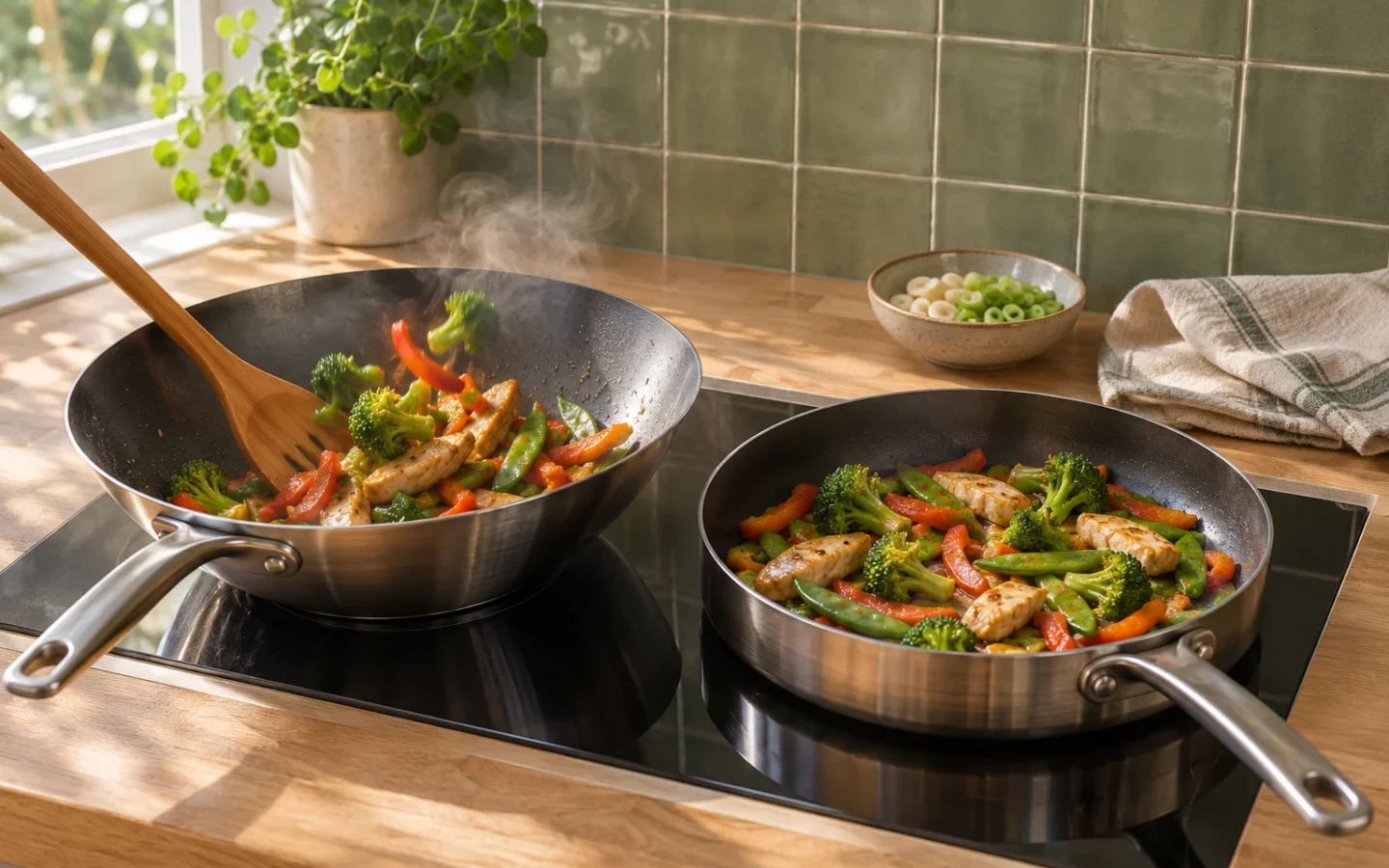
On a flat stovetop, a wok and a skillet are not competing for the same job. A skillet gives food a wide, flat floor to sit on and brown. A wok gives food a small hot floor and tall sloping walls to climb, fall back from, and stay inside while you toss. Which one you need depends less on the recipe name and more on how the food has to move, how much of it you cook at once, and what kind of burner sits underneath the pan.

HexClad 10-Inch Hybrid Nonstick Wok, Dishwasher and Oven Safe, Induction-Ready
Certain content that appears on this site comes from Amazon. This content is provided “as is” and is subject to change or removal at any time.
Why we picked it
- Tri-ply construction with an aluminum core, listed as compatible with induction, gas, and electric cooktops
- Flat base with tall, flared walls sized for one- or two-serving stir-fries, fried rice, and quick soups
- Hybrid surface of laser-etched stainless steel and ceramic coating, listed as metal-utensil safe and dishwasher-friendly
- Listed as oven-safe up to 900°F, with a lifetime warranty against manufacturer's defects when sold by HexClad (commercial use excluded)
Reported drawbacks
- A lid is not included with this version, although the longer product description mentions one; glass lids sold separately are rated lower, at 400°F
- At about 10 inches across the rim, the flat floor is small, so larger family batches need several rounds
- About 3 pounds empty, which some owners find heavy to toss with one hand once the pan is loaded
- A hybrid surface does not build seasoning like carbon steel and does not release like a fresh fully coated pan; avoid empty high-heat preheating
A Flat Stovetop Changes What a Wok Can Do
The classic round-bottomed wok was designed around a fire that wraps up the sides of the pan. A restaurant wok burner throws a tall, concentrated flame, so the bottom and the lower walls get hot at the same time. The cook pushes food up the cooler walls to rest it and drags it back into the hot center to sear it. The pan is a gradient of temperature, and the cook works that gradient constantly.
A home electric coil, a glass radiant top, or an induction hob does something very different. It heats only the part of the pan that is touching it, or sitting directly above it. On induction, the magnetic field heats the metal in contact with the glass and very little else. On radiant glass, heat moves mostly by contact and close radiation. In both cases, the walls of a wok get hot only by conduction from the floor, so they run noticeably cooler than they would over a gas wok burner.
That is why woks sold for flat stovetops have a flat base. A round-bottomed wok on a flat surface touches the heat at a single point, rocks, and wastes most of the energy. A flat-bottomed wok trades some of the traditional shape for stable contact. You get a hot floor and gently warmer lower walls, which is enough for home stir-fry, but you should not expect the sweeping heat of a restaurant station.
Measure the Floor, Not the Rim
Pan sizes are sold by rim diameter, and that number is especially misleading on a wok. A ten-inch wok and a ten-inch skillet are both about ten inches across the top, but the wok spends much of that width on its sloping walls. The flat, directly heated floor is far smaller. We explain the general rule in Pan Diameter Is Not Cooking Surface, and it applies twice over here.
On a flat stovetop, the floor is where the searing happens. If the floor is small, only a small amount of food can touch hot metal at any moment. The walls still matter, because they hold the food you are not searing yet, but they do not brown it. Before you buy, measure the flat base if the listing does not state it, and compare it to your largest burner or the induction zone you plan to use. A floor much smaller than the burner wastes heat around the edge; a floor much larger than an induction zone leaves a cold ring.
A skillet of the same rim size usually gives you more flat floor. That is the main reason a skillet can brown more chicken thighs or more mushrooms in one pass than a small wok can, even though the wok can hold more total volume.
Use a Wok When Food Must Be Tossed and Kept In
The real advantage of a wok on a home range is containment and motion. Tall, flared walls let you toss, flip, and stir aggressively without flinging rice and vegetables over the edge. Food can be pushed up the sides to slow it down while something else gets the hot center. Sauces can be swirled around the sloped walls to coat everything quickly in the last thirty seconds.
- Fried rice and noodles. These need constant turning so every grain or strand touches the hot floor briefly and then moves away before it sticks or turns mushy.
- Small stir-fries for one or two. A modest amount of protein and vegetables can be tossed hard without spilling, and the sloped walls make it easy to scoop everything out.
- Quick braises and soups. The depth and the narrow base mean a small amount of liquid reaches a useful depth, which is handy for a single bowl of soup or a quick sauce.
- Shallow frying with less oil. Because the base is narrow, a small amount of oil reaches frying depth, and the high walls catch more spatter than a skillet does.
If most of what you cook involves moving food constantly, the wok shape earns its place even on a flat burner.
Use a Skillet When Food Must Sit Still and Brown
Browning is a contact process. Meat, tofu, and firm vegetables brown when they stay still against hot metal long enough for their surface to dry and color. A wide, flat skillet floor lets you lay pieces out in a single layer with space between them, so the moisture they release can escape as steam instead of pooling and boiling the food.
That is the job a small wok on a flat stovetop does worst. When you load a narrow floor with more food than it can hold in one layer, the pieces pile up, the pan temperature drops, and released water collects at the bottom. The result is gray, simmered meat instead of a seared crust. You can work around this by searing in batches, but a skillet often gets the same result in fewer rounds.
If your idea of stir-fry is really “sear the protein, then add vegetables and sauce,” a large skillet or a sauté pan may serve you better than a wok. The difference between those two shapes is covered in Sauté Pan vs. Skillet, and it is worth reading before you decide you need a third pan.
Batch Size Decides More Than the Recipe Does
A practical way to choose is to think about how much food goes into the pan at once. On a home burner, stir-frying works best in small batches. The burner can recover heat quickly when the pan holds a modest amount of food, and that recovery is what keeps the vegetables crisp instead of soft.
- One or two servings: a small wok handles this comfortably, with room to toss.
- Three or four servings of a tossed dish: a small wok will usually need two or more batches; a larger wok or a wide skillet will need fewer.
- Large amounts of seared protein: a big skillet, or batches, will brown more evenly than piling food into a small wok.
Notice that the wok’s advantage shrinks as the batch grows. Its volume keeps food inside the pan, but volume is not the same as searing area. If you regularly cook for a family, a ten-inch wok is a side pan or a solo-meal pan, not the main stir-fry vessel.
Read the Construction Before You Read the Marketing
Woks for flat stovetops come in several constructions, and each behaves differently on a home burner.
- Carbon steel: thin, light, fast to respond, and traditional. It needs seasoning, can rust if neglected, and must be magnetic and flat-bottomed to work on induction.
- Cast iron: holds a lot of heat, which helps on a weak burner, but it is heavy to toss and slow to cool when you need to back off the heat.
- Clad stainless with an aluminum core: spreads heat across the floor evenly and works on induction when the outer layer is magnetic. It is heavier than thin carbon steel and does not develop a seasoning layer in the same way.
- Coated or hybrid surfaces: add release properties on top of a metal body. How long they keep that release depends on the coating, the heat you use, and how you clean them.
Clad construction makes sense on a flat stovetop because the floor is the only directly heated area. An aluminum core helps spread that heat toward the edges of the base and up into the lower walls. It does not turn the walls into a second cooking surface, but it reduces the hot spot directly over a small burner. If you want to understand what the layer counts and core materials actually tell you, see How to Read Stainless Cookware Specs.
What the HexClad 10-Inch Wok Listing Actually Tells You
The product in the box above is a small, deep, flat-bottomed wok designed to work on any home cooktop. It is a useful example because its listing answers several of the questions above and leaves a few others for you to check.
- Size: the listing describes it as about 10 inches in diameter and 3.5 inches tall, weighing about 3 pounds, with a listed capacity of 2.23 liters. The brand itself positions it for solo meals, fast side dishes, fried rice, and soups. That matches the batch-size logic above: this is a one-or-two-serving wok.
- Construction: tri-ply with an aluminum core, and compatible with induction, gas, and electric cooktops according to the listing.
- Surface: a laser-etched hexagonal pattern that combines raised stainless steel with a ceramic nonstick coating the brand calls TerraBond. The listing describes it as metal-utensil safe and dishwasher-friendly.
- Heat limits: the listing states the wok is oven-safe up to 900°F, and notes that tempered glass lids are rated lower, at 400°F, while stainless lids match the pan.
- Lid: the listing states that a lid is not included with this version, even though the longer product description mentions a lid. Read the option you select carefully.
- Warranty: the listing describes a lifetime warranty against manufacturer’s defects for products sold by HexClad, excluding commercial and restaurant use.
None of those details tells you how the surface will feel after a year of your cooking, and we are not going to pretend it does. What they do tell you is that this is a compact, induction-ready wok meant for small tossed dishes, which is the job a wok does best on a flat stovetop anyway.
Treat Hybrid and Nonstick Surfaces as Their Own Category
A hybrid surface sits between bare stainless and a conventional coated pan. The raised metal pattern is meant to give some of the browning behavior of steel, while the coating in the recesses helps food release. In practice, it still behaves differently from both. It will not build up a seasoning like carbon steel, and it will not release like a fresh, fully coated nonstick pan.
That matters for stir-fry. Most stir-fry recipes use a little oil, keep food moving, and finish quickly, which is friendly to coated surfaces. The habit that shortens the life of any coating is long, empty preheating at high power. On induction, a pan can get very hot very quickly, and a dry coated pan reaches high temperatures before you notice. Add the oil early, keep the heat at a level the food can absorb, and do not leave the pan empty on a high setting.
If you are still deciding between coated and bare surfaces in general, our guides on nonstick vs. stainless skillets and ceramic vs. PTFE nonstick explain the tradeoffs in more detail. The same logic applies to a wok: the surface you choose sets how much heat and abuse the pan will tolerate.
Oven Ratings Do Not Change How a Wok Behaves on the Stove
A high oven rating is useful if you want to finish a dish in the oven, but it says little about stovetop performance. Your stir-fry will be limited by burner output, floor size, and batch size long before the pan reaches any oven limit. Oven ratings also apply to the weakest part of the setup: a glass lid, a handle material, or a coating may all have different limits. We go through that logic in Oven-Safe Does Not Mean Broiler-Safe.
For a wok specifically, the more important handle question is how it feels when you lift and toss a loaded pan. A long handle with a helper handle is easier to control than a short loop when the pan is full. Weight matters too: a pan that feels light empty becomes much heavier once it holds oil, protein, rice, and sauce. Pick up any wok you are considering and imagine tilting it over a serving bowl with one hand.
Make the Most of a Wok on Induction or Glass
If you decide a wok fits your cooking, a few habits will close much of the gap between a flat home burner and a restaurant setup.
- Prep everything first. Stir-fry moves too fast to slice vegetables between steps. Cut pieces to similar sizes so they finish together.
- Dry your ingredients. Wet vegetables and marinated meat release water that drops the pan temperature and steams the food. Pat them dry and drain marinades.
- Cook in small batches. Sear the protein, remove it, cook the vegetables, then bring everything back together with the sauce.
- Keep the pan in contact. On induction and glass, lifting the pan off the surface stops heating it. Toss with a spatula or a short tilt instead of long lifts.
- Add sauce at the end. Sauce cools the pan and starts a simmer. Add it once the main ingredients are cooked and give it a short, hot toss.
These habits matter more than the pan. A careful cook with a skillet will make better stir-fry than a rushed cook with a wok, especially on a home burner.
When You Probably Do Not Need a Wok
A wok is not mandatory for good stir-fry, and it is not always the most useful next pan. You can probably skip it if your cooking looks like this:
- You usually cook for three or more people at once. A small wok will push you into many batches; a large skillet or sauté pan may be more efficient.
- Most of your stir-fry is really seared protein with sauce. A wide skillet browns more pieces at a time.
- Your storage is tight. A wok’s shape does not nest neatly with other pans, so it takes more cupboard space than its rim size suggests.
- You already own a deep sauté pan. It can contain tossed food reasonably well, even if it is less comfortable to toss than a wok.
On the other hand, if you cook fried rice, noodles, and quick vegetable dishes for one or two people several times a week, a small flat-bottomed wok makes those meals easier and less messy. Its walls keep food in the pan, and its narrow base heats quickly on a home burner. If you are building a set from scratch, our guide to building a small cookware set around meals can help you decide whether a wok earns a spot.
The Short Version: Match the Pan to the Motion
On a flat stovetop, choose a wok when food needs to be tossed, turned, and kept inside the pan, and when batches are small. Choose a skillet when food needs to sit still and brown, and when you need more flat floor in one pass. Check the flat base, not just the rim, and make sure it fits your burner or induction zone. Then pick a construction and surface you will actually care for.
The best wok for a home kitchen is not the one that looks most authentic. It is the one whose size, floor, weight, and surface match the meals you really cook on the burner you really have.