
As an Amazon Associate I earn from qualifying purchases. CookwareCompass is a participant in the Amazon Services LLC Associates Program, an affiliate advertising program designed to provide a means for sites to earn advertising fees by advertising and linking to Amazon.com.
A carbon steel wok is one of the most versatile pans you can own, and one of the easiest to buy wrong. The listing photos all look alike: a dark bowl, a wooden handle, a few hammer marks. What separates a wok you will use for twenty years from one that hangs on a hook is less visible: the shape of the bottom against your burner, the thickness of the steel, the handle layout, the overall diameter, and whether you are ready to season and maintain bare metal. Decide those five things in that order, and the brand becomes the last and smallest question.
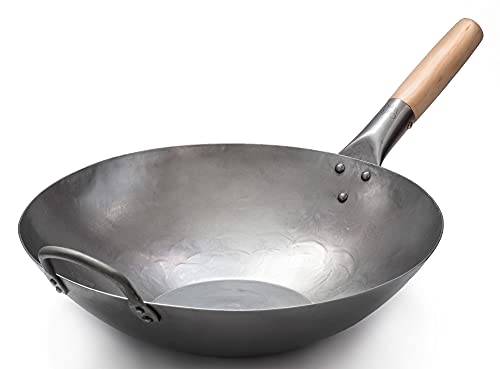
Craft Wok Flat Hand Hammered Carbon Steel Pow Wok with Wooden and Steel Helper Handle (14 Inch, Flat Bottom)
Certain content that appears on this site comes from Amazon. This content is provided “as is” and is subject to change or removal at any time.
Why we picked it
- Hand-hammered 14-inch carbon steel bowl listed at 15 gauge (1.8 mm), a heavier, heat-holding build that suits home burners
- Flattened bottom made for flat electric, induction, and gas stoves, so it sits on the cooktop instead of needing a wok ring
- Long wooden handle for stirring plus a steel helper handle for two-handed lifting and hanging storage
Reported drawbacks
- Listed at 4.6 pounds before food goes in, so lifting and pouring a full wok can take two hands
- The flat zone is not perfectly flat because of hand hammering, which can reduce contact on glass or induction tops
- Bare carbon steel must be seasoned before use, is hand wash only, and some owners report rust when it is not dried and oiled
Start With Your Burner, Because It Chooses the Bottom Shape
Woks come in two basic bottom shapes, and the right one depends almost entirely on what is under the pan. A round-bottom wok is the traditional form. It sits in a ring or directly in the flame of a powerful gas burner, and heat climbs up the curved sides, so the whole lower bowl becomes the cooking zone. On a restaurant-style burner or a dedicated outdoor wok burner, nothing tosses food better.
A flat-bottom wok has a flattened floor in the middle of the bowl. That flat zone is what makes contact with an electric coil, a glass-ceramic radiant top, or an induction surface. Those cooktops heat by contact or by magnetic coupling with the metal directly above them. A round bottom touches a flat surface at a single point, which means very little heat moves into the pan, and an induction hob may not even register the pan as present.
- Glass, coil, or induction cooktop: choose a flat bottom. This is not a compromise; it is the only shape that works properly.
- Standard home gas range: a flat bottom is still the practical choice for most people, because it sits steady on the grate. A round bottom needs a wok ring, and many home burners are not strong enough to make the ring setup worthwhile.
- High-output gas or outdoor wok burner: this is where a round bottom earns its place.
If you are still deciding whether a wok belongs in your kitchen at all on a flat cooktop, our comparison of a wok vs. skillet on a flat stovetop covers the motion and batch-size questions. This guide assumes you have decided you want the wok and now need to pick one.
Understand What “Flat Bottom” Means on a Hammered Wok
Do not expect the flat zone on a hand-hammered wok to be machined flat like the base of a clad skillet. Hammering moves metal, and the flattened area often has a slight dome or wave in it. Craft Wok states this directly on its 14-inch flat-bottom listing: the flat part “is not 100% flat,” and it describes a “flat bubble” that settles as the wok is used and heated. That is honest, and it is typical of the method.
What this means in practice depends on your cooktop. On gas, a small dome does not matter, because flame wraps the base anyway. On a glass radiant top, a little gap reduces contact in the center and slows the pan down a bit. On induction, flatness matters most, because the coil works best with close, even contact. A slightly domed wok will usually still work on induction, but it may heat less evenly than a stamped or spun wok with a truly flat disk, and it may rock or buzz slightly at high power. If induction is your only cooktop and you want the most even contact, ask yourself whether the hand-hammered character is worth that tradeoff. Many cooks decide that it is; just make the decision knowingly.
Read Gauge as Thickness, and Remember That the Number Runs Backward
Carbon steel woks are often described by gauge, and the scale confuses people because a smaller gauge number means thicker steel. A 14-gauge wok is heavier and thicker than a 16-gauge wok. Many listings, sensibly, give the thickness in millimeters as well, and that is the number worth comparing.
Thickness changes how the pan behaves:
- Thinner steel (roughly 16 gauge and up) heats and cools very fast. It responds instantly when you lift it off the heat or turn down the flame, which suits quick tossing over a powerful burner. It is also lighter and easier to lift. On the other hand, it is more prone to hot spots on a small burner and can warp if abused.
- Thicker steel (roughly 14 to 15 gauge) holds more heat. When cold ingredients hit the pan, the temperature drops less, which helps on a home burner that cannot recover quickly. It resists warping better. The cost is weight and slower response.
For most home cooks with modest burners, a thicker wok is the more forgiving choice, because heat storage partly makes up for a weaker heat source. The Craft Wok listing describes its 14-inch flat-bottom model as 15 gauge, 1.8 mm, and states a wok weight of 4.6 pounds (2.1 kg). That places it on the heavier, heat-holding side of carbon steel woks, which fits its target: flat electric, induction, and gas stoves.
Weigh the Wok Against the Way You Will Actually Lift It
Weight is the spec people skip and then regret. A wok is not a pan you only slide around. You tilt it to pour out sauce, you lift it to tip food onto a platter, and on gas you may want to toss. A bare wok that weighs over four pounds becomes considerably heavier once it holds a full batch of food.
Ask two practical questions. First, can you lift the loaded wok one-handed long enough to plate food, or will you need a second hand? Second, will you mainly push food around with a spatula on the burner, or do you want to flip it? If you plan to stir with a spatula and plate with two hands, a heavier wok is fine and the extra steel helps. If you dream of restaurant-style tossing, look for something lighter and accept that it will be less forgiving on a weak burner. Our cast iron skillet buying guide covers the same lift-and-pour logic for heavy pans, and the reasoning carries over directly.
Choose the Handle Layout for Control and Storage
Woks come in three common handle layouts.
- Two loop handles (the Cantonese style): small steel ears on opposite sides. This layout is strong and good for steaming, braising, and deep-frying, and it goes into an oven or over a campfire without worry. It is awkward for one-handed tossing, and the loops get hot.
- One long handle (often called the pow wok or Mandarin style): a long wooden or steel stick handle that gives leverage for stirring, tilting, and tossing.
- Long handle plus a helper handle: the long handle for control, plus a small loop opposite it for lifting a full wok with two hands. For a home cook, this is usually the best of both.
The Craft Wok model in this guide uses the third layout: a wooden main handle and a steel helper handle. The listing notes the steel helper will not burn over high heat and doubles as a hanging point for storage. Wooden handles stay cooler than bare steel ones, but they are a limit on oven use, and they should not sit in water. Handle attachment matters too. Look at how the handle socket is fixed to the bowl and whether the wood can be tightened or replaced over time. Our guide to riveted, welded, and screwed cookware handles explains how each fastening method tends to fail.
Pick Diameter by Burner and Batch, Not by Ambition
Wok size is quoted as rim diameter, and 14 inches is the common home size for good reason. It is large enough to keep food in the pan while you stir a stir-fry for two to four people, yet it still fits on a standard home range. Much larger woks look impressive but need much more heat than a home burner gives, so the outer bowl never gets hot enough to sear.
As with any pan, rim diameter is not cooking surface. The useful hot zone of a wok on a flat cooktop is the flat floor plus the lower part of the walls. The rest of the bowl is for pushing cooked food aside while the next ingredient hits the hot center. See pan diameter vs. cooking surface for why the rim number overstates what touches the heat. Smaller woks of about 12 inches make sense for one or two people or very small burners. Bigger is worth it only with a burner that can actually heat the extra steel.
Know What Hand Hammering Does and Does Not Change
Hand-hammered woks have a recognizable surface of small dimples. Sellers often present this as a mark of craft, and it does have practical effects, though they are modest. The dimpled texture can help oil spread and cling in a thin film, and it gives pushed-up food a little grip on the walls, so cooked ingredients rest on the sides instead of sliding straight back into the center.
What hammering does not do is change the material. It is still carbon steel, which means it still needs seasoning, still reacts with acidic food until the seasoning is established, and still rusts if left wet. Hammering also produces natural variation, including the uneven flat zone mentioned above, so two woks of the same model will not be perfectly identical. A machine-spun or stamped carbon steel wok can cook just as well; the choice comes down to whether you value the surface texture and the heavier construction that often comes with it.
Plan for the Factory Oil and the First Seasoning
Most carbon steel woks ship with a protective coating to prevent rust in storage. It is not cooking seasoning, and it has to come off before the wok’s first use. Methods vary by maker: some recommend a hot scrub with soapy water, others call for heating the wok on the burner until the coating burns off. Follow the instructions that come with your wok. Craft Wok says seasoning instructions are included and that the seasoning process includes removing the protective oil.
After the coating is gone, the wok needs its first seasoning. In broad strokes, that means heating the bare steel, wiping on a very thin layer of high-smoke-point oil, and heating until the oil polymerizes into a hard film. The steel usually changes color in the process, often from silver to blue, bronze, and eventually black. Patchy color early on is normal. Seasoning builds with cooking, especially frying and stir-frying with oil, so the wok improves the more you use it.
If you have seasoned cast iron, the idea will feel familiar. The film works the same way, though carbon steel is thinner and heats much faster, so it can go from heating to smoking in moments. Our guide on seasoning and maintaining a pre-seasoned cast iron skillet explains why thin layers of oil beat thick ones, and the same rule applies to a wok.
Accept That Bare Steel Rusts, and Build the Habit Early
Rust is the most common complaint with carbon steel woks, and it is nearly always a maintenance issue rather than a defect. Craft Wok is direct about it: any carbon steel wok “may rust if not maintained properly,” and the listing calls the wok hand wash only, not dishwasher safe. Its suggested routine is short: wash, dry, oil, fire.
In practice, that routine looks like this:
- Wash with hot water and a soft brush or sponge soon after cooking. A bamboo wok brush works well. Avoid soaking.
- Dry immediately with a towel, then set the wok on the burner for a minute to drive off the last moisture.
- Oil with a very thin wipe of neutral oil while the steel is warm, using a paper towel.
- Store somewhere dry. A hanging helper handle makes this easy, and air movement around the pan helps.
Light orange rust on new carbon steel is not the end of the wok. Scrub it off, rinse, dry, and re-season the spot. What actually ruins a wok is the dishwasher, long soaks, or storing it damp in a closed cabinet. If you know you will not keep up with this, a wok is not the right pan for you, and that is useful to know before you buy.
Treat Acid and Long Simmering Carefully While the Seasoning Is Young
Woks are versatile: they stir-fry, deep-fry, steam with a rack and lid, and handle quick braises. A new wok with thin seasoning is less forgiving with acidic ingredients such as tomato, vinegar, wine, or citrus, and with long wet cooking. Acid can strip young seasoning and leave a metallic taste. For the first several weeks, cook plenty of oily food in the wok, like stir-fries, fried rice, and shallow frying, so the coating builds before you push it with sauces and steaming. Brief splashes of soy sauce or vinegar at the end of a stir-fry are fine. A long tomato braise is better done in an enameled pot.
What the Craft Wok 14-Inch Flat-Bottom Listing Actually Tells You
The product in the box above is the Craft Wok hand-hammered carbon steel pow wok, 14 inches, flat bottom, model 731W316. Here is what its public listing states, without additions:
- Material: carbon steel with no coating; must be seasoned before use.
- Size and thickness: 14-inch diameter, 15 gauge (1.8 mm).
- Weight: 4.6 pounds (2.1 kg), described as heavy and sturdy.
- Bottom: flattened for flat electric, induction, and gas stoves, with a flat zone that is not perfectly flat because of hand hammering.
- Handles: long wooden handle plus a steel helper handle that also serves for hanging.
- Origin: described as hand hammered in Guangzhou.
- Care: hand wash only; may rust if not maintained; seasoning instructions included.
Read against the framework above, that adds up to a heavier, heat-holding wok aimed at home cooks on flat cooktops who want the traditional hammered pow-wok form with a helper handle for lifting. It is not a lightweight tossing wok, and it is not a no-maintenance pan. If you cook on induction and want the flattest possible contact, keep the “flat bubble” note in mind. If you cook on gas or radiant glass and want one wok that can handle stir-fries for a family, it lines up well with the specs that matter.
Consider What You Will Use Alongside the Wok
A wok works best with a few inexpensive companions. A long-handled wok spatula, often called a shovel or chuan, has a curved edge that matches the bowl and lets you scoop and turn food against the side. A bamboo brush makes rinsing quick. A domed lid turns the wok into a steamer or lets you finish a quick braise. A steaming rack or bamboo steamer basket that fits inside the bowl expands what it can do.
If you mainly cook on gas with a round-bottom wok, a wok ring stabilizes the pan. With a flat-bottom wok, you do not need one, and on a glass or induction top you should not use one, because it lifts the pan off the surface it needs to touch.
A Short Checklist Before You Buy
Run through these points in order, and most carbon steel woks will sort themselves out:
- Bottom shape: flat for electric, glass, and induction; flat for most home gas ranges; round only for a strong gas or outdoor burner.
- Thickness: around 14 to 15 gauge for heat holding on a home burner; thinner for speed and light weight if your burner is strong.
- Weight: realistic for how you will lift, pour, and plate.
- Handles: long handle plus helper is the easiest home layout; check how the handle is attached.
- Diameter: 14 inches for most households; smaller for one or two people.
- Care: you are ready to wash, dry, oil, and store it properly from the first day.
Get those right, and the wok will season darker and cook better every month you use it. Get them wrong, and even a well-made wok becomes the pan that never leaves the hook.