
As an Amazon Associate I earn from qualifying purchases. CookwareCompass is a participant in the Amazon Services LLC Associates Program, an affiliate advertising program designed to provide a means for sites to earn advertising fees by advertising and linking to Amazon.com.
A stand mixer is easy to buy for the color and easy to buy wrong for the work it has to do. The KitchenAid Artisan Series 5-quart tilt-head mixer is the mid-size model most home kitchens actually consider: a 5-quart polished stainless bowl with a handle, a 325-watt motor, 10 speeds, and a head that tilts back so you can reach the bowl. Those specs are enough for weeknight cookie dough, cake batter, whipped cream, and moderate batches of bread or pizza dough. They are not enough for every recipe, and the wattage number alone will not tell you where the limit is. Match the bowl, the head design, and the motor to the batches you actually mix, then choose the color.

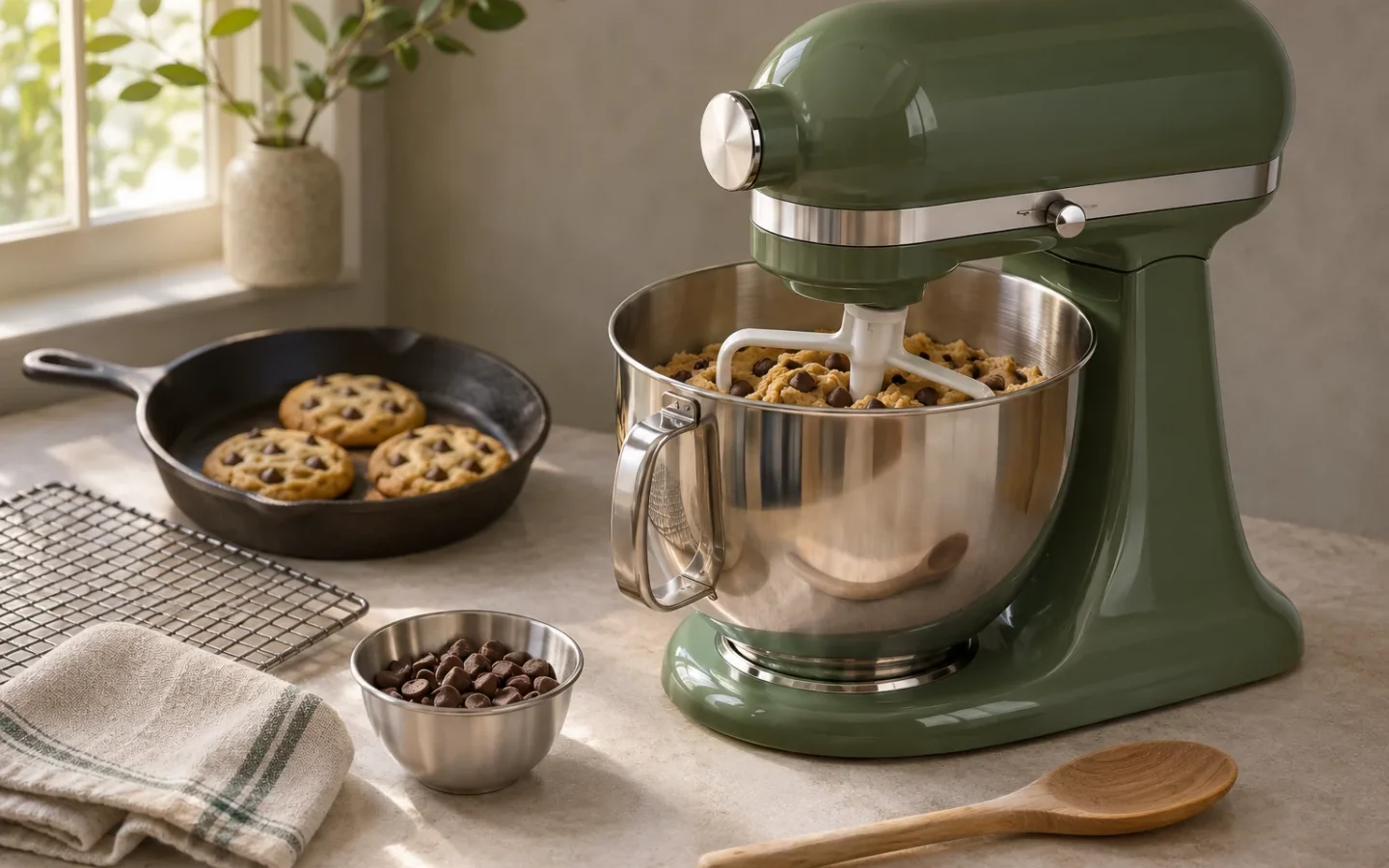
KitchenAid Artisan Series 5 Quart Tilt-Head Stand Mixer, Juniper
Certain content that appears on this site comes from Amazon. This content is provided “as is” and is subject to change or removal at any time.
Why we picked it
- 5-quart polished stainless bowl with a handle, sized for most home cookie, cake, and moderate dough batches
- Tilt-head design makes it easier to add ingredients and change tools, then locks for mixing
- 10 speeds and planetary mixing cover stirring, creaming, whipping, and Speed 2 kneading
- Includes coated flat beater, coated dough hook, 6-wire whip, and a one-piece pouring shield
- 325-watt motor is a step up from the Classic Series 275-watt rating
- Front power hub accepts optional KitchenAid attachments, sold separately
Reported drawbacks
- Yeast-dough limit is 8 cups all-purpose flour or 6 cups whole-wheat; frequent large bread batches need a bigger bowl-lift mixer
- KitchenAid requires Speed 2 only for yeast dough; other speeds risk damaging the mixer
- This U.S. model does not include Soft Start, so starting on a high speed can fling dry ingredients
- Coated beaters can chip if they scrape the bowl and may need a clearance adjustment
- The 6-wire whip may need hand-washing if it has a burnished aluminum hub
- Optional hub attachments are sold separately
- U.S. warranty is one year limited
- Tilt-head needs extra height when raised, so the mixer often has to be pulled out from under cabinets
A Mixer Has Three Jobs: Stir, Beat, and Knead Without Walking Off the Counter
A stand mixer is not a faster spoon. It has to turn a tool through a bowl at a controlled speed, keep that tool in contact with as much of the batch as possible, and stay planted on the counter while it does so. If it only spins in the center, you get a well-mixed core and a ring of unmixed flour. If you ask a mid-size machine to knead a stiff dough at a high speed, the whole unit can rock or walk.
KitchenAid uses a planetary path for that first job: the beater, hook, or whip spins on its own axis while it travels around the bowl. The company describes that path as contacting 59 points around the bowl, which is its way of saying the tool is meant to scrape more of the batch than a single centered paddle would. You cannot usefully count those points at home. What you can see is whether batter is climbing unmixed up the sides, and whether you still have to stop and scrape.
The second job is torque at low speed, not a headline wattage. KitchenAid rates the Artisan Series motor at 325 watts; the related Classic Series motor is rated at 275 watts. Both are alternating-current motors, and both figures are electrical input ratings, not a direct measure of hook strength. Wattage tells you the size of the motor in this chassis. It does not tell you how long you can knead a dense whole-wheat dough before the gears protest. The useful question is whether the motor, the gears, and the bowl are in the right class for the stiffest mixture you make often.
The third job is staying put. The Artisan uses a metal body and a solid base, and KitchenAid lists a gross weight of about 26 pounds for this series. That mass helps with cake batter and cookie dough. It is not a guarantee that a very stiff dough, mixed too fast, will leave the machine where you set it. A dry, level counter and the correct speed matter more than any marketing word about durability.
The 5-Quart Label Is Not the Same as Working Capacity
The bowl that ships with the Artisan is a 5-quart polished stainless steel bowl with a handle. KitchenAid lists it as dishwasher-safe. The handle is a real everyday difference from the Classic Series bowl, which is 4.5 quarts, brushed rather than polished, and has no handle. On paper, five quarts sounds like a lot of room. In use, you cannot fill a mixing bowl to the rim and still mix well, especially with a pouring shield in place and a tool sweeping the sides.
KitchenAid’s own capacity claim for this mixer is that the 5-quart bowl can mix up to nine dozen cookies in one batch, using the flat beater and 28 grams of dough per cookie. That is a manufacturer figure, not a kitchen test, and it assumes a relatively soft cookie dough. Cake batter, mashed potatoes, and frosting also use the flat beater, and they usually ask less of the motor than bread dough does. If cookies, cakes, and frosting are most of what you mix, the 5-quart Artisan is in the right size class.
Yeast dough is the hard limit, and it is written more tightly in the use-and-care manual than in the marketing copy. For a 4.8-liter (5-quart) bowl, KitchenAid says not to use recipes calling for more than 8 cups (1 kilogram) of all-purpose flour, or 6 cups (800 grams) of whole-wheat flour. Always use the dough hook for yeast doughs, and only Speed 2. The manual is blunt about other speeds: they create a high potential for unit failure. The Stir setting is also the wrong place to knead; KitchenAid tells you not to use Speed 1 to mix or knead yeast doughs.
KitchenAid also publishes a Flour Power rating of 9 cups for this series. Treat that as a general series rating, not a reason to ignore the lower, more specific yeast-dough limit in the manual. When the two numbers disagree, follow the lower one. That official cap still covers a loaf or two, pizza dough for a family dinner, rolls, or buns. A double batch of sandwich bread, or a heavy whole-wheat dough above those flour caps, is a reason to use a larger mixer, not a reason to crowd this one.
Tilt-Head Access Is the Main Reason to Choose This Design
The Artisan is a tilt-head mixer. You unlock the head, tilt it back, add ingredients or change tools, then lock it down again before you mix. KitchenAid’s instruction is to lock the head in place while mixing. If you leave the lock open, the head can rise under load, the tool loses contact with the bowl, and the batch is only partly mixed. The payoff is access. Scraping the bowl, dropping in chocolate chips, or swapping a flat beater for a whip is faster when the head is out of the way.
A bowl-lift mixer solves a different problem. The bowl rises into the tool on a locking yoke, usually with a three-point hold, and the head stays fixed. KitchenAid’s residential bowl-lift models are typically 5.5 or 7 quarts. The company rates a 7-quart bowl-lift at up to 13 dozen cookies, or more than 8.5 pounds of bread dough, in one batch. Those are again manufacturer figures, but the direction is clear: a bowl-lift is the more stable, higher-capacity design for frequent, heavy dough. The trade-off is access. You raise and lower the bowl to add ingredients or change tools, which is a little slower than tilting a head.
Clearance on the counter decides this as often as dough does. KitchenAid lists the Artisan and Classic tilt-head mixers at 14.1 inches deep, 8.7 inches wide, and 13.9 inches high with the head down. That height can tuck under many standard upper cabinets when the mixer is stored. When you tilt the head back, you need more vertical room, so most people pull the mixer forward to change tools or add flour. That is ordinary friction, not a defect. If your mixer will live under a low cabinet and you do not want to slide a 26-pound machine in and out, measure the open height before you buy, or plan a nearby landing spot.
Ten Speeds Only Help If You Start in the Right Place
The Artisan has 10 speeds. The lever can be set between the marked stops, which is how you get the odd-numbered speeds. KitchenAid’s speed guide is more useful than the number of notches, because the wrong speed is how a mid-size mixer gets into trouble.
- Stir: slow stirring, combining, mashing, and the start of almost every mixing job. Use it to add flour or liquids so they do not puff or splash. Do not use it to knead yeast dough.
- Speed 2: slow mixing, and the only speed KitchenAid wants you to use for yeast dough. Also used for heavy batters, cutting shortening into flour, and starting mashed potatoes.
- Speed 4: mixing semi-heavy batters such as cookies, and combining sugar and shortening. A medium speed for many cake mixes.
- Speed 6: creaming and faster beating, and a common place to finish cake and similar batters.
- Speed 8: KitchenAid’s listed speed for whipping cream, egg whites, and boiled frostings.
The standard U.S. Artisan Series 5-quart specification lists Soft Start as not included. This mixer does not automatically ramp up from a slow start the way some other KitchenAid models do. If you click the lever straight to a whipping speed with a bowl of flour in it, the first second can throw dry ingredients. Start on Stir, then move up. Pair the 6-wire whip with a higher speed when you want air in cream or egg whites; use the coated flat beater for cookies and most batters; and keep yeast dough on the coated dough hook at Speed 2. Those pairings are the conditions under which this mixer is meant to work.
What Comes in the Box, and What You Add Later
The standard Artisan model, including this Juniper listing, ships as a complete basic mixing kit. KitchenAid’s bill of materials for the KSM150PS is consistent across the regular colorways:
- 5-quart polished stainless bowl with a handle. This is the working vessel. Extra bowls in other materials and sizes are sold separately.
- Nylon-coated flat beater. The everyday tool for cookies, cakes, frosting, mashed potatoes, and similar mixtures. KitchenAid describes the coating as dishwasher-safe.
- Coated dough hook. For mixing and kneading yeast doughs. KitchenAid lists the coated hook as top-rack dishwasher-safe.
- 6-wire whip. For cream, egg whites, and other mixtures that need air. See the care notes below before you assume it can go in the dishwasher.
- One-piece pouring shield. A rim that sits on the bowl so you can add ingredients while mixing with less splash. This shield is part of the Artisan package; it is not included with the Classic and is sold separately for that line.
The mixer also has a multi-purpose power hub on the front of the head. KitchenAid says 10 or more optional hub-powered attachments can turn the mixer into a pasta maker, food grinder, spiralizer, or similar tool. Those attachments are sold separately, and not every attachment fits every mixer in the broader lineup. The hub is a genuine advantage of staying inside the KitchenAid system, but it is not versatility that arrives in the box.
The Artisan versus Classic comparison is the cleanest way to see what this chassis actually adds, without treating color as the whole story. Both are 10-speed tilt-head mixers with the same footprint and the same one-year limited warranty in the United States. The Artisan adds a 325-watt motor against the Classic’s 275 watts, a 5-quart polished bowl with a handle against a 4.5-quart brushed bowl without one, a pouring shield in the box, and a much wider color range. If you only need a smaller bowl and a simple black or white finish, the Classic is the more stripped-down machine. If you want the extra half quart, the handle, the shield, and a mid-range motor, the Artisan is the standard 5-quart tilt-head for that job.
Power, Plug, and Where the Mixer Lives Next to Your Pans
This is a 120-volt, 60-hertz household mixer with a 4-foot, three-prong cord. KitchenAid rates the Artisan motor at 325 watts, and the use-and-care manual groups KSM120 through KSM200 models at a 325-watt maximum. The manual also says not to use an extension cord. If the cord will not reach, the right fix is an outlet closer to the counter, not a longer cable trailing past a range. The same manual tells you not to let the cord contact hot surfaces, including the stove. Give the mixer a clear landing zone beside the cooktop, not a cord path across a hot grate or a skillet handle. It is a countertop appliance, not cookware: it is not oven-safe, it is not induction cookware, and the body must not go in water.
Used well, it feeds the pans you already own. Cookie dough and skillet cakes go into a cast iron skillet or a baking pan. A lean bread dough that stays inside the flour cap can be baked in an enameled or bare Dutch oven. Mashed potatoes, pan sauces, and melted butter still need a stainless saucepan or a saucier. A stand mixer does not replace those pieces, and it should not be the first tool you buy if the kitchen is still missing a skillet and a pot. Our guide to building a small cookware set around meals is the better starting point for the pans; the mixer is the tool that prepares what goes into them. When a mixed stuffing or batter is headed for the oven in a larger vessel, fit that vessel with the same care you would use when you choose a roasting pan.
The Bowl, the Coatings, and the Whip Need Different Care
The stainless bowl is the easy part. KitchenAid says its stand mixer bowls are dishwasher-safe, with a narrow exception for a special hammered copper bowl that does not apply to this Artisan. The polished finish will still show water spots if it sits un-rinsed. If a stainless pan or bowl develops rainbow tints or white spots, the same logic in our guide to rainbow stains and white spots on stainless applies: diagnose the film or heat tint before you scour. For grades and finishes more generally, see how to read stainless cookware specs.
The coated flat beater and coated dough hook are a different material. KitchenAid describes coated and stainless beaters as dishwasher-safe and recommends the upper rack. The coating is gentler on the bowl and releases food more easily than bare metal, but it can chip if the tool scrapes the bowl. KitchenAid documents this as a clearance issue as well as a care issue: the beater should pass close to the bowl without knocking against it, and the company describes a beater-to-bowl height adjustment for when the gap is wrong. Do not pry dough off the coating with a sharp metal tool. A spatula is enough. Replacement beaters exist if a coating eventually chips; that is a wear item, not a reason to ignore clearance.
The 6-wire whip needs a closer look before it goes in the dishwasher. KitchenAid notes that some wire whips are stainless with a burnished aluminum hub, and those are not dishwasher-safe. A burnished hub that is washed in a dishwasher or left to soak can oxidize. The company says that oxidation is not harmful and can be removed, but the better habit is to hand-wash the whip and dry it immediately unless you have confirmed that your particular whip is an all-stainless, dishwasher-safe version. If you are not sure, wash it by hand.
The mixer body is never a dishwasher part. Unplug it, then wipe the housing and the beater shaft with a soft, damp cloth. Do not put the stand mixer in water or other liquid. Keep hands, hair, spatulas, and towels away from a moving tool.
When the Artisan 5-Quart Tilt-Head Is the Right Mixer
This machine is the right size when most of your mixing is cookies, cakes, frosting, whipped cream, mashed potatoes, and similar batters, with occasional pizza dough, rolls, or a loaf or two of bread inside the official flour cap. You want easy access to the bowl, a handle when you carry that bowl to the counter, and a pouring shield already in the box. You have a roughly 14-by-9-inch footprint to spare, and you are willing to pull the mixer forward when the head has to tilt. You also want a specific Artisan color. This listing is Juniper, a muted green in KitchenAid’s broader Artisan palette of more than 20 colors. The machine underneath the paint is the standard KSM150PS Artisan, not a different motor or bowl.
It is also a reasonable first stand mixer for a home cook who already has pans and wants one tool that can cream butter, whip cream, and knead a moderate dough. The attachment hub leaves a path to expand later. Just do not buy it as if those attachments were included.
When You Should Choose a Different Design
Choose a larger bowl-lift mixer if you regularly knead dough above the 8-cup all-purpose or 6-cup whole-wheat cap, or if you want the extra stability of a locked bowl for frequent, heavy bread work. The 5-quart tilt-head can do bread; it is not the mixer KitchenAid builds for the biggest home batches.
Look at a smaller mixer, such as the Artisan Mini 3.5-quart tilt-head, if your batches are consistently small and counter space is tight. A 5-quart bowl is awkward when you are whipping a few egg whites, and a large mixer is a poor use of a crowded counter if you never fill it. Consider the Classic tilt-head only if you want the same basic design in a slightly smaller 4.5-quart bowl, you do not need a handle or an included pouring shield, and a simple color is enough. You give up some motor rating and some capacity, not the 10-speed planetary design or the attachment hub.
Skip a full-size stand mixer altogether if you mix only occasionally and a sturdy hand mixer or a bowl and whisk will do. A stand mixer earns its footprint when you use it often enough that holding a hand mixer becomes the annoying step. If that is not your kitchen, the counter space is better left for pans you will use every day.
What the KitchenAid Artisan 5-Quart in Juniper Tells You About This Category
The product in the box above is the standard Artisan Series 5-quart tilt-head mixer in Juniper, model KSM150PSJP, listed as Amazon ASIN B0D1DNF2F6. It is not a Design Series model with a glass bowl, and it is not a bowl-lift. It is the common mid-size KitchenAid: 325-watt motor, 10 speeds, 5-quart polished stainless bowl with handle, coated flat beater, coated dough hook, 6-wire whip, one-piece pouring shield, and a front power hub for optional attachments. The Juniper finish is a color choice, not a performance choice; other standard Artisan colors use the same KSM150PS platform.
The honest drawbacks travel with the same specs. Yeast dough must stay on the dough hook at Speed 2. This U.S. model does not include Soft Start, so you should start on Stir. Coated beaters can chip if they scrape the bowl and may need a clearance adjustment. The 6-wire whip may need hand-washing if its hub is burnished aluminum. Hub attachments are sold separately. The U.S. warranty is a one-year limited warranty from the date of purchase, which is short for a machine many people expect to keep for years, and it is a reason to register the mixer and keep the receipt. None of those points make the Artisan a poor mid-size mixer. They are the terms on which it works.
The Short Version: Choose Capacity, Head Design, and Motor Before the Color
The KitchenAid Artisan 5-quart tilt-head mixer is the right tool when your usual work is cookies, cakes, frosting, and moderate dough inside an 8-cup all-purpose or 6-cup whole-wheat flour cap, and when you want a handle, a pouring shield, and easy bowl access. A larger bowl-lift is the better tool when bread batches regularly exceed that cap or you want more stability under a heavy hook. A smaller mixer is the better tool when the batches themselves are small and the counter is tight.
Before you buy, read the flour limits in the manual, measure the space above the counter with the head tilted back, and be honest about how often you actually knead stiff dough. Get those three things right, start on Stir, keep yeast dough at Speed 2, and this 5-quart Artisan will do the three jobs a home stand mixer has: stir, beat, and knead, without asking the motor or the bowl to do work they were not sized for. Pick the color last. Juniper is one finish on the same machine.