
As an Amazon Associate I earn from qualifying purchases. CookwareCompass is a participant in the Amazon Services LLC Associates Program, an affiliate advertising program designed to provide a means for sites to earn advertising fees by advertising and linking to Amazon.com.
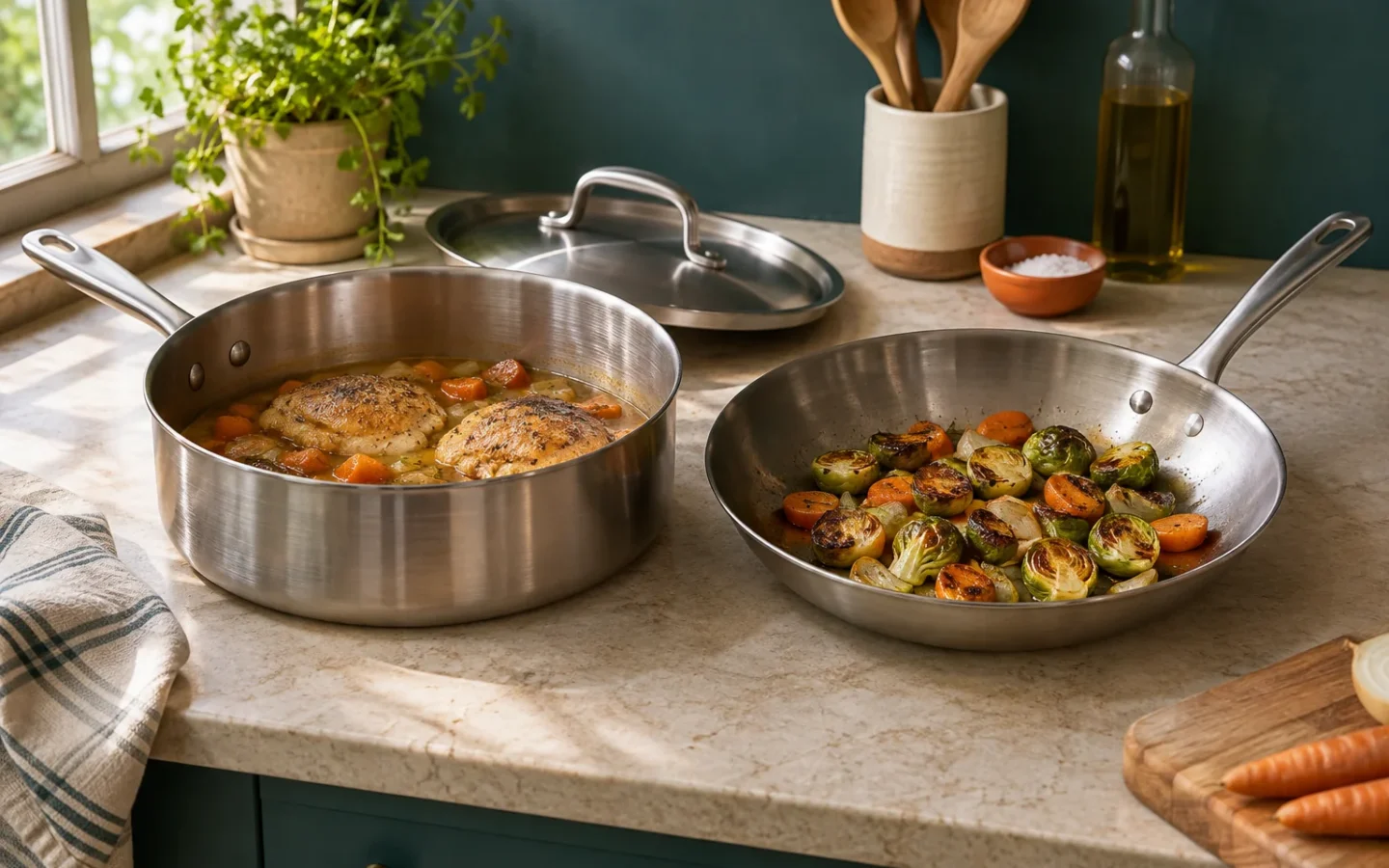
A sauté pan and a skillet can share the same advertised diameter yet behave like different sizes. The sauté pan carries its flat floor almost to the rim, then rises into straight walls. The skillet curves upward, exchanging floor area for access and evaporation. Choosing between them is less about culinary vocabulary than about what must happen to moisture, utensils, and food at the edge of the pan.

OXO Obsidian Pre-Seasoned Carbon Steel 8-Inch Frying Pan
Certain content that appears on this site comes from Amazon. This content is provided “as is” and is subject to change or removal at any time.
Why we picked it
- Sloped skillet walls leave a utensil a clean approach angle
- Carbon steel responds faster than thick cast iron
- Removable silicone sleeve separates grip comfort from oven use
Reported drawbacks
- Eight-inch rim leaves a notably smaller cooking floor
- Low flared sides contain less liquid than a sauté pan
- Seasoned carbon steel needs drying and light oiling
Compare the floor before the label
A twelve-inch skillet may have a cooking floor only nine or ten inches across. A twelve-inch sauté pan can provide close to the full diameter, depending on its corner radius. The extra circle of metal may hold another chicken thigh or prevent mushrooms from stacking. When browning depends on spacing, usable floor diameter matters more than the name.
That does not mean the sauté pan is automatically larger in every useful way. A spatula approaches food horizontally, and a straight wall blocks the handle sooner. The skillet’s slope lets the blade slide under fish, pancakes, and eggs without forcing them into the wall. Its apparent lost area buys working access.
Straight walls keep liquid where it belongs
For a shallow braise, curry, or pan sauce, vertical sides contain more liquid at a given floor size. They reduce the chance that stirring pushes sauce over a low edge and make a lid easier to seat. The corner also gives a whisk a defined path, although a very sharp interior angle can trap flour or thickened sauce.
A sauté pan with a four-quart capacity can move from browning to deglazing to covered simmering without changing vessels. That workflow is its strongest case. If you mostly cook dry foods and finish with a spoonful of butter, the capacity is unused weight.
Sloped walls help moisture escape
Steam leaves food, moves upward, and must clear the pan. A broad, open skillet presents less wall around that path. This helps when sautéing vegetables whose texture depends on shedding water quickly. It also makes reduction easier to judge because the exposed surface is visible.
The effect is not magic. Crowding, low heat capacity, and wet ingredients can overwhelm either shape. A wide sauté pan may still evaporate faster than a small skillet because surface area dominates. Wall angle is one factor in a system that includes batch size and burner power.
Tossing requires a ramp
When a skillet is pulled sharply toward you, food travels up the far slope and turns back into the pan. A vertical wall stops that movement. You can stir a sauté pan perfectly well, but it is the wrong geometry for repeated pan tossing. If wrist mobility or pan weight makes tossing impractical anyway, this advantage may not matter. A heavy cast iron skillet has the sloped walls but rarely the lightness to toss food comfortably, so its size and weight deserve extra thought.
Do not choose by imagining restaurant technique you rarely use. Think about your actual utensil. A flexible fish spatula loves a low flare. A wooden spoon working through stew benefits from containment. Tongs can operate in either but need enough wall clearance to turn long pieces.
A lid changes the role
Sauté pans usually include lids because their straight rims are designed for covered cooking. Many skillets are sold open, and a universal lid may sit awkwardly on a flared rim. If you routinely steam vegetables after browning or finish chicken gently under cover, a stable fitted lid is useful.
The lid also adds storage and handling weight. Confirm that its knob clears shelves and stays graspable with an oven mitt. A glass lid gives a view only until condensation forms; a metal lid is lighter and more tolerant of knocks. The pan’s oven rating may be higher than the lid’s.
The helper handle is not decorative
Straight sides hold more food and liquid, so a sauté pan becomes heavy quickly. A helper handle opposite the main grip lets two hands control a full transfer to the oven or table. It is especially important on wide clad pans, where the empty vessel is already substantial.
Check that both handles accept oven mitts without forcing knuckles against the wall. A tiny loop may look elegant and fail under a loaded pan. On a skillet, a helper grip is still valuable above ten inches, but the lighter capacity makes it less essential for quick stovetop work.
Which foods reveal the difference?
- Choose the skillet for: eggs, pancakes, cutlets, fish fillets, grilled sandwiches, quick vegetables, and food you turn with a spatula.
- Choose the sauté pan for: chicken braises, meatballs in sauce, shallow frying, curries, risotto, pan sauces, and dishes that begin dry and finish with liquid.
- Either works for: searing steaks, browning ground meat, reheating leftovers, or reducing a small sauce—provided size and heat distribution are right.
The boundary is practical, not ceremonial. You are not cooking incorrectly when you scramble eggs in a sauté pan. You are accepting slightly worse utensil access in exchange for using the pan already on the stove.
Storage can decide the answer
A sauté pan occupies a wide cylinder in a cabinet, and its lid needs another slot. A skillet can nest with other sloped pans, though bare stainless placed inside nonstick needs a protector. Measure shelf depth with the full handle; wide pans often fit the cooktop and fail the cupboard.
If you can own only one, choose based on your dominant cooking method. Households that braise and make saucy one-pan dinners gain more from the sauté pan. Cooks who fry, flip, and serve food directly from a dry pan usually reach for the skillet.
How to compare them fairly
Ignore matching rim diameters and compare flat floors, empty weight, working capacity, total length, and handle clearance. Hold each with a few pounds inside. Slide your usual spatula across the floor. Put the lid on, rotate it, and check whether the helper grip remains accessible.
Then look at construction. A sauté pan benefits from conductive material into the lower wall. A skillet needs even coverage across its broad floor. Neither shape compensates for a hot center, rocking base, or uncomfortable handle.
Shallow frying favors containment
Straight, higher walls give oil more distance before it can splash over the rim. The broad floor also holds several breaded pieces at a consistent depth. Leave generous headroom, add food away from you, and monitor temperature; wall shape reduces mess but does not make hot oil forgiving.
A skillet is easier to enter with a fish spatula and easier to pour from, but its low flare exposes more of the oil surface. For a spoonful of oil and quick cutlets, that openness is convenient. For half an inch of oil and multiple batches, a sauté pan or another deep, stable vessel is the more controlled choice.
Corner shape matters when building a sauce
After searing, browned fond collects across the floor and near the wall. A gently rounded interior corner lets a whisk or wooden spoon sweep through that transition. A sharp corner creates extra floor area but can hide flour paste and scorch thick sauce. Examine the inside profile rather than assuming every straight-sided pan is identical.
The skillet’s continuous curve is easy to scrape, yet liquid spreads into a thinner layer as it rises toward the rim. That accelerates reduction and makes small volumes harder to pool for spooning. Choose the corner and wall based on whether you want containment or rapid evaporation after deglazing.
Pouring exposes another difference. A skillet’s flare offers a broad path but can send a thin sauce over a wide section of rim. A sauté pan contains the liquid until it reaches one point, especially when it has a pouring lip. Test the motion with cold water before attempting it with hot fat.
The shortest useful rule
Choose a skillet when access and evaporation are part of the technique. Choose a sauté pan when floor area and liquid containment are part of the recipe. If both seem appropriate, the one you can lift, clean, and store comfortably will be the one that actually cooks dinner. If you only have room for one more piece, pick the one that fills a gap in your set.