
As an Amazon Associate I earn from qualifying purchases. CookwareCompass is a participant in the Amazon Services LLC Associates Program, an affiliate advertising program designed to provide a means for sites to earn advertising fees by advertising and linking to Amazon.com.
A “PFAS-free” sticker on a nonstick pan tells you something real but narrow: the cooking surface is not made from a fluorinated polymer such as PTFE. It does not tell you how long the release will last, how much heat the coating tolerates, or whether the pan works on your cooktop. To buy well, you need to know what each coating is made of, how each one fails, and which label words are claims versus decoration.

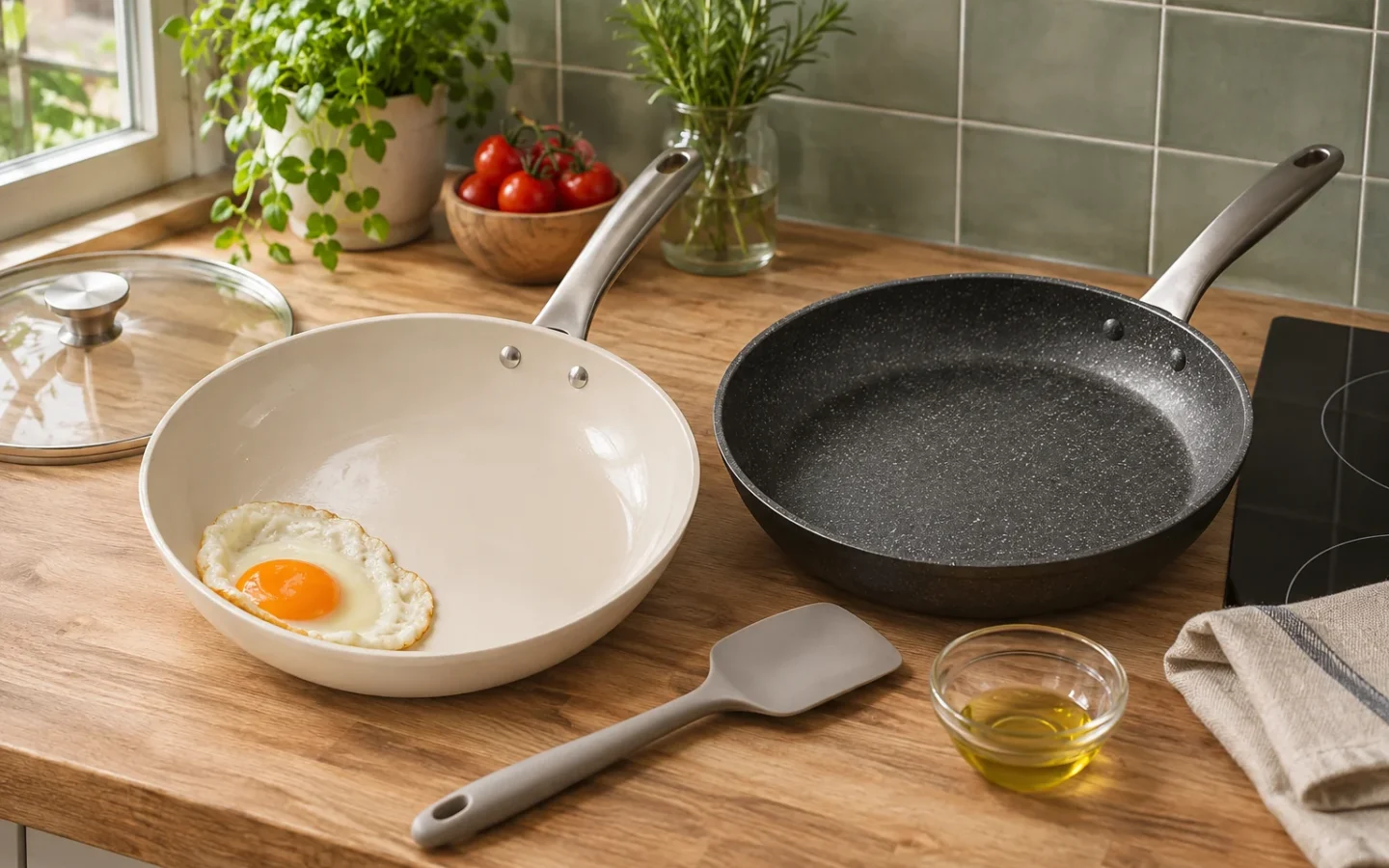
SENSARTE Nonstick Ceramic Frying Pan with Lid, PFAS/PTFE Free, Induction Compatible
Certain content that appears on this site comes from Amazon. This content is provided “as is” and is subject to change or removal at any time.
Why we picked it
- Ceramic coating listed as free of intentionally added PFOA, PTFE, PFAS, lead, and cadmium
- Heavy-duty cast aluminum body with an induction-compatible base
- Tempered glass lid included, and the rivet-free interior is easy to wipe clean
- Bakelite woodgrain handle listed as staying cool on the stovetop
Reported drawbacks
- No oven-safe temperature is listed on the product page, so treat it as a stovetop pan unless the maker confirms a limit
- Listing is inconsistent on care (dishwasher safe vs. hand wash only); hand-wash it to protect the coating
- Ceramic release typically fades sooner than PTFE nonstick; keep heat low to medium and skip aerosol sprays
Start With What PTFE Actually Is
PTFE stands for polytetrafluoroethylene, a long carbon chain completely sheathed in fluorine atoms. Teflon is the best-known brand name, but many companies make PTFE coatings under their own trade names. The carbon–fluorine bond is one of the strongest in chemistry, which is why so little sticks to the surface and so few cooking ingredients react with it.
On a pan, PTFE is applied as several thin layers over a roughened aluminum or steel body, then sintered at high temperature at the factory. The result is a slick, slightly soft film. Better coatings use more layers and sometimes add hard particles to the base layers to slow abrasion, but the food still touches PTFE on top.
At normal cooking temperatures PTFE is stable. The commonly cited concern is overheating: coating manufacturers advise against heating an empty PTFE pan on high, because the polymer begins to degrade at temperatures well above normal sautéing, and the fumes from a badly overheated pan can cause temporary flu-like symptoms in people and are known to be dangerous to pet birds. That is a heat-management rule, not a reason to panic about an omelet.
Separate PFOA, PFAS, and PTFE Before You Read Any Box
These three abbreviations get blended together on packaging, and they mean different things. Getting them straight removes most of the confusion in this category.
- PFOA (perfluorooctanoic acid) is a small fluorinated chemical that was once used as a processing aid when PTFE was manufactured. Major U.S. producers phased it out under an EPA stewardship program that concluded in 2015. A “PFOA-free” label on a new pan is true, but it no longer distinguishes one PTFE pan from another.
- PFAS (per- and polyfluoroalkyl substances) is a broad family of thousands of fluorinated compounds. PFOA is one of them. Under widely used definitions, including the OECD’s, fluoropolymers such as PTFE also fall inside the PFAS family, though industry groups argue that large, stable polymers should be treated differently from small, mobile molecules.
- PTFE is the specific polymer that forms the slick layer on traditional nonstick pans. A pan can honestly be “PFOA-free” and still be a PTFE pan.
So when a pan says “PFAS-free” or “PTFE-free,” the meaningful part is that the coating does not rely on fluorinated chemistry at all. Some U.S. states have begun restricting or requiring disclosure of intentionally added PFAS in cookware, which is one reason these labels have multiplied. What the label means legally can vary by jurisdiction, so treat it as a statement about coating chemistry, not a performance promise.
Understand What a Sol-Gel Ceramic Coating Is
Most “ceramic nonstick” pans use a sol-gel coating. A liquid made from silicon-based precursors is sprayed onto the pan body and cured into a thin, hard, glass-like film. Chemically it is closer to a very thin layer of silica glass than to the pottery the word “ceramic” suggests.
That film is harder than PTFE, which is why it can look glossy and feel slick when new. Its release comes from a very smooth surface rather than from a fluorinated chain that food cannot grip. Many formulations are widely understood to get part of their early slickness from silicone-based components in the coating, and that contribution diminishes with heat and use.
Do not confuse sol-gel with porcelain enamel, the thick glass layer fused onto enameled cast iron at high temperature, or with solid ceramic stoneware. Those are different materials with different behavior. A ceramic-coated frying pan is usually an aluminum pan with a thin sol-gel skin.
Expect Each Coating to Fail in a Different Way
Every nonstick coating is a wear item. The useful question is not whether it will fail, but how, and whether you can slow that failure with the way you cook.
PTFE fails mostly by abrasion and overheating. Metal utensils, abrasive pads, stacking pans without protection, and repeated high heat wear through or roughen the film. You usually see it: scratches, dull patches, then spots where eggs suddenly grab. As long as the film is intact and kept at moderate heat, release tends to stay consistent for a long time.
Ceramic fails mostly by gradual loss of release. The hard surface resists light scratching better than PTFE, but its slickness fades with heat cycles even when the surface looks undamaged. Independent durability testing has generally found that ceramic coatings lose their egg-sliding release sooner than good PTFE coatings. Polymerized oil films and burned-on residue speed that decline because they fill the smooth surface with something food can grip.
Both can chip or blister. Thermal shock, such as plunging a hot pan into cold water, stresses the bond between coating and metal. Dropping or knocking the rim can chip a ceramic film, since harder coatings tend to be more brittle. Once the coating lifts at an edge, it rarely stops there.
Respect Heat Limits and Change How You Preheat
The two coatings have different reasons for wanting moderate heat, and the reasons matter. PTFE should stay moderate because the polymer itself degrades if overheated. Ceramic does not produce fluoropolymer fumes, but high heat is the single fastest way to burn off its release and carbonize oil onto the surface.
In practice, that means the same habits work for both:
- Preheat on low to medium, not on high. Thin aluminum pans reach cooking temperature quickly, often within a minute or two.
- Add fat early or with the food. A thin film of oil in the pan during preheating helps you see when the surface is hot, since the oil shimmers, and keeps the bare coating from sitting empty over a flame.
- Never leave an empty nonstick pan on a burner. This rule is about the polymer for PTFE and about the coating’s lifespan for ceramic.
- Size the burner to the pan. A flame licking up the sides overheats the rim and handle area while doing nothing for the food.
If you need a hard sear, neither coating is the right tool. That job belongs to stainless steel, cast iron, or carbon steel, as we explain in our comparison of nonstick vs. stainless skillets. Nonstick earns its place with eggs, delicate fish, pancakes, and anything that must release cleanly at moderate heat.
Oven use follows the same logic. The coating may tolerate an oven, but the handle material, any silicone grip, and a glass lid’s knob or vent often set a lower limit. A broiler is a different situation entirely, because radiant heat can push the surface far past the oven dial’s number. Read the manufacturer’s listed limits for every part, and see our guide to oven-safe vs. broiler-safe cookware before you put any nonstick pan under a broiler.
Check the Base Before You Trust an Induction Claim
Most nonstick pans have aluminum bodies, and aluminum alone does not work on induction. Induction needs a ferromagnetic material in contact with the glass, so induction-compatible aluminum pans carry a steel plate bonded or pressed into the base. The coating type has nothing to do with it; a ceramic pan and a PTFE pan face the same requirement.
Three things are worth checking on any induction-ready nonstick pan:
- Plate coverage. The magnetic plate is often smaller than the pan’s full base. Only the area above the plate heats directly; the rest relies on the aluminum to spread heat outward.
- Flatness. Induction rewards flat contact. A base that bows when hot can cause hums, uneven heating, or a pan that the cooktop intermittently fails to detect.
- Magnet test. A fridge magnet should grip the base firmly. If it barely holds, expect weaker or slower heating on some induction units.
Induction can also bring a thin pan up to temperature very quickly. That is convenient, but it makes the “preheat on low to medium” rule even more important for both coatings. Start lower than you would on gas and adjust upward.
Cook and Clean Each Coating the Way It Wants
Day to day, ceramic and PTFE pans are handled similarly, with a few differences that change how long they last.
Utensils. Use wood, silicone, or nylon on both. Ceramic’s harder surface tolerates an occasional slip better than PTFE does, but metal edges still create micro-scratches that give food a foothold.
Fats. A small amount of oil or butter improves release on both coatings and protects the surface. Skip aerosol cooking sprays. Their propellants and emulsifiers leave a thin residue that bakes into a sticky film, and on ceramic that film is a common cause of a pan that “stopped working” within months.
Cooling and washing. Let the pan cool before it meets water to avoid thermal shock. Hand washing with a soft sponge and mild detergent is the gentlest option for both coatings, even when a pan is labeled dishwasher-safe, because harsh detergent and long hot cycles wear coatings faster.
Residue removal. If release fades on a ceramic pan, the cause is often a clear, slightly tacky layer of polymerized oil rather than a worn-out coating. A paste of baking soda and water, worked gently with a soft sponge, can lift that film. Avoid scouring powders and green abrasive pads on either coating.
Storage. Hang the pan or put a soft liner between stacked pans. Rim-to-surface contact during stacking scrapes coatings more than most people realize.
Read Coating Labels for What They Commit To
Nonstick packaging is crowded with words that sound technical but commit to very little. Read it as a buyer looking for specific claims.
- “PFOA-free” is standard for current pans sold in the U.S. It says nothing about whether the coating is PTFE.
- “PTFE-free” and “PFAS-free” are the claims that matter if you want to avoid fluoropolymer coatings. Look for one of them stated plainly, ideally alongside a description of the coating type.
- “Granite,” “stone,” “marble,” “diamond,” and “titanium” usually describe appearance or reinforcing particles, not the release layer. Many pans marketed this way use a PTFE-based coating. If the listing does not say PTFE-free, do not assume it is.
- “Ceramic” usually means a sol-gel coating, but some products use the word for ceramic-reinforced PTFE. A ceramic pan that is not also described as PTFE-free deserves a closer look.
- “Non-toxic” is a marketing word, not a defined standard. It tells you what the seller wants you to feel, not what the coating is.
- “Metal-utensil safe” describes a durability goal. Even when true, metal tools shorten the release life of every nonstick coating.
The most useful listing tells you the coating chemistry, the base material, induction compatibility, the oven limit for each component, and the care instructions. If a listing gives you a color name and three adjectives instead, the label is doing branding work, not informing you.
Judge Health Claims by What Is Actually Supported
The honest summary is narrower than either side of the internet tends to admit. Intact PTFE used at normal cooking temperatures is considered very stable, and the clearest documented hazard is fumes from serious overheating. Much of the broader PFAS concern relates to manufacturing, environmental persistence, and smaller, mobile PFAS compounds, rather than to a cooked egg touching an intact coating.
At the same time, choosing to avoid fluoropolymers is a reasonable preference, whether your reasons are environmental, regulatory, or personal. A PTFE-free ceramic pan is a legitimate way to act on that preference. What it is not is a proven health upgrade for your dinner, and a seller who implies otherwise is overselling.
Ceramic coatings are less studied over long periods simply because they are newer and formulations vary by manufacturer. That is not evidence of harm. It is a reason to rely on stated coating claims and sensible use, not on marketing words like “healthy” or “toxin-free.”
Match the Coating to the Cook, Not to the Fear
Once you strip away the labels, the choice comes down to how you cook and what trade-off you accept.
Choose PTFE if your priority is the longest-lasting easy release for eggs, crepes, and fish, and you are disciplined about moderate heat and soft utensils. PTFE generally gives the most consistent release per year of use, which also means fewer replacement pans.
Choose ceramic if you want a cooking surface made without fluorinated chemistry and accept that its slickness will likely fade sooner. Ceramic suits cooks who already use a little fat, keep heat moderate, and clean carefully. Plan on treating it as a replaceable pan rather than a lifetime one.
Choose neither for high-heat work. If most of your cooking is searing steaks, charring vegetables, or building a fond for pan sauces, buy stainless, cast iron, or carbon steel first and keep a single nonstick pan for eggs.
Choose by cooktop, too. If you cook on induction, confirm compatibility in the listing and check the base with a magnet. A great coating on the wrong base is still the wrong pan.
Use This Checklist Before You Buy Either Pan
- Identify the coating chemistry in plain words: PTFE-based or PTFE-free ceramic (sol-gel).
- Ignore “PFOA-free” as a differentiator; it applies to essentially all current pans.
- Treat “granite,” “stone,” “diamond,” and similar words as appearance terms until the listing says otherwise.
- Confirm the base material and, if needed, induction compatibility and plate coverage.
- Find the oven limit for the body, handle, and lid separately, and use the lowest number.
- Read the care instructions and decide honestly whether you will hand wash and avoid aerosol sprays.
- Expect to replace any nonstick pan eventually, and budget for that rather than for a forever pan.
“PFAS-free” is a useful filter if avoiding fluoropolymers matters to you. It is not a quality grade. The pan that serves you best is the one whose coating, base, and care demands match the way you actually cook on an ordinary weeknight.