
As an Amazon Associate I earn from qualifying purchases. CookwareCompass is a participant in the Amazon Services LLC Associates Program, an affiliate advertising program designed to provide a means for sites to earn advertising fees by advertising and linking to Amazon.com.
Stainless cookware listings are dense with numbers that sound precise and often answer the wrong question. “18/10,” “five-ply,” “surgical,” and “induction ready” can all be technically true without telling you whether the pan spreads heat evenly, balances well, or fits your burner. A useful reading starts by separating the food-contact surface, conductive core, magnetic exterior, and physical dimensions.

All-Clad D3 12-Inch Stainless Fry Pan with Lid
Certain content that appears on this site comes from Amazon. This content is provided “as is” and is subject to change or removal at any time.
Why we picked it
- Published model, dimensions, construction, and heat limit are specific
- Fully bonded tri-ply body extends the core to the rim
- Metal lid and handle avoid mixed-material heat limits
Reported drawbacks
- Premium price makes specification comparison especially important
- Long handle and lid require more storage than the pan alone
- Polished stainless shows cooked-on oil and water marks
18/10 describes an alloy, not an entire pan
The familiar notation refers approximately to chromium and nickel percentages in one stainless alloy. Chromium supports corrosion resistance; nickel helps stability and finish. It does not specify thickness, core material, flatness, handle quality, or heat distribution. A thin 18/10 shell around a weak base can cook poorly, while a well-built pan using a different stainless grade can perform very well.
Some manufacturers avoid nickel on the exterior so the pan works on induction, because common nickel-rich stainless is not strongly magnetic. That exterior choice says nothing alarming about the interior. Ask which alloy contacts food and which layer is magnetic rather than treating one number as the recipe for the whole vessel.
Ply count needs total thickness
Three-ply usually means stainless, conductive core, stainless. Five-ply may split the core into multiple alloys, add bonding layers, or alternate thin sheets. Counting layers does not tell you how much conductive metal is present. A thick aluminum core spreads heat farther than several very thin layers with the same impressive label.
Look for total wall thickness and a description of the core. If neither is published, weight can provide a rough clue when pans have similar dimensions. It cannot distinguish steel from aluminum, but an unusually light “seven-layer” pan is not hiding a massive conductive core. More layers also do not guarantee faster response; more mass generally slows temperature change.
Fully clad and impact-bonded are locations
Fully clad means the layered material continues from base into walls. Impact-bonded or encapsulated-base cookware uses a separate conductive disc beneath the vessel. The first can help shallow pans where food and sauce contact lower sidewalls. The second can be entirely appropriate for stockpots and saucepans, especially when the disc is thick and reaches the edge of the floor.
Read construction together with shape. Paying for cladding at the upper wall of a tall water-filled pot provides less practical benefit than paying for a broad base and strong handles. Conversely, a small disc under a wide sauté pan can leave a stubborn cool perimeter.
Dimensions should include three diameters
The top rim controls lid fit and storage. The interior floor controls how much food can brown without crowding. The exterior base controls contact with the burner. A listing that supplies only one “diameter” forces you to guess at the other two. For a skillet with sloped sides, the difference can be several inches.
Also check overall length with the handle, interior depth, height with the lid knob, and weight without packaging. These decide whether the pan fits your oven, cabinet, sink, and wrist. Capacity measured to the brim is not normal working capacity; hot food needs headroom.
Induction ready is only the first test
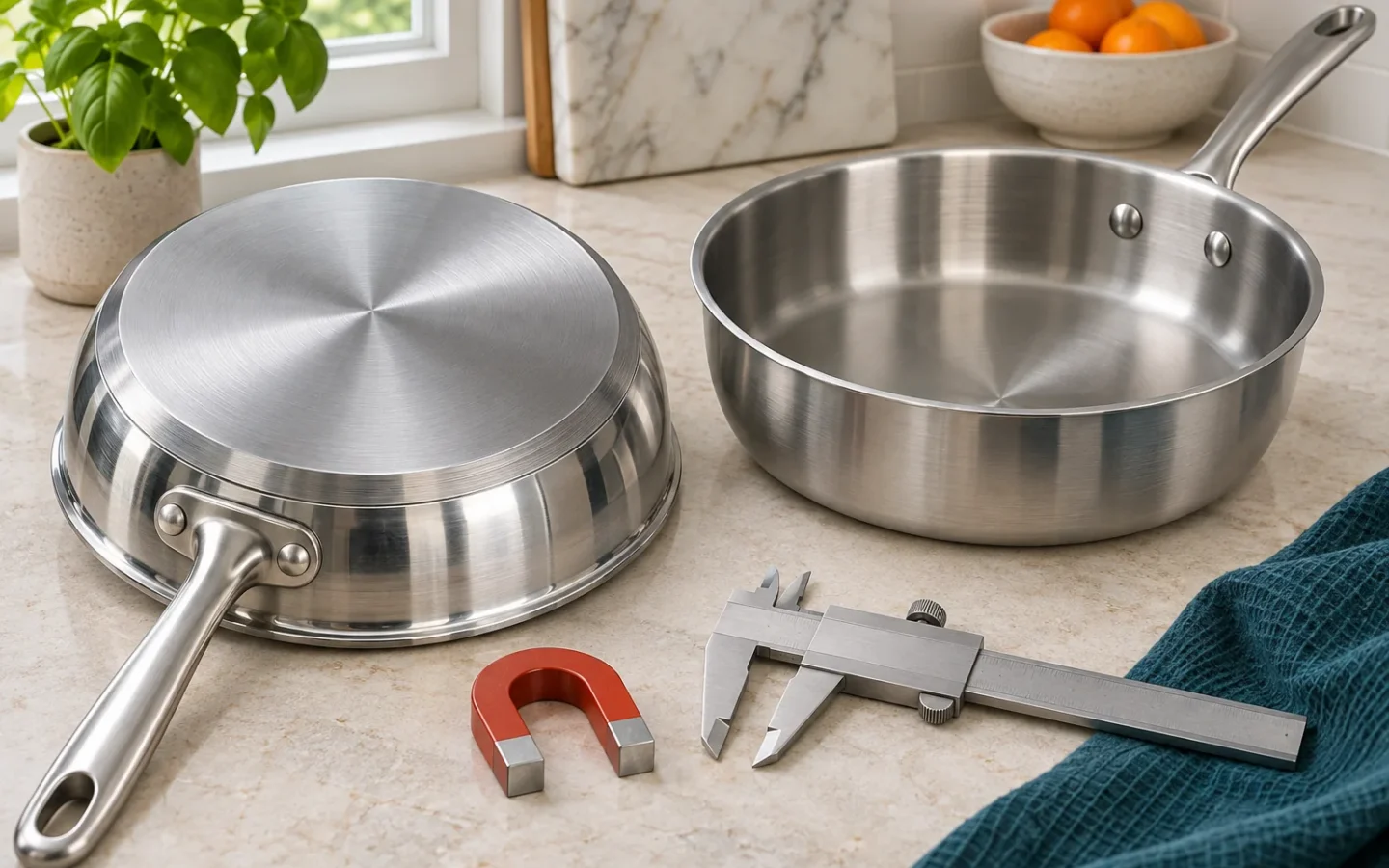
A magnet should cling firmly across the flat base. That confirms magnetic material but not even heating, quiet operation, or compatibility with every cooktop’s pan detection. Very small bases can fall below a zone’s minimum diameter. Thin magnetic layers can concentrate heat before the aluminum core distributes it.
Look for a base diameter range in the cooktop manual and compare it with the cookware’s external flat base. Ignore photos of magnets stuck to sidewalls; sidewall attraction is not required for a base-driven induction zone. A perfectly flat base matters because rocking reduces stability and can confuse temperature control on some appliances.
Oven-safe temperature follows the weakest component
A stainless body may tolerate more heat than its silicone grip, nonstick interior, glass lid, adhesive badge, or handle finish. Read separate limits for pan and lid. Check whether the stated limit includes broiler use; direct radiant heat from above is different from the air temperature in an oven.
“Stay-cool handle” applies to ordinary stovetop conditions, not the oven. Hollow grips and forked brackets slow heat conduction from the body, but oven air surrounds the handle. Plan to use a dry mitt and keep a visible reminder on any pan recently removed from the oven.
Dishwasher safe is not the same as consequence free
Dishwasher detergent is alkaline and abrasive. It can dull polished finishes, attack exposed aluminum at a clad rim, and leave mineral film. A maker may call a pan dishwasher safe because the process does not make it unsafe, even though appearance changes. Read care instructions for sealed rims, handle materials, and exterior coatings.
If a warranty excludes discoloration, pitting from salt, thermal shock, and dishwasher damage, those exclusions matter more than a large “lifetime” headline. A useful warranty names the covered structural faults and explains how shipping, proof of purchase, and discontinued models are handled.
Country-of-origin language can be narrow
“Designed in,” “engineered in,” “finished in,” and “made in” are different claims. A vessel can be designed in one country, its metal bonded in another, formed elsewhere, and packaged at the brand’s headquarters. None of those locations alone predicts quality. Treat origin as traceability information, not a substitute for construction details.
Specificity is the useful signal. A manufacturer that publishes alloy, thickness, dimensions, replacement-part availability, and care limits gives you facts to compare. A page dominated by heritage language and proprietary layer names gives you fewer.
A practical specification checklist
- Food-contact alloy and whether the interior has any coating.
- Core material, total thickness, and whether it covers base only or walls too.
- Interior floor, exterior base, rim, depth, overall length, and bare weight.
- Handle attachment, helper handle, lid material, and replacement-part support.
- Separate oven and lid limits, plus an explicit broiler statement.
- Induction base diameter and compatibility with your specific cooking zone.
- Warranty exclusions, service location, and who pays return freight.
If a listing omits several of these, ask the seller in writing or choose a product that publishes them. Precise cookware is not necessarily better cookware, but precise specifications make bad fit less likely.
Product photographs can confirm or contradict the copy
Look for an underside view, a direct side profile, the interior handle attachment, the rim, and the lid seated on the vessel. A base close-up can reveal whether “clad construction” means a continuous body or a separate disc. Side photographs show how much of the advertised diameter disappears into the wall slope.
Ignore images where every pan is shown at a different angle or filled to hide the interior. Rendered cutaways may explain an intended layer stack but do not prove production thickness. Customer photographs with a ruler can help, yet model revisions and bundled variants mean you should match handle shape and item number before relying on them.
Balance is the missing specification
Total weight does not tell you where the weight sits. A heavy handle can tip a small empty saucepan; a thick disc can make another stable but tiring to pour. Few listings publish center of mass, so this is one reason to handle cookware in person or buy from a seller with a clear return path.
Simulate the intended load rather than waving an empty display pan. A folded towel or sealed bag of dry rice can stand in for food without making a mess. Lift, pour, and support the helper grip. If the handle twists in your hand before the pan is hot, no alloy specification will fix the ergonomics.
Read from the cooking job backward
Start with the meal, portion count, burner, and storage space. Then use specifications to rule pans in or out. The alloy number and ply count become supporting facts instead of shopping goals. That shift prevents you from buying an impressive materials story attached to the wrong shape, size, or weight. If you are buying several pieces at once, plan a small set around the meals you cook before comparing spec sheets.
Keep the comparison in a simple table and mark every missing value as unknown, not zero. Unknown floor diameter, weight, or heat limit is still information: it tells you which question must be answered before the return window closes.