
As an Amazon Associate I earn from qualifying purchases. CookwareCompass is a participant in the Amazon Services LLC Associates Program, an affiliate advertising program designed to provide a means for sites to earn advertising fees by advertising and linking to Amazon.com.
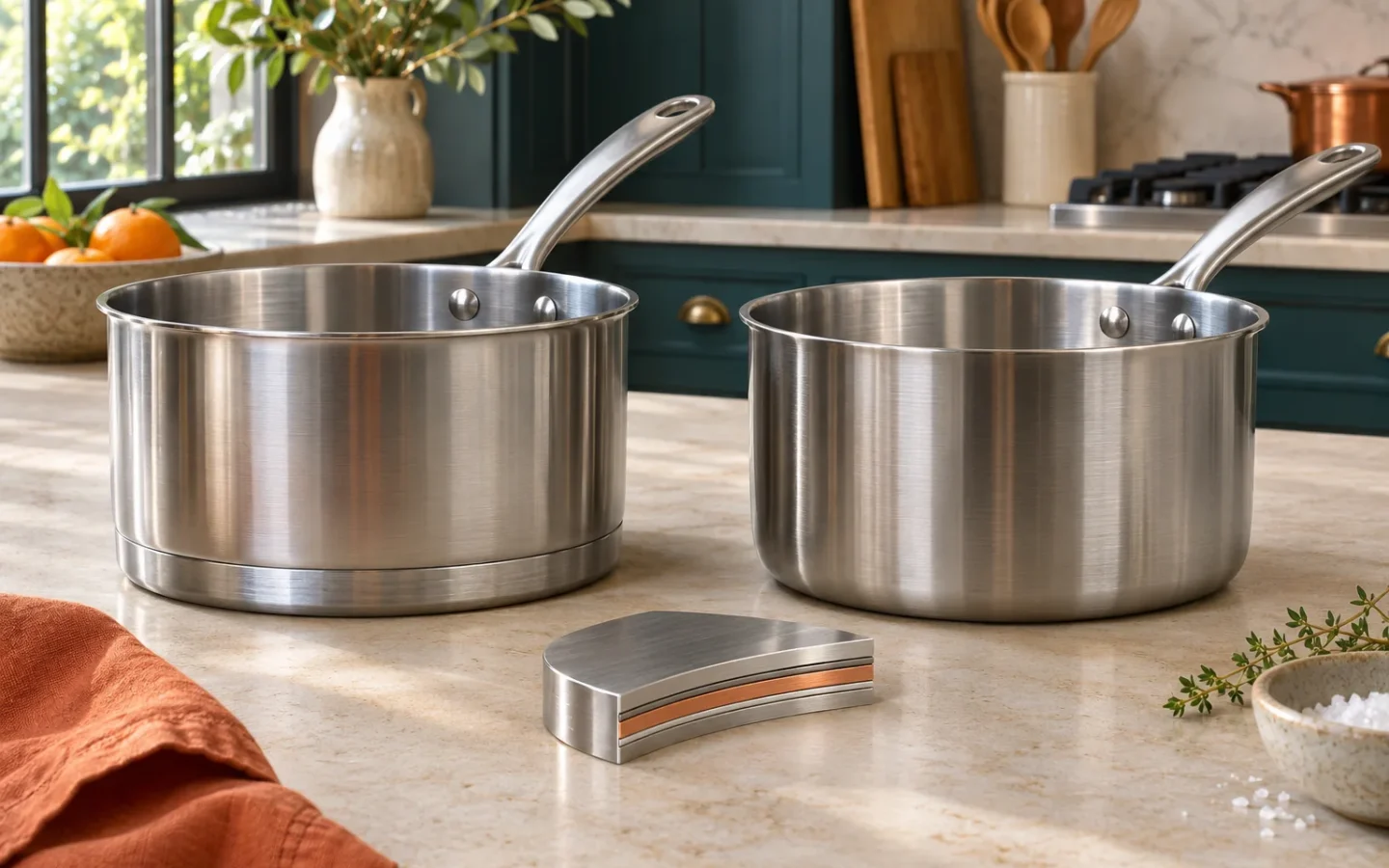
“Fully clad” is often presented as the finish line of stainless cookware, while a bonded disc is treated as a budget compromise. That hierarchy ignores where heat needs to travel. A thick disc under a stockpot can be the more rational construction; continuous cladding can earn its cost in a shallow sauté pan. The useful question is not which label sounds premium, but whether the conductive layer reaches the parts of the vessel doing real cooking.

Cuisinart Chef’s Classic 5.5-Quart Sauté Pan with Cover
Certain content that appears on this site comes from Amazon. This content is provided “as is” and is subject to change or removal at any time.
Why we picked it
- Encapsulated base demonstrates where a disc-bottom design works
- Wide floor suits searing before adding braising liquid
- Helper handle supports the pan when it is full
Reported drawbacks
- Sidewalls do not spread heat like a fully clad vessel
- Large footprint needs a burner that can cover its base
- Seven-pound assembly is bulky to wash and store
What the two constructions actually are
Fully clad cookware is made from a sheet with multiple bonded layers, commonly stainless steel around an aluminum core. That sheet is formed into the base and walls, so the conductive layer continues up the sides. In disc-bottom cookware, the vessel body is formed first and a separate conductive plate is bonded to the exterior base, often with a magnetic stainless cap.
Both designs solve stainless steel’s main thermal weakness. Stainless is durable and nonreactive, but it spreads heat poorly compared with aluminum or copper. The hidden conductive layer distributes energy beyond the footprint of a flame, coil, or induction field. Its thickness and coverage matter more than the number of layers in the marketing name.
A disc concentrates material where boiling happens
In a stockpot full of water, the base receives heat and convection circulates it through the liquid. The upper wall is surrounded by water on one side and air on the other; extending expensive aluminum to the rim adds little to boiling performance. A thick, broad disc can deliver excellent stability and evenness at lower cost.
The disc should reach close to the outer edge of the interior floor. A small plate leaves an unheated ring where the base curves into the wall. Starch or thick soup can stick there while the center remains controlled. Turn the pot over: the visible disc diameter is useful, but remember the conductive material may stop inside the decorative cap.
Clad walls matter when food touches them
A sauté pan uses its lower sidewall. Food is pushed up the wall during stirring, sauce reduces across a wide surface, and a shallow braise may sit above the base curve. Continuous cladding smooths the thermal transition from floor to wall. It can reduce the cool band that encourages sauce to thicken unevenly at the perimeter.
Clad walls also respond to heat arriving from around a gas burner. That is not permission to let flames wrap the pan, but it helps distribute unavoidable edge heating. In an oven, where energy reaches every surface, the entire shell participates more directly. A fully clad roasting or sauté vessel makes more sense than a fully clad tall pasta pot.
Thickness beats layer count
Three-ply, five-ply, and seven-ply do not describe performance by themselves. Manufacturers can divide a similar total thickness into more layers or add thin alloys for bonding and induction compatibility. A substantial three-layer body may spread heat better than a thin five-layer one. Without total thickness and core composition, ply count is incomplete information.
More conductive metal generally improves evenness but increases weight and slows response. That can be welcome for searing, where temperature stability matters. It can be frustrating for a small saucepan used for custard, where you want the pan to react when the burner is lowered. “More metal” is not a universal upgrade.
The edge reveals construction quality
Inspect the rim of clad cookware. An exposed aluminum core can gradually pit in a dishwasher, particularly with aggressive detergent. A sealed rim encloses that layer, although the quality of the seal still matters. On disc cookware, inspect the perimeter of the base for gaps, sharp steps, or a plate that appears off-center.
A visible seam around a disc is normal. Separation is not. If the edge lifts, traps water, or clicks when pressed, stop using the vessel; a partially detached plate will not heat predictably. Dark residue along an intact seam is commonly grease and can be cleaned with a soft brush.
Induction compatibility needs two checks
A magnetic outer layer makes either construction detectable by induction. Test the entire base with a magnet, not the wall or an embossed medallion. Strong attraction is a useful screen, but it does not reveal how evenly the conductive core spreads the concentrated energy from the induction coil.
Disc bases often contain a thick aluminum core and a magnetic cap, a combination well suited to induction. Fully clad pans may use a thinner magnetic exterior to manage weight. Neither category wins automatically. Base flatness, magnetic coverage, and core thickness decide the result.
Weight changes how the cookware behaves
A heavy disc lowers the center of gravity in a tall pot and helps it sit securely on a grate. The same disc can make a small saucepan feel base-heavy when pouring. Fully clad construction distributes mass up the wall, which can improve balance in a skillet but makes a large stockpot unnecessarily tiring to wash.
- For boiling water: prioritize a broad, flat disc, secure handles, and manageable loaded weight.
- For sauces: prioritize responsive material, a clean interior corner, and comfortable pouring balance.
- For searing and pan sauces: prioritize even floor coverage and conductive material through the lower wall.
- For oven braises: prioritize continuous heating, lid fit, handle safety, and total weight.
How to compare two pans without laboratory equipment
Start with dimensions and mass. Compare base diameter, interior floor diameter, wall thickness at the rim, and total weight. A dramatically lighter vessel claiming more layers is probably using thinner layers. Check the warranty for separation and warping, because those terms reveal which failures the maker expects to stand behind.
At home, heat a shallow, even layer of water over moderate power and watch where bubbles first form. This is a qualitative comparison, not a precision test: surface scratches and dissolved gas influence nucleation. It can still reveal a severe hot ring or cold edge. Do not perform flour-scorching tests; they create smoke and tell you less than cooking actual food.
Cook a task that exposes the construction
For a skillet or sauté pan, brown a single layer of evenly cut mushrooms over moderate heat. Note whether the outer pieces remain pale while the center races ahead, and whether rotating the pan corrects the pattern. For a saucepan, make a milk-based sauce and sweep a silicone spatula through the corner; persistent catching at one ring can reveal weak coverage or a burner mismatch.
Repeat only after learning the burner setting. One uneven result can come from a pan that was not centered, ingredients with different moisture, or a cooking zone smaller than the base. Construction should be judged as part of the pan-and-burner pair, not as an isolated laboratory sample.
Failure patterns are different
A bonded disc can separate at its edge after impact, severe overheating, or manufacturing failure. Fully clad cookware has no separate bottom plate, but its body can still warp, and exposed core material at the rim can pit. Neither design is immune to thermal shock from plunging a hot pan into cold water.
Before each high-heat use, set the clean pan on a flat surface and press opposite edges. Rocking suggests distortion. Look along a disc seam for lifting and along a clad rim for deep corrosion. A cosmetic scratch is normal; a moving base, sharp delamination, or crack near the handle changes safety and deserves manufacturer review.
Choose construction vessel by vessel
A coherent cookware collection does not need one construction throughout. A disc-bottom stockpot, responsive clad saucepan, and sturdy fully clad skillet can each be the right tool. Matching logos are less valuable than matching the heat path to the task. The same logic works when you plan a starter set one vessel at a time.
Pay for conductive metal where food will use it. In tall vessels full of liquid, that is mainly the base. In shallow vessels where ingredients and sauces work across the lower walls, cladding earns more of its price. That distinction is more useful than any number printed before the word “ply.”