As an Amazon Associate I earn from qualifying purchases. Cookware Compass is reader-supported: if you buy through a link on this page we may earn a commission, at no extra cost to you. Read our disclosure.
Induction cooktops are fast, precise, and easy to clean, but they don’t work with every pan. If you have just switched to induction, or are thinking about it, here is how to tell which cookware will work and what to look for when buying.
How induction works
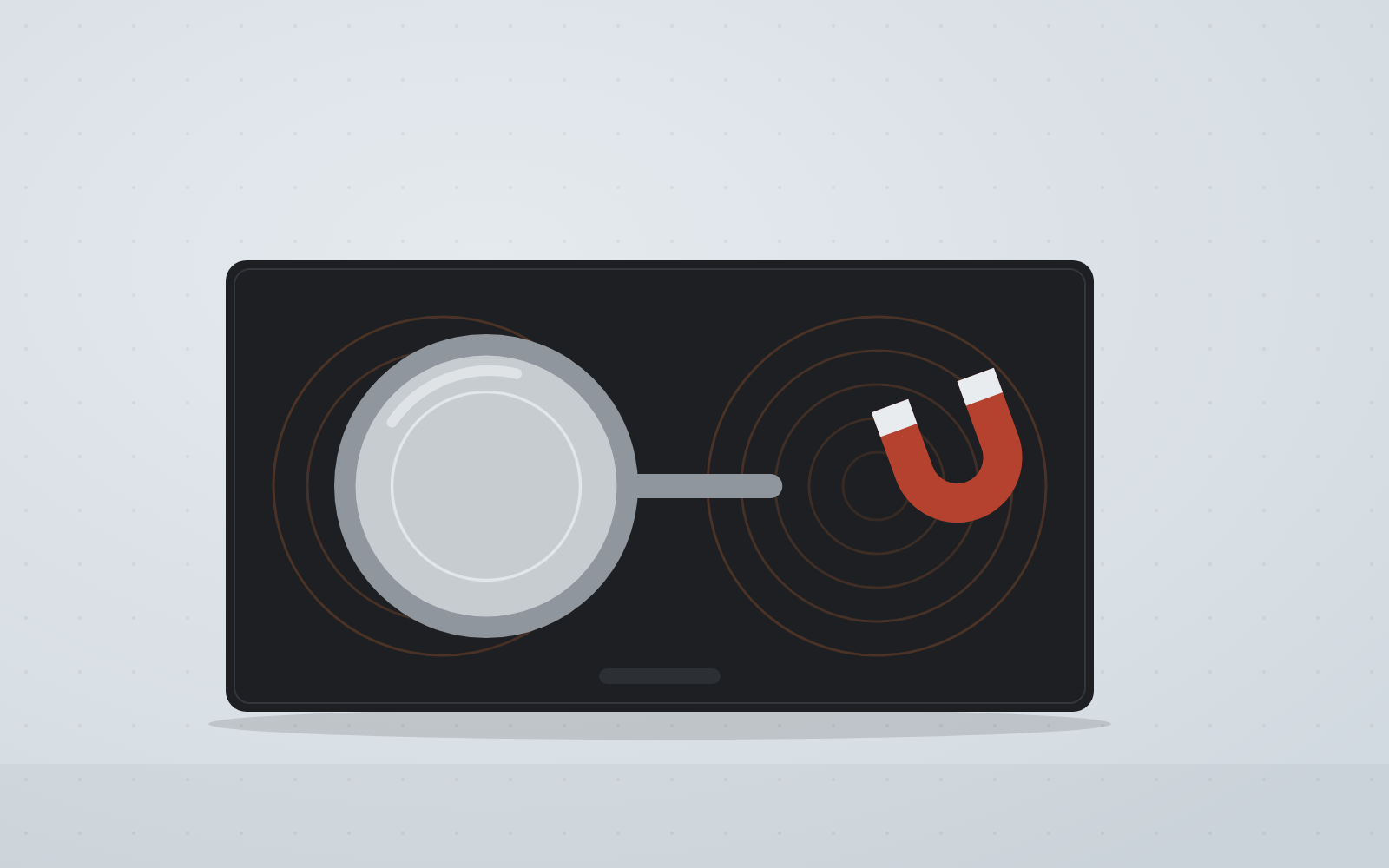
An induction cooktop uses a magnetic field to generate heat directly in the base of the pan, rather than heating a burner that then heats the pan. That only happens if the pan’s base contains a magnetic (ferromagnetic) metal, such as iron or certain types of stainless steel. If the pan isn’t magnetic, the cooktop simply won’t heat it.
Because the pan itself becomes the heat source, induction responds almost instantly when you change the setting, and the glass around the pan stays cooler than on a radiant electric cooktop.
The magnet test
The easiest check: hold a fridge magnet against the bottom of the pan.
- The magnet sticks firmly: the pan will work on induction.
- The magnet sticks weakly: it may work, but may heat slowly or unevenly.
- The magnet doesn’t stick: the pan won’t work on induction.
Many manufacturers also print an induction symbol, often a coil of wire, on the base or the packaging.
Material by material
| Material | Works on induction? |
|---|---|
| Cast iron (bare or enameled) | Yes |
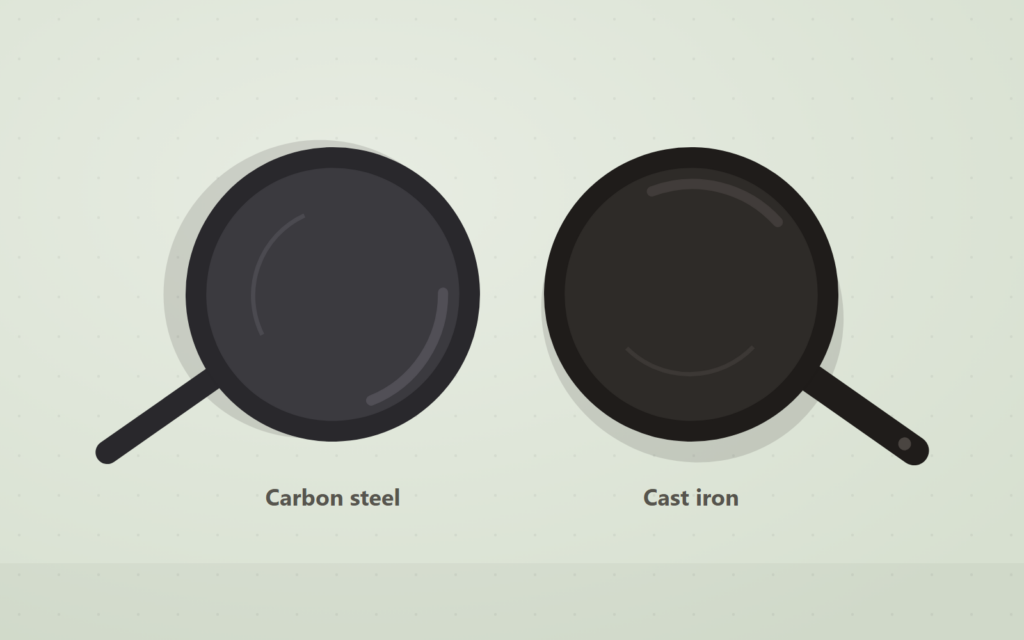
| Carbon steel | Yes |
| Stainless steel | Usually, but it depends on the steel on the outside of the base |
| Aluminum | Only with a magnetic steel plate bonded to the base |
| Copper | Only with a magnetic steel plate or layer |
| Nonstick | Only if the pan body or base is magnetic. Many are aluminum with a steel base plate, and some aren’t induction-compatible at all. |
| Glass and ceramic | No |
With stainless steel, the outer layer matters. Many clad pans use a magnetic stainless steel on the outside for exactly this reason. See tri-ply vs fully clad stainless steel for how these pans are built.
What else to check
- A flat base. Induction works best when the pan sits flat on the glass. A warped or strongly curved base heats unevenly.
- Base diameter. Each cooking zone needs a minimum pan size to detect the pan. Very small pans may not register. Check your cooktop manual.
- Size of the magnetic area. On pans with a bonded steel disc, the disc may be smaller than the base, so the outer edge heats less.
Normal induction quirks
A light buzzing or humming at high power is common, especially with multi-layer pans. It is usually harmless and often fades at lower settings. Heavier pans with a thick base tend to be quieter.
What about adapter discs?
An induction adapter is a magnetic plate that sits on the cooktop and heats up, letting you use non-magnetic pans. It works in a pinch, but it gives up much of induction’s speed and responsiveness, since you are back to heating a plate that heats the pan.
An induction-ready stainless example
If you want one versatile pan for an induction cooktop, a fully clad stainless steel skillet is a safe bet. The Tramontina Signature 12-inch fry pan is one example: the manufacturer lists it as induction-ready, with tri-ply construction around an aluminum core.
Induction-ready stainless
Tramontina Signature Tri-Ply Clad Stainless Steel 12-Inch Frying Pan
A good everyday skillet if you have, or plan to buy, an induction cooktop.
- Listed as compatible with all cooktops, including induction
- Tri-ply clad with an aluminum core
- Oven-safe up to 500°F
- Dishwasher-safe
- Stainless needs proper preheating to keep food from sticking
- Not a nonstick pan, so eggs need more fat and technique
Want to keep food from sticking in stainless? Preheat the empty pan, then add oil. Our guide on cleaning stainless steel pans explains the water-drop test.
Quick answers
Will induction scratch my pans? No more than any glass cooktop. Lift pans instead of sliding them to protect both the pan and the glass.
Does cast iron work on induction? Yes, very well. Lift it rather than dragging it, since rough bases can scratch the glass.
Is induction cookware more expensive? Not necessarily. Many affordable cast iron and stainless pans are already induction-compatible.
Bottom line
If a magnet sticks firmly to the base, the pan will work on induction. Cast iron and carbon steel always do, most good stainless steel does, and aluminum or copper only do if they have a magnetic base.