As an Amazon Associate I earn from qualifying purchases. Cookware Compass is reader-supported: if you buy through a link on this page we may earn a commission, at no extra cost to you. Read our disclosure.
A 10-piece cookware set looks like great value, especially when it costs about the same as two or three individual pans. But many people later find that half the set lives in a cupboard while they reach for the same two pans every day. Here is how to tell whether a set makes sense for you, and what to buy instead if it does not.
How piece counts work
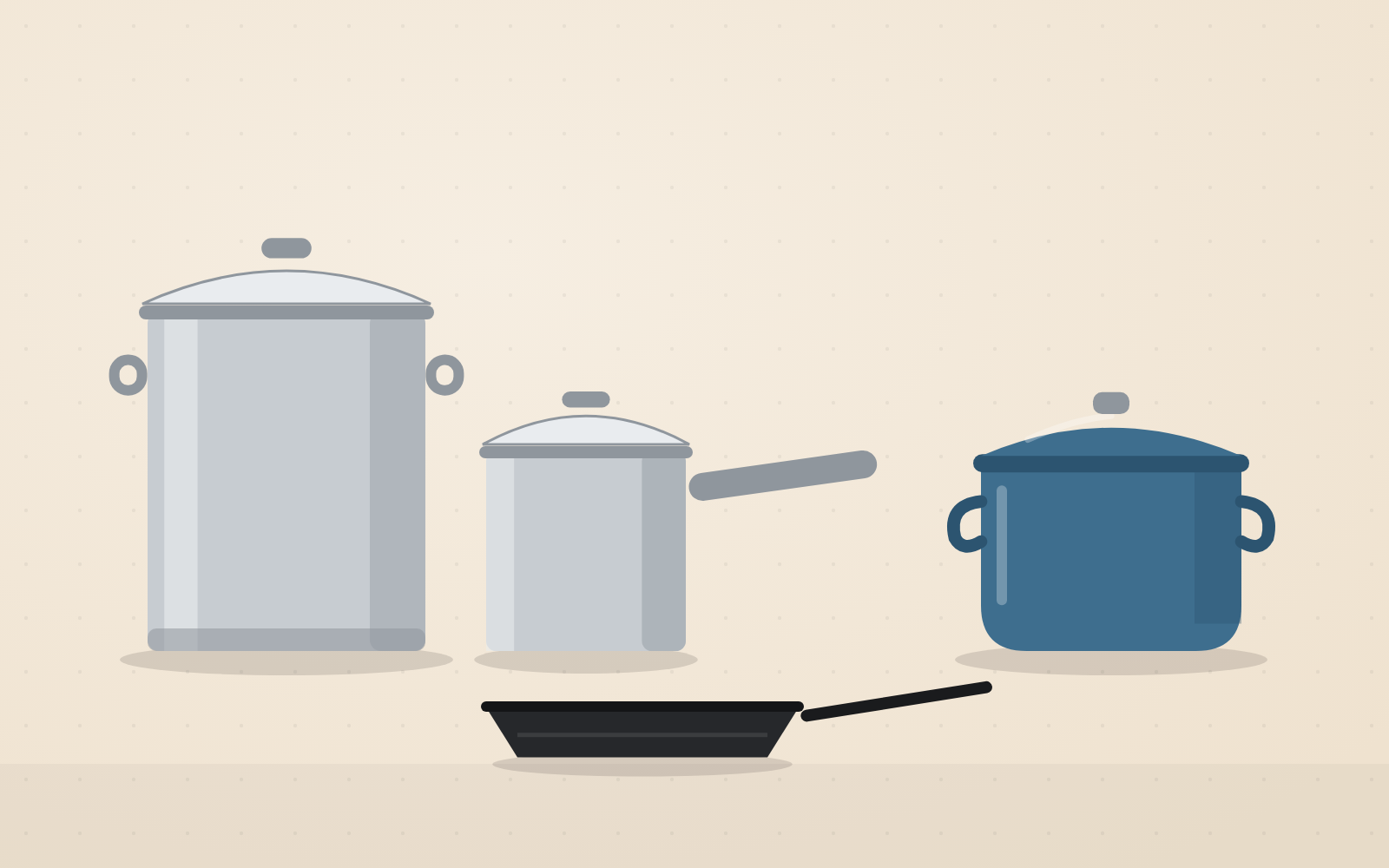
Manufacturers count every lid as a piece. A “10-piece set” is often six pots and pans plus four lids. Some sets also count utensils or steamer inserts. Before comparing sets, count the actual cooking vessels and check their sizes.
When a set is a good idea
- You are setting up a kitchen from scratch and need everything at once.
- You want matching cookware with consistent quality and handles.
- The set’s sizes match what you actually cook. Look for a 10- or 12-inch skillet, a 3-quart saucepan, and a large stockpot.
- It is a fully clad stainless or well-reviewed set where every piece is useful.
When to buy piece by piece
- You already own some pans and only need to fill gaps.
- You want different materials for different jobs, such as cast iron for searing and nonstick for eggs.
- The set includes small, rarely used pieces, like a 1-quart saucepan or an 8-inch skillet, while missing the sizes you need most.
- Kitchen storage is limited.
The core pieces most kitchens need
| Piece | Suggested size | Used for |
|---|---|---|
| Skillet | 10 to 12 inches | Searing, sautéing, pan sauces |
| Nonstick skillet | 8 to 10 inches | Eggs, pancakes, delicate fish |
| Saucepan with lid | 2 to 3 quarts | Rice, grains, sauces, reheating |
| Stockpot with lid | 6 to 8 quarts | Pasta, stock, soup |
| Dutch oven | 5.5 to 6 quarts | Braises, stews, bread |
Optional additions include a sauté pan with straight sides for shallow frying and one-pan dinners, a cast iron skillet for searing, and a small saucepan for melting butter or warming milk.
Mixing materials is normal
Many experienced home cooks use a mix: stainless steel for the skillet and pots, a cast iron skillet or Dutch oven, and one nonstick pan for eggs. Each material handles different tasks best. Our material comparison guide explains which jobs each one is best at.
Checklist before buying any set
- Count the real pots and pans, not the lids.
- Check the diameter of the skillets and the capacity of the pots.
- Confirm the construction. For stainless sets, look for fully clad pieces, explained in our guide to tri-ply vs fully clad stainless steel.
- Check induction compatibility and oven-safe temperature.
- Make sure you have space to store everything.
Bottom line
A set is worth it if you are starting from zero and the sizes match how you cook. Otherwise, buying a few well-chosen individual pieces usually gives you better pans for the same money.